¶ Tripods and Tripod Heads: Wood, Carbon and Aluminium Compared
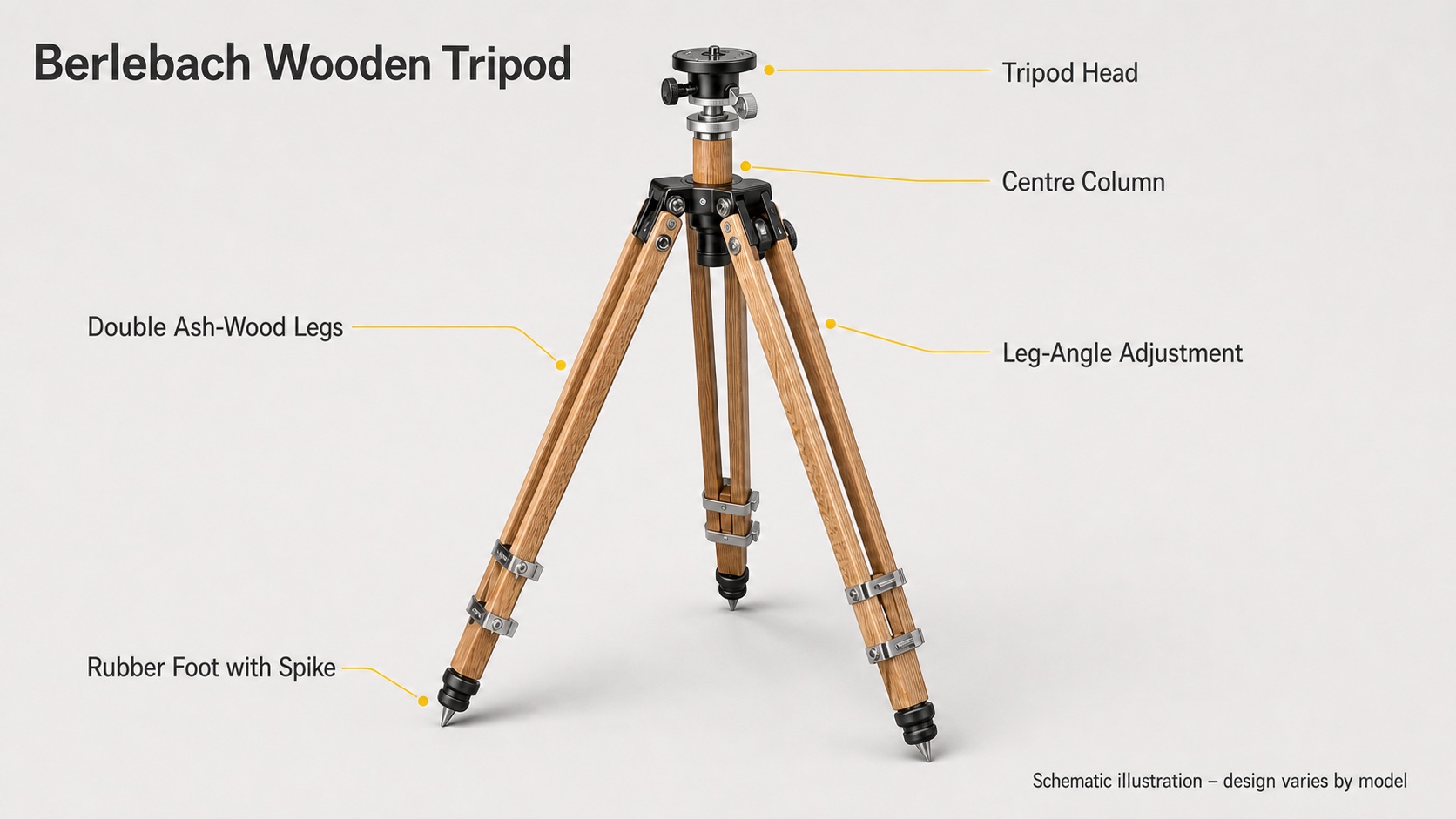
Open the title illustration at full size – the labelled diagram explains the principal components of a wooden photographic tripod.
Image note: This AI-assisted educational illustration is schematic. Construction, fittings and leg geometry differ between models; it will be replaced by an original photograph or an independently produced technical image when available.
¶ Document information
| Document information | Definition |
|---|---|
| Document ID | FW-ZUB-01-02 |
| Title | Tripods: Berlebach wood vs NOVOFLEX carbon and aluminium |
| Area | Equipment – accessories – tripods and tripod heads |
| Document type | Comparison and selection guide |
| Responsible | Wiki owner |
| Version | 1.1 EN |
| Translation basis | German version 1.3 |
| Last reviewed | 4 August 2026 |
| Document status | Editorially and technically reviewed |
| Classification | Public |
| Technical data status | Official Berlebach and NOVOFLEX product pages, reviewed on 4 August 2026 |
| Wiki.js path | /Fotografen-Wiki/Ausruestung/Zubehoer/FW-ZUB-01-02_Stative_und_Stativkoepfe |
¶ Freshness status
Reviewed: 4 August 2026 · Next review: 1 November 2026 or after a model, price or availability change
Source basis: official Berlebach and NOVOFLEX product pages
Variable information: prices, availability, package contents and configuration options
Important: A manufacturer's “30 kg load capacity” is not a cross-brand measure of stability or image sharpness unless all products are tested under the same standard. The complete setup, settling time, focal length, wind and ground matter more.
Language note: This English page follows the reviewed German version 1.3. Open the German page.
¶ SEO data
| SEO field | Content |
|---|---|
| SEO title | Tripods and Tripod Heads: Wood, Carbon or Aluminium? |
| Meta description | Berlebach wooden tripods and NOVOFLEX carbon and aluminium tripods compared by weight, packed size, stability, head type and photographic use. |
| Primary keyword | tripod and tripod head comparison |
| Secondary keywords | Berlebach wooden tripod, NOVOFLEX carbon tripod, aluminium tripod, ball head, geared head, gimbal, tripod buying guide |
| Search intent | Select the appropriate tripod material and head for a specific photographic task |
| Recommended URL slug | tripods-tripod-heads-wood-carbon-aluminium-comparison |
¶ 1. Short answer
A Berlebach wooden tripod is particularly attractive when vibration damping, a stable platform, long exposures and pleasant handling in cold conditions are more important than low weight and a small packed size. A NOVOFLEX carbon tripod is especially suitable for hiking, travel and frequent changes of position because it can be considerably lighter and more compact at a comparable working height. The NOVOFLEX aluminium version offers the same modular system and working heights, but is slightly heavier and generally less expensive than the equivalent carbon version.
The material alone does not determine image sharpness. Construction, leg sections, extension height, centre column, tripod head, ground, wind, camera operation and focal length are at least as important.
¶ Decision in one sentence
| Priority | Appropriate direction |
|---|---|
| Maximum stability and vibration damping near a vehicle or at a fixed location | Berlebach wood |
| Low weight and small packed size for tours | NOVOFLEX carbon |
| Modularity at a lower price than carbon | NOVOFLEX aluminium |
| Heavy telephoto, large-format or astrophotography equipment | Compare a specific Berlebach UNI or NOVOFLEX PRO75 system separately |
¶ 2. The fundamental material difference
| Criterion | Berlebach ash wood | NOVOFLEX carbon | NOVOFLEX aluminium |
|---|---|---|---|
| Vibration behaviour | Wood has high inherent damping; Berlebach rates the damping of many REPORT models as “very good” | Stiff and light; the overall result depends greatly on tube diameter, number of sections, locks and extension | Robust and stiff, but heavier than carbon with similar geometry; vibration behaviour depends on construction |
| Weight | Generally higher | Lightest in the NOVOFLEX sets compared | Heavier than carbon with identical NOVOFLEX geometry |
| Packed size | Single-extension REPORT models are comparatively long | Multi-section telescopic legs make the system considerably more compact | Similar compactness to carbon with the same number of sections |
| Behaviour in cold conditions | Wood feels less cold and conducts heat less readily than metal | More pleasant than bare metal, although locks and metal components still become cold | Conducts heat well and feels cold more quickly in frost |
| Wind | Greater weight may stabilise the setup | Light and easy to carry; secure it safely on location if necessary without creating pendulum movement | Slightly greater weight than carbon may be helpful |
| Impact and damage | Dents and surface damage are often visible; inspect clamps and wood regularly | Inspect for cracks, delamination or soft areas after a hard impact; concealed damage is possible | May dent or deform; damage is often visible |
| Moisture and dirt | Clean after exposure to water and allow to dry completely; inspect wood and fittings | Keep telescopic sections and locks clean; clean after sand, salt and mud | Also clean locks and sections; inspect for corrosion and deformation |
| System concept | REPORT platform with interchangeable module inserts and different leg lengths | Interchangeable legs, mini legs, monopod adapter and extensions | Same NOVOFLEX platform as carbon |
| Typical strength | Stationary landscape, architecture, macro, long focal lengths and long exposures | Travel, mountain tours, photowalks, low-level work and frequent changes of location | Versatile entry into the modular system |
The table describes typical material and construction differences. A heavy carbon tripod may be more stable than a lightweight wooden tripod, and a well-designed aluminium tripod may outperform a weak carbon model. The next section therefore compares specific products.
¶ 3. Comparison without a conventional centre column
The Berlebach REPORT 332 with its integrated levelling ball and the two NOVOFLEX TrioPod 2840 versions with identical leg dimensions in carbon and aluminium serve as practical reference models.
| Feature | Berlebach REPORT 332 | NOVOFLEX TrioPod Carbon TRIOC2840 | NOVOFLEX TrioPod Aluminium TRIOA2840 |
|---|---|---|---|
| Leg material | Ash wood | 8-layer carbon | Aluminium |
| Leg sections | Single extension | 4 | 4 |
| Weight | 3.20 kg | 1.45 kg | 1.75 kg |
| Packed length | 89 cm | 54 cm | 54 cm |
| Minimum height | 8 cm | 6.5 cm with mini legs | 6.5 cm with mini legs |
| Maximum height | 143 cm | 148 cm | 148 cm |
| Manufacturer load rating | 12 kg | 25 kg | 25 kg |
| Leg angles | Approx. 20°, 40°, 60°, 80°, 100° | 20°, 40°, 60°, 87° | 20°, 40°, 60°, 87° |
| Levelling | Integrated 55 mm levelling ball, ±30° | No integrated levelling ball in this platform | No integrated levelling ball in this platform |
| Upper connection | Spring-mounted attachment screw | 3/8″ | 3/8″ |
| Manufacturer's stated package contents | Tripod with module insert 3 | Mini legs, monopod adapter and bag | Mini legs, monopod adapter and bag |
| Manufacturer price at review* | €363.00 | €548.99 | €389.00 |
* Prices shown on the manufacturers' websites on 4 August 2026, including German VAT and excluding delivery; promotions, configurations and availability may differ.
¶ Weight and packed-size advantage
In this configuration, the TrioPod Carbon is approximately 1.75 kg lighter and about 35 cm shorter when packed than the REPORT 332. The TrioPod Aluminium is approximately 1.45 kg lighter than the wooden tripod, but 300 g heavier than the geometrically comparable carbon version.
The comparison is not fully functionally equivalent: the REPORT 332 already includes a levelling ball. A levelling base or suitable tripod head would have to be considered additionally for the TrioPod. The weight and price of the complete setup must therefore include the head, clamp and camera plate.
¶ 4. Comparison with a centre column
For photographers who require greater working height and rapid height adjustment, the Berlebach REPORT 342 can be compared with the NOVOFLEX TrioPod-M 2840.
| Feature | Berlebach REPORT 342 | NOVOFLEX TrioPod-M Carbon TRIOMC2840 | NOVOFLEX TrioPod-M Aluminium TRIOMA2840 |
|---|---|---|---|
| Leg material | Ash wood | Carbon | Aluminium |
| Weight | 3.40 kg | 1.745 kg | 2.060 kg |
| Packed length | 92 cm | 56 cm | 56 cm |
| Minimum height | 53 cm with conventional centre column; short column optional | 6.5 cm with mini legs and without centre column | 6.5 cm with mini legs and without centre column |
| Maximum height | 187 cm | 175 cm | 175 cm |
| Manufacturer load rating | 10 kg | 30 kg | 30 kg |
| Centre column | 50 cm, with levelling ball | Interchangeable, 1/4″ and 3/8″ connections | Interchangeable, 1/4″ and 3/8″ connections |
| Levelling | Centre column can be levelled by 30° in every direction | Depends on platform and additional head | Depends on platform and additional head |
| Manufacturer price at review* | €433.00 | €659.00 | €518.99 |
| Availability at review | In stock according to manufacturer | Available to order | Currently unavailable according to manufacturer |
A fully extended centre column is the weakest part of any of these systems. For maximum stability, extend the thickest leg sections first and keep the centre column as short as possible.
Use the centre column carefully: Establish the required height with the legs first, then extend only as much column as necessary. A high centre column increases leverage and can make vibration more visible.
¶ 5. Interpreting load capacity correctly
Manufacturer values of 10, 12, 25 or 30 kg must not be treated as directly comparable measures of stability or sharpness. The product pages used do not refer to a common test standard defining setup, leg angle, centre-column extension, safety factor and permitted movement identically.
In practice, the following are more important:
- focal length and the equipment's centre of gravity,
- torsional rigidity during panning and operation,
- settling time after touching the camera or releasing the shutter,
- stability of the smallest extended leg section,
- rigidity of the head, quick-release clamp and camera plate,
- wind area of the camera, lens hood and carrying strap,
- the ground and tripod feet.
A Leica M, Leica Q or Leica R 6.2 with a normal lens is far below all the stated load limits. For these cameras, the highest kilogram figure is less important than which complete setup settles most quickly at the actual focal length, in the prevailing wind and with the required exposure time.
Wind affects the entire system: Secure or remove the camera strap. Add ballast only low, safely and without allowing it to swing; a freely moving backpack can cause more blur than a lightweight tripod.
¶ 6. Practical use by subject
¶ Landscape and long exposures
Berlebach wood is a strong choice when the tripod does not have to be carried far and maximum stability is the priority. The greater weight can help in wind, and the levelling modules are practical for panoramas and landscape work. Carbon is appropriate when the location can be reached only on foot. A tripod that is actually carried is more valuable than a heavier one left in the car.
¶ Photowalk and travel
NOVOFLEX carbon provides the clearest advantage in packed size and weight. With the mini legs, the TrioPod system can be converted into a low-level tripod and, with an adapter, into a monopod. Aluminium remains a sensible alternative when the approximately 300 g additional weight over the compared carbon version is acceptable and the lower purchase price matters more.
¶ Caves and Project Franconia
The compact NOVOFLEX system is practical for longer walks, narrow passages and low camera positions. Mini legs reduce the required space. In easily accessible caves or at rock locations near the vehicle, the Berlebach may provide an advantage through its mass and damping.
Irrespective of material:
- position the tripod only on stable ground,
- keep escape routes and walking routes clear,
- do not touch speleothems, sediment or habitats,
- clean the locks after mud, sand or dripping water,
- dry and inspect the tripod completely after the tour.
Safety before the photograph: In caves, near drop-offs and on public paths, a tripod must not block an escape route or create a trip hazard. Never choose an unsafe position merely for the composition.
¶ Macro and low-level work
The REPORT 332 and TrioPod can reach very low positions without a conventional centre column. The TrioPod uses its supplied mini legs. The REPORT 342 requires a short centre column for low-level work. The actual camera height also increases with the tripod head and camera.
¶ Long focal lengths and wildlife photography
Wood offers advantages when the location is fixed and the equipment remains set up for a long time. Carbon is generally more realistic for long approaches. With telephoto lenses, balance the centre of gravity over a tripod collar. A suitable two-way head or gimbal may be more important than the leg material alone.
Heavy telephoto lenses: Support the lens at its tripod collar. Do not use the camera body as the only suspension point for a heavy telephoto system. Check the quick-release plate and safety stops before every outing.
¶ 7. Recommendations for the existing Leica cameras
| Camera and use | Recommendation |
|---|---|
| Leica M11 Monochrom while hiking | NOVOFLEX carbon: low carrying weight and small packed size |
| Leica M11 Monochrom for architecture, panoramas or long exposures near the vehicle | Berlebach REPORT with an appropriate levelling module |
| Leica R 6.2 with a 28–90 mm lens on a photowalk | Carbon; aluminium when price matters more than the final 300 g |
| Leica R 6.2 with a heavy telephoto or long exposure | Berlebach wood or a stiffer NOVOFLEX system after practical testing |
| Cave photography and confined spaces | NOVOFLEX with mini legs; Berlebach at an accessible location when damping is the priority |
¶ Personal short recommendation
- Only one tripod for tours and travel: NOVOFLEX carbon.
- Only one tripod for maximum stability and stationary work: Berlebach REPORT.
- Modular system with a lower entry price: NOVOFLEX aluminium.
- Unsure: set up the camera, heaviest lens and intended head at the dealer and check the settling time yourself.
¶ 8. Tripod head and connection
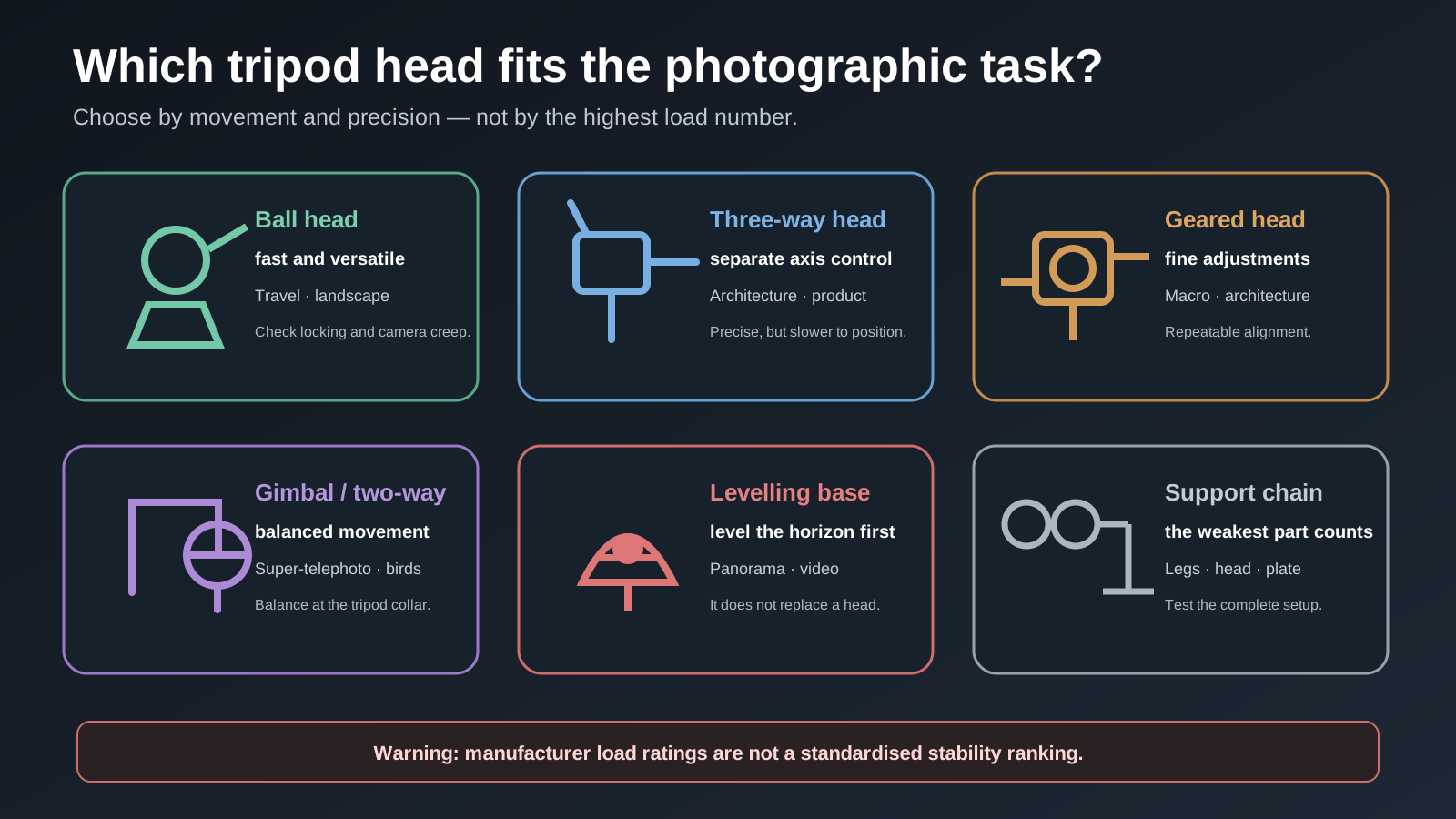
Open the tripod-head selection matrix at full size – AI-assisted, editorially reviewed teaching graphic for selecting by movement, precision and centre-of-gravity control; not a manufacturer drawing.
The legs are only one part of the system. Before buying, clarify:
- whether the tripod has a 1/4″ or 3/8″ upper connection,
- whether a levelling ball is already integrated,
- whether a ball head, three-way head, video head or gimbal is required,
- whether the quick-release system is Arca-compatible or manufacturer-specific,
- whether the camera plate fits the Leica baseplate or lens collar,
- whether the head is secured against accidental loosening,
- whether the centre of gravity remains within the tripod footprint.
On the REPORT 332, the integrated levelling ball may replace an additional levelling adapter in certain setups. It does not automatically replace every tripod head: free camera tilt, portrait orientation or precise independent axes may still require a suitable head.
Check the complete support chain: Legs, centre column, head, quick-release clamp and plate must work together. An undersized clamp or a twisting camera plate can negate the advantages of the most stable tripod.
¶ 9. Buying and practical test
- Total weight including head and plate determined
- Packed size checked against the actual backpack
- Working height sufficient without fully extending the centre column
- Lowest required camera height tested in practice
- Thick and thin leg sections checked separately for stiffness
- Settling time observed at the longest focal length used
- Operation tested while wearing gloves
- Stability tested on rock, forest floor and sloping ground
- Thread and quick-release clamp compatible
- Spare parts and service available
- Cleaning after sand, salt, mud and moisture possible
- Price of the complete system compared, not only the legs
¶ 10. Related wiki pages
| Subject | Link |
|---|---|
| Equipment overview | Open FW-AUS-01-01 – English |
| Leica M11 Monochrom | Open FW-KAM-LEI-M11M-01 – English |
| Leica R 6.2 | Open FW-KAM-LEI-R62-01 – German |
| Cave photography: Project Franconia | Open FW-GEN-01-06 – German |
| Long-exposure photography | Open FW-WIS-AT-01 – German |
| NOVOFLEX accessories | Open FW-ZUB-NOV-01 – German |
| German version of this page | Open FW-ZUB-01-02 – German |
¶ 11. Manufacturer sources and data status
¶ Berlebach
- Berlebach REPORT 332 – English product page
- Berlebach REPORT 342 – English product page
- Berlebach – information about wooden tripods and ash wood (PDF)
- Berlebach REPORT – product overview
¶ NOVOFLEX
- NOVOFLEX TrioPod Carbon TRIOC2840 – English product page
- NOVOFLEX TrioPod product overview, including aluminium TRIOA2840
- NOVOFLEX TrioPod-M Aluminium TRIOMA2840 – English product page
- NOVOFLEX TrioPod – English system overview
Technical data, prices, configurations and availability were checked against the manufacturers' websites on 4 August 2026. Prices and availability can change at short notice. Load ratings are manufacturer values, not measurements made under a cross-manufacturer standard.
Source status: Before a purchase, verify prices, package contents and technical details directly with the manufacturer. This page is a photographic selection guide, not a safety approval for operation at a maximum load.
¶ 12. Review Traffic Light
| Review area | Status | Result |
|---|---|---|
| Document information | 🟢 | Version 1.1 EN, translation basis and public classification stated |
| German reference version | 🟢 | Content aligned with German version 1.3 |
| Reference-model data | 🟢 | REPORT 332, REPORT 342 and selected TrioPod data checked against official product pages on 4 August 2026 |
| Prices and availability | 🟠 | Snapshot only; manufacturer prices and delivery status can change without notice |
| Load ratings | 🟠 | Manufacturer values retained, but not treated as a standardised cross-brand stability test |
| Safety guidance | 🟢 | Centre column, wind, caves, heavy telephoto systems and complete support chain covered |
| Images | 🟢 | Two local illustrations, meaningful alternative text and full-size links opening in a new tab |
| Internal links | 🟢 | Seven locale-specific or labelled German fallback targets checked against the Wiki.js export |
| External sources | 🟢 | Official Berlebach and NOVOFLEX pages used; external links open in a new tab |
| Overall status | 🟢 | Editorially and technically reviewed, with orange reservations for changing commercial data |
¶ 13. Change history
| Version | Date | Change |
|---|---|---|
| 1.1 EN | 4 August 2026 | Synchronised with German version 1.3; added freshness status, SEO data, vertical review traffic light, nine safety, image, language and source warnings, enlargable English tripod-head matrix, current official product links and validated language-aware internal links |
| 1.0 EN | 30 July 2026 | Complete English translation of German version 1.2; created and included a dedicated English-labelled tripod diagram, visually checked and optimised to less than 1 MB |
| 1.0 DE | 24 July 2026 | Created the comparison of Berlebach wooden tripods with NOVOFLEX carbon and aluminium, including material characteristics, reference models, weights, packed sizes, heights, prices, use recommendations and manufacturer sources |
| 1.1 DE | 24 July 2026 | Added a schematic educational graphic of a Berlebach-style wooden tripod with labelled components and prepared it as a Wiki.js image |
| 1.2 DE | 26 July 2026 | Linked the new FW-ZUB-NOV-01 system overview of NOVOFLEX tripods, ball heads, panorama and macro accessories |