¶ FW-ZUB-01-08 – Leica Visoflex 2: Electronic Viewfinder for M10 and M11
The Leica Visoflex 2 adds a sensor-based electronic live view to compatible Leica M cameras. It becomes especially useful when the optical rangefinder reaches practical limits with extreme wide angles, long focal lengths, shallow depth of field, close-up work or adapted lenses.
The attachable EVF does not replace the rangefinder. It provides a second way of working with complete frame coverage, exposure preview, focus magnification and—depending on camera and firmware—additional display aids. This page distinguishes confirmed Leica specifications from practical editorial guidance and model-dependent functions.
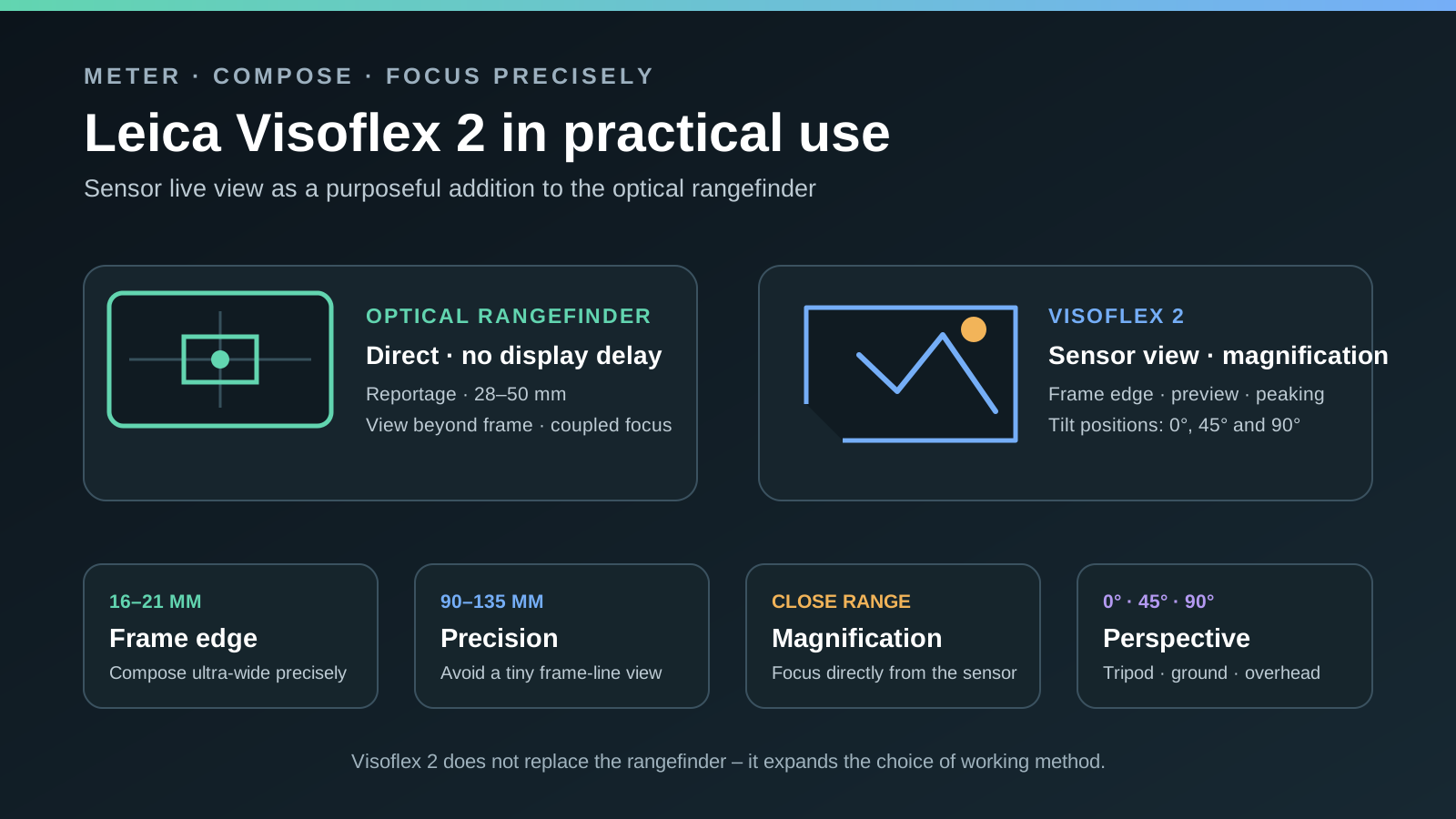
The optical rangefinder and Visoflex 2 are complementary tools. Open the graphic in a new tab for a larger view.
Image note: This is an original schematic SVG educational graphic, not a scale product rendering. Do not infer the shape or controls of the real Visoflex 2 from it.
Language note: This is the English version of the Visoflex 2 page. The corresponding German page is available at Leica Visoflex 2 – German.
¶ Document Information
| Field | Content |
|---|---|
| Document ID | FW-ZUB-01-08 |
| Title | Leica Visoflex 2 |
| Section | Equipment – Accessories – Electronic Viewfinders |
| Page type | Public product, operating and practical guide |
| Responsible | Wiki owner |
| Version | 2.1 EN |
| Translation basis | German version 2.1 dated 2 August 2026 |
| Last reviewed | 4 August 2026 |
| Document status | Editorially reviewed – functions depend on camera and firmware |
| Classification | Public |
| Source basis | Leica product page, Leica data sheet and Leica M11/M11-D instructions |
| Last source check | 4 August 2026 |
| Next review | 4 November 2026 or after a new camera or firmware release |
| Wiki.js path | /Fotografen-Wiki/Ausruestung/Zubehoer/FW-ZUB-01-08_Leica_Visoflex_2 |
¶ Review Traffic Light
| Review area | Status | Result |
|---|---|---|
| Core specifications | 🟢 Green | Checked against Leica's current product page and official data sheet |
| M11 family | 🟢 Green | Visoflex 2 is the intended external EVF; the manual for the exact model remains authoritative |
| M10 family | 🟠 Amber | Use only after installing the firmware specified by Leica |
| Older Visoflex Typ 020 on M11 | 🔴 Red | Do not attach it; Leica warns that irreparable damage can occur in the worst case |
| Model-dependent displays and menus | 🟠 Amber | Available functions vary by camera and firmware |
| Controlled long-term test | 🟠 Amber | Not claimed; practical statements are marked as editorial guidance |
| Internal Wiki links | 🟢 Green | Locale-specific targets checked against the page export on 4 August 2026 |
| Public source links | 🟢 Green | Official Leica targets checked on 4 August 2026 |
| Graphics and alternative text | 🟢 Green | Two local, enlargeable English SVG educational graphics checked |
Overall status: Amber. Construction and core specifications are confirmed by Leica. M10 compatibility requires the appropriate firmware, and display functions vary by camera and firmware. Check the exact product name, camera model and current Leica instructions before attaching the viewfinder.
¶ Leica Visoflex 2 Technical Specifications
| Feature | Leica Visoflex 2 |
|---|---|
| Viewfinder type | Attachable electronic OLED viewfinder |
| Display | 0.5 inch, 4:3 aspect ratio |
| Resolution | 3.68 million dots; rounded by Leica to 3.7 MP |
| Housing | Black anodised aluminium |
| Eye sensor | Automatic switching between monitor and viewfinder, depending on camera and settings |
| Dioptre adjustment | −4 to +3 dpt |
| Tilt positions | Detents at 0°, 45° and 90° |
| Lock | Magnetic lock in the 0° position |
| Brightness | Adjustable through the camera menu |
| Power supply | Supplied by the camera through the accessory shoe |
| Dimensions | Approximately 41 × 34.5 × 43.3 mm |
| Weight | Approximately 93 g |
| Leica order number | 24 028 |
| Supplied accessories | Visoflex 2, contact-foot cover and nylon pouch |
| GPS | Not integrated into the Visoflex 2 |
The specifications are based on Leica's published product information. Firmware, menu terminology and individual functions may change with updates.
¶ Which Leica Cameras Are Compatible with the Visoflex 2?
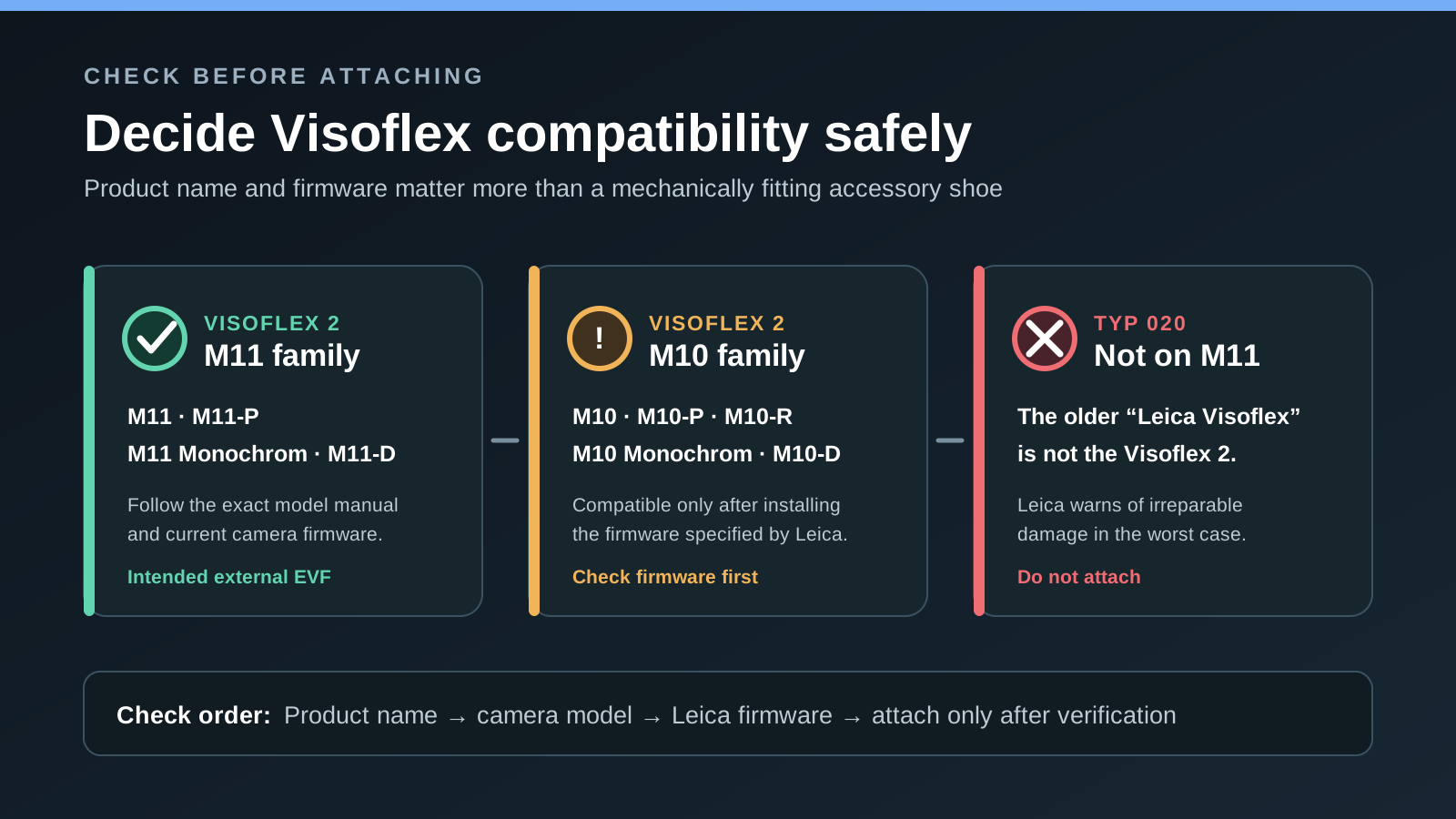
Check the product designation, camera model and firmware before attaching the EVF. Open the graphic in a new tab for a larger view.
¶ Leica M11 Family
The Visoflex 2 is designed for the digital models of the M11 family:
- Leica M11,
- Leica M11-P,
- Leica M11 Monochrom,
- Leica M11-D.
The camera should always be operated with current firmware. For future model variants, Leica's current compatibility information should also be checked.
¶ Leica M10 Family
After installation of the appropriate firmware update, Leica lists the Visoflex 2 as backward compatible with:
- Leica M10,
- Leica M10-P,
- Leica M10-R,
- Leica M10 Monochrom,
- Leica M10-D,
- Leica M10-P “ASC 100 Edition”.
Before attaching the viewfinder for the first time, install the latest firmware available for the specific camera model from Leica's official product page. With older firmware, the viewfinder may not work or may offer only limited functionality.
Do not assume general compatibility: A mechanically similar accessory shoe does not mean that the Visoflex 2 is electrically compatible with the camera. Earlier M models, the Leica CL, Leica TL/TL2, Leica Q and Leica SL use different viewfinder solutions or already have an integrated viewfinder.
¶ Essential Safety Warning for the Leica M11
In the operating instructions for the M11 family, Leica explicitly warns against using an older Visoflex model on an M11. In the worst case, the camera and/or the viewfinder may be irreparably damaged.
Only the expressly approved Leica Visoflex 2 should therefore be used with an M11, M11-P, M11 Monochrom or M11-D. The older Visoflex (Typ 020) is not a suitable alternative.
Safety warning: On the M11, M11-P, M11 Monochrom and M11-D, use only the expressly intended Visoflex 2. If the product designation is unclear, do not attach it; check Leica material number 24 028 and the current camera manual first.
¶ What Does the Electronic Viewfinder Display?
The Visoflex 2 displays a live image directly from the camera sensor. It therefore shows what will actually be captured. Depending on the camera and its configuration, the following information and tools may also be displayed:
- shutter speed, ISO and exposure compensation,
- exposure scale,
- focus peaking,
- focus magnification or digital zoom,
- histogram,
- clipping or overexposure warning,
- level gauge,
- image field and aspect ratio,
- shooting information and remaining capacity.
On the M11, the information displayed in the Visoflex generally corresponds to the displays available on the rear monitor. The exact display profiles and aids depend on the camera model and installed firmware.
¶ When Is the Visoflex 2 Particularly Useful?
¶ Very Wide-Angle Lenses
With focal lengths outside the available rangefinder frame lines, the EVF makes accurate composition easier. Lines near the image boundary, partially cropped subjects and the effect of perspective can be assessed directly. This is particularly useful at focal lengths such as 16, 18 or 21 mm.
¶ Long Focal Lengths
At 90 or 135 mm, the corresponding frame in the optical rangefinder is relatively small. The Visoflex 2 displays the subject at a more useful size and therefore makes both composition and precise focusing easier.
¶ Fast Lenses and Shallow Depth of Field
At a wide aperture, even a small focusing error can become visible. Focus magnification is particularly helpful when:
- the subject's eye must be critically sharp,
- a 50 mm or 75 mm lens is used at a wide aperture,
- the rangefinder or lens may not be perfectly calibrated,
- the point of focus does not lie on a high-contrast vertical edge.
Focus peaking provides quick guidance. For final assessment at very shallow depth of field, the magnified view is usually more reliable. Depending on the contrast, peaking can highlight areas that are not exactly within the plane of focus.
¶ Close Range and Lenses with an Extended Minimum Focusing Distance
Some recent M lenses focus closer than the coupled rangefinder can fully support. At close distances, the Visoflex 2 allows focusing directly from the sensor image. This is also a significant advantage when using macro accessories or adapted lenses.
¶ Adapted Leica R Lenses
Adapted lenses usually have no rangefinder coupling. The Visoflex 2 then turns the M camera into a live-view camera with manual focusing. Focus magnification and peaking make this considerably easier.
¶ Tripod, Architecture, Landscape and Cave Photography
The 45- and 90-degree tilt positions are practical when the camera:
- is placed very close to the ground,
- is used above normal eye level,
- must be aligned precisely on a tripod,
- is positioned close to a rock face or within a confined cave.
At 90 degrees, the photographer can look down into the viewfinder. This resembles working with a waist-level finder and can support quieter, less conspicuous composition.
¶ Interactive Use-Case Finder
Use the filters to identify combinations of camera, lens and task for which the Visoflex 2 can be particularly useful. These ratings are editorial practical guidance, not a Leica compatibility list.
12 of 12 applications
| Application | Camera | Lens | Benefit | Important limit |
|---|---|---|---|---|
| Ultra-wide angle | M11 / M10* | 16–21 mm | Inspect the complete frame edge | Lens perspective remains unchanged |
| Long M focal length | M11 / M10* | 90–135 mm | Larger subject view and more precise focus | Moving subjects remain challenging |
| Wide-aperture work | M11 / M10* | Fast 35–75 mm | Magnify an eye or critical detail | Do not overestimate peaking |
| Extended close range | M11 / M10* | Recent M lenses | Focus below the rangefinder limit | Check camera and lens function |
| Leica R adapter | M11 / M10* | Adapted R lenses | Magnification instead of rangefinder coupling | Manual focus only |
| Macro accessories | M11 / M10* | Uncoupled | Inspect frame and focus at sensor level | A tripod is often advisable |
| Low camera position | M11 / M10* | All | Look down into the 90° EVF | Protect the shoe from side loads |
| Tripod architecture | M11 / M10* | Wide angle | Inspect frame edge and alignment | Level display is model-dependent |
| Caves and low light | M11 / M10* | Wide angle | Bright live view and precise focus | Watch battery use and exposure data |
| Screenless M11-D | M11-D | All | Live view, zoom and exposure preview | Not a complete rear-screen replacement |
| M11 Monochrom | M11 Monochrom | Standard / tele | Inspect focus and critical highlights | EVF preview is not the DNG file |
| Street and reportage | M11 / M10* | 28–50 mm | Tilted, discreet working position | The optical finder is often more direct |
| No matching application found. Change or reset the filters. | ||||
Technical note: If the filters do not respond in Wiki.js, all rows remain visible. The central filter-table script and its Theme CSS must be loaded for interactive filtering.
* M10 family only with the firmware specified by Leica for the exact model.
¶ Practical Use with Selected Leica M Cameras
¶ Leica M10-R
On the Leica M10-R, the Visoflex 2 is particularly useful after installation of the required firmware update. The high-resolution sensor makes small focusing errors readily visible. Suitable applications include landscape, architecture, reproduction work and fast M lenses used wide open.
The Visoflex 2 does not contain an integrated GPS receiver. Photographers who previously used the older Visoflex (Typ 020) for its GPS function should take this difference into account.
¶ Leica M11 and M11-P
The M11 family makes extensive use of the Visoflex 2. Exposure preview, focus magnification, focus peaking and the various display profiles make precise work with the high-resolution sensor easier. The viewfinder remains optional: for classic reportage and street photography, the optical rangefinder is often faster and more direct.
¶ Leica M11 Monochrom
Exposure control is especially important with the Leica M11 Monochrom because clipped highlights from a true monochrome sensor cannot be reconstructed from information in other colour channels. The Visoflex 2 helps photographers assess tonal distribution and bright areas more consciously before exposure.
The histogram and clipping display are useful aids, but they do not provide an absolute measurement of the final raw-file headroom. A DNG may still contain detail even if the preview already displays a warning. Nevertheless, when important highlights are present, conservative exposure and, where appropriate, a test shot or exposure bracket are advisable.
¶ Leica M11-D
The M11-D has no rear monitor. With the Visoflex 2, a live image, magnified focusing and exposure preview are nevertheless available. The camera's reduced operating concept can therefore be supplemented with precise electronic control whenever required.
The viewfinder is not intended to become a permanently necessary replacement for a screen. It is most useful when accurate framing, close focusing or a difficult focusing situation is more important than the pure rangefinder experience.
¶ How to Adjust the Dioptre Correctly
The dioptre adjustment corrects the photographer's vision within the electronic viewfinder. It changes neither lens focus nor the recorded image.
Correct procedure:
- Switch on the camera and Visoflex 2.
- Select a display containing clearly rendered information, such as numbers, symbols or the exposure-scale outline.
- Do not begin by focusing on a distant subject. Look only at the information displayed by the viewfinder.
- Turn the dioptre control slowly until the text and symbols appear maximally sharp and comfortable.
- Look away briefly and then check the adjustment again.
- Only then focus the lens on the subject.
Adjusting the dioptre using a potentially out-of-focus subject mixes up two independent settings: the eyesight correction of the viewfinder and the focusing distance of the lens.
¶ Recommended Working Procedure
- Choose the subject and focal length.
- Select the viewfinder mode: automatic, EVF only or, where available, extended EVF mode.
- Check the dioptre setting.
- Assess composition using the complete sensor image.
- Move focus magnification to the decisive part of the subject.
- Focus manually and use the magnified view for final confirmation.
- Check the histogram and critical highlights.
- Leave the magnified view and inspect the complete image boundary.
- Release the shutter steadily; use the self-timer or remote release where appropriate.
For moving subjects, focus peaking may be faster than magnification. For static subjects, architecture and landscape, the magnified view is usually more accurate.
¶ Viewfinder Modes on the M11
Different switching modes may be available depending on the camera model and firmware:
| Mode | Typical Use |
|---|---|
| Auto | The eye sensor automatically switches to the Visoflex when the photographer looks into it. |
| EVF | The image is displayed only in the Visoflex. This may save power when the monitor is not required. |
| LCD | The rear monitor remains active; the Visoflex is not activated automatically. |
| EVF Extended | The EVF is used for shooting, while certain operating or playback functions remain on the monitor. Availability depends on the camera model. |
If the display switches unexpectedly, check whether a finger, item of clothing or camera strap is covering the eye sensor.
¶ Recommended Basic Settings
| Setting | Recommendation | Reason |
|---|---|---|
| EVF brightness | Medium or automatic | Clear assessment without an unnecessarily bright finder image |
| Focus peaking | Subtle colour, medium sensitivity | Clearly visible without marking excessive areas as sharp |
| Focus magnification | Activate for static subjects | More precise focusing than peaking alone |
| Histogram | Display for high-contrast scenes | Quick assessment of tonal distribution |
| Clipping warning | Particularly useful with the M11 Monochrom | Helps to protect important highlights |
| Level gauge | Architecture and tripod work | Reduces the need for later geometric correction |
| Auto power-off | Do not set too short | Prevents unwanted shutdown during careful composition |
An electronic viewfinder can display a dark scene more brightly than it actually is. Shutter speed, ISO and the histogram therefore remain more important than the subjective brightness of the viewfinder image.
Exposure warning: EVF brightness is a viewing aid, not a measurement of exposure. Judge critical highlights using exposure data, histogram, warning indicators and—where appropriate—a test exposure.
¶ Visoflex 2 Compared with the Visoflex (Typ 020)
| Feature | Leica Visoflex 2 | Leica Visoflex (Typ 020) |
|---|---|---|
| Generation | Current model for the M11 and compatible M10 cameras | Previous model for the M10 and selected T/TL cameras, among others |
| Resolution | 3.68 MP | 2.4 MP |
| Tilt | 0°, 45° and 90° | Tilts up to 90° |
| GPS | No | Integrated GPS on supported cameras |
| Housing | Aluminium | Earlier construction |
| M11 compatibility | Yes | No; Leica warns of a risk of damage |
| M10 compatibility | Yes, after the appropriate firmware update | Yes, depending on M10 model and firmware |
| CL/TL/TL2 | Not listed as compatible by Leica | Intended for selected models |
The Visoflex 2 is therefore not a functionally identical replacement for the Typ 020 in every respect. It offers significantly higher resolution and compatibility with the current M generation, but it does not include the older model's GPS receiver.
¶ Limitations and Disadvantages
- The additional weight of approximately 93 g and increased height change the compact shape of the M camera.
- The accessory shoe is occupied. A shoe-mounted flash or radio trigger cannot be used at the same time.
- The viewfinder draws power from the camera battery.
- An EVF does not present the scene as directly and without electronic delay as the optical rangefinder.
- For critical wide-aperture work, focus peaking does not always replace confirmation with magnification.
- A very bright finder setting can cause the exposure to be assessed incorrectly.
- An attachable viewfinder is more exposed to stress during transport than an integrated viewfinder.
¶ Attaching and Removing the Visoflex 2
- Switch off the camera.
- Remove the accessory-shoe cover.
- Check the contact foot and accessory shoe for dirt or damage.
- Slide the Visoflex 2 straight and fully into the shoe without using force.
- Switch on the camera and check its operation.
- Switch the camera off again before removal.
- Pull the viewfinder straight out and replace the contact cover.
When carrying the camera in a tightly packed bag, it is advisable to remove the viewfinder. Lateral pressure on the attached Visoflex places stress on the accessory shoe and electrical contacts.
Transport warning: Never carry or lift the camera by the attached Visoflex 2. Remove and protect the EVF when side loads can occur in a tightly packed bag.
¶ Care and Storage
- Clean the viewfinder window with a blower and a clean microfibre cloth.
- Do not use aggressive cleaning agents.
- Keep the electrical contacts dry and avoid touching them with your fingers.
- Cover the contact foot during longer periods of storage.
- Allow moisture to dry completely before packing the viewfinder away.
- Never use the viewfinder as a handle for the camera.
The Visoflex 2 is not a substitute for a weather-sealed camera body. In rain or high humidity, the accessory shoe and contact area require particular protection.
¶ What to Check When Buying Used
When buying a used Visoflex 2, inspect:
- the exact Visoflex 2 designation and Leica order number 24 028,
- an undamaged contact foot,
- secure seating in the accessory shoe,
- reliable switching by the eye sensor,
- an even OLED image without obvious defects,
- a functioning dioptre adjustment,
- stable detents at 0°, 45° and 90°,
- absence of unusual noises or excessive play in the hinge,
- the contact cover and, ideally, the nylon pouch,
- correct operation on your own camera after its firmware has been updated.
Do not buy by name alone: Listings that merely say “Visoflex” may refer to the older Typ 020. Confirm Visoflex 2, material number 24 028, before purchase.
¶ Decision Guide
| Photographic Task | Benefit of the Visoflex 2 |
|---|---|
| Classic reportage with 28, 35 or 50 mm | Optional; the optical rangefinder is often more direct |
| 16–21 mm | Very useful for accurate framing and perspective |
| 90–135 mm | Useful for composition and precise focusing |
| Fast lens used wide open | Very useful with focus magnification |
| Close-up work or macro accessories | Frequently necessary |
| Adapted Leica R lenses | Very useful because there is no rangefinder coupling |
| Architecture and tripod work | Very useful due to live view, level gauge and tilt mechanism |
| Discreet street photography | Depends on the situation; the 90° position can be unobtrusive |
| M11-D as a reduced everyday camera | Optional for difficult subjects and exact control |
¶ Frequently Asked Questions
¶ Does the Visoflex 2 Replace the Rangefinder?
No. It supplements the optical rangefinder with an electronic sensor image. The two types of viewfinder have different strengths.
¶ Can I Use the Older Visoflex 020 on the Leica M11?
No. Leica warns that the camera and/or the viewfinder may be irreparably damaged.
¶ Does the Visoflex 2 Have GPS?
No. The older Visoflex (Typ 020) had an integrated GPS receiver. On the M11 family, geotagging may instead be provided through the Leica FOTOS connection.
¶ Does My Leica M10 Need a Firmware Update?
Yes. Compatible M10 models require suitable firmware for the Visoflex 2. Install the current Leica firmware before attaching the viewfinder.
¶ What Should I Use to Set the Dioptre?
Use the numbers and symbols displayed in the viewfinder, not a distant subject. Focus the lens on the subject only after the dioptre adjustment has been completed.
¶ Can I Use a Flash at the Same Time?
A conventional shoe-mounted flash or radio trigger cannot occupy the same accessory shoe at the same time. Special flash arrangements require separate, expressly compatible solutions.
¶ Related Pages
- Leica Cameras – Overview
- Leica M – German
- Leica CL and TL – German
- Storage, Batteries and Cleaning – German
- Leica Electronic Viewfinders – German
- Accessory Viewfinders for Leica – German
¶ Sources and Further Information
- Leica Camera – Visoflex 2 technical specifications and M10 firmware notice
- Leica Camera – Visoflex 2 product page and M10/M11 compatibility
- Leica Camera – Visoflex 2 data sheet, May 2022
- Leica M11 instruction manual (PDF)
- Leica M11-D instruction manual (PDF)
Source status: 4 August 2026. Leica may change firmware, compatibility statements and menu functions. Always verify the official product page and the current manual for the exact camera model before purchase or installation.
¶ Version History
| Version | Date | Change |
|---|---|---|
| 2.1 EN | 4 August 2026 | Fully synchronised with German version 2.1; added vertical review traffic light, two English enlargeable SVG educational graphics, safety warnings, filterable use-case finder, current Leica sources, locale-aware links and complete image/link validation. |
| 1.0 EN | 28 July 2026 | Initial English product and practical guide. |