¶ Leica Macro Lenses Compared – Macro-Elmarit-R 60 and APO-Macro-Elmarit 100 R/SL
The Leica Macro-Elmarit-R 60 mm f/2.8 and the APO-Macro-Elmarit-R 100 mm f/2.8 are among the most important macro lenses of the historic Leica R system. The 60 mm lens is also a versatile normal lens for close-ups, reproduction work, product photography and everyday use. The 100 mm lens provides a greater working distance and apochromatic correction. In June 2026, Leica introduced the APO-Macro-Elmarit-SL 100 f/2.8, a modern successor for the L-Mount and SL system.
All three lenses have a maximum aperture of f/2.8, but they differ fundamentally. The two R lenses are operated manually and reach 1:2 without accessories. The Macro-Elmarit-R 60 reaches 1:1 with the appropriate Macro-Adapter-R, while the APO-Macro-Elmarit-R 100 reaches approximately 1:1 with its specifically matched ELPRO. The new SL lens has autofocus, electronic aperture control and achieves almost 1:1 without a close-up lens or extension tube.
In brief: The 60 mm R lens is the most compact and versatile option. A protected test on the Leica SL3 found high resolution, but also pronounced sensitivity to backlight and colour fringing at wider apertures. The 100 mm R lens provides a greater working distance and APO correction. The new 100 mm SL lens is the native, weather-sealed 1:1 autofocus solution. The choice is therefore not only about sharpness, but also perspective, rendering character, working distance, system integration and price.
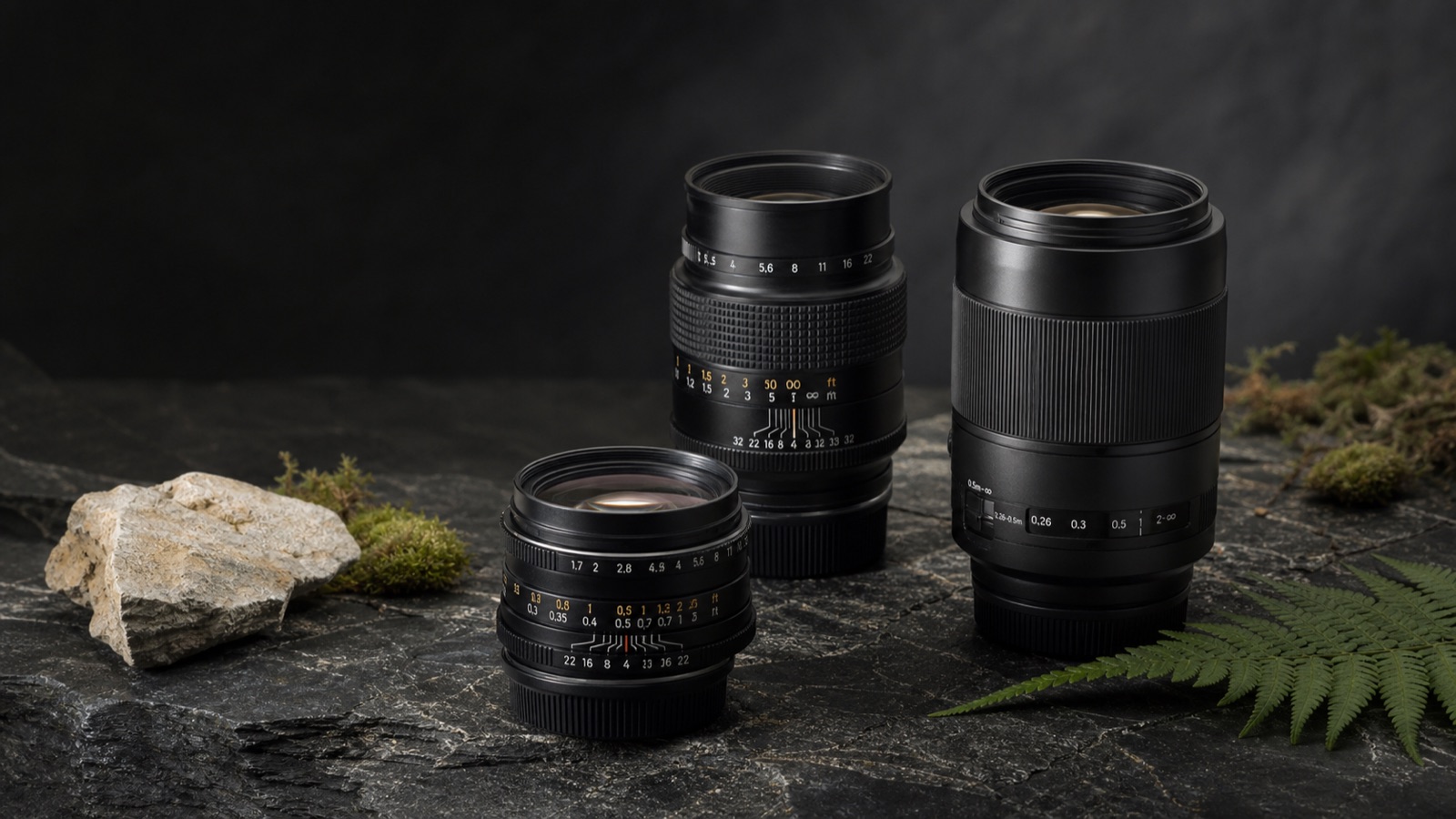
Leica 60 and 100 mm macro lenses for the R and SL systems. AI-generated illustration used as a temporary symbolic image; it will be replaced with an original photograph.
¶ Document information
| Document information | Definition |
|---|---|
| Document ID | FW-OBJ-LEI-MAK-01 |
| Title | Leica macro lenses – Macro-Elmarit-R 60 and APO-Macro-Elmarit 100 R/SL |
| Area | Equipment – lenses – Leica – macro |
| Document type | Public SEO, comparison and practical guide |
| Responsible | Wiki owner |
| Version | 1.2 EN |
| Translation basis | German version 1.2 |
| Last reviewed | 4 August 2026 |
| Document status | Public – editorially and technically reviewed |
| Classification | Public |
| Focus keyword | Leica macro lenses |
| Additional keywords | Leica Macro-Elmarit-R 60, Leica APO-Macro-Elmarit-R 100, Leica APO-Macro-Elmarit-SL 100, Leica SL macro lens, Leica R macro lens |
| Technical review basis | Official Leica data sheets, product page and press release, plus a protected twelve-page practical test of the Macro-Elmarit-R 60 on the Leica SL3; reviewed on 4 August 2026 |
| SL lens market status | Announced on 25 June 2026; according to Leica's German press release, worldwide availability is planned for the end of 2026 |
| Image review | Title image 1600 × 900 pixels, about 283 KB; English teaching graphic 1600 × 900 pixels, below 10 KB; both local and enlargable |
| Last link review | 4 August 2026 |
| Next content review | After the SL lens reaches regular retail availability, no later than 4 February 2027 |
| Wiki.js path | /Fotografen-Wiki/Ausruestung/Objektive/Leica/Makro/FW-OBJ-LEI-MAK-01_Leica_APO-Macro-Elmarit_100mm_R_und_SL |
¶ Review traffic light
| Review area | Status | Result |
|---|---|---|
| SEO and page structure | 🟢 Reviewed | Clear title and description, one H1, search intent and structured comparison sections are present. |
| Technical specifications | 🟢 Reviewed | Core specifications of the APO-Macro-Elmarit-SL 100 were reconciled with Leica's June 2026 data sheet and current official product page. |
| Historical R lenses | 🟢 Classified | Historic specifications, versions and accessories are separated from current product information. |
| Protected research | 🟢 Transparent | Findings for the Macro-Elmarit-R 60 are paraphrased, attributed to one reviewed sample and not generalised. |
| Images and alternative text | 🟢 Reviewed | Both local images are below 1 MB, have precise English alternative text and open full size in a new tab. |
| Interactive lens finder | 🟢 Functionally prepared | All three rows remain readable without JavaScript; search and filters work with the central Wiki.js filter-table component. |
| Internal links | 🟢 Reviewed | All internal targets were reconciled with the local Wiki.js page export; German-only targets are labelled explicitly. |
| External sources | 🟢 Reviewed | Current Leica product page, data sheet and announcement are linked; historical references are marked as archived sources. |
| Market and long-term experience | 🟠 Open | Regular production-sample tests and the wiki owner's own long-term experience with the SL lens are not yet available. |
Overall status: Orange. The page is technically and editorially reviewed. A final practical assessment of the APO-Macro-Elmarit-SL 100 requires regular production samples and longer-term use after market availability.
Language: Open the current German version
¶ SEO data
| SEO field | Content |
|---|---|
| SEO title | Leica macro lenses: 60 and 100 mm compared |
| Meta description | Leica Macro-Elmarit-R 60, APO-Macro-Elmarit-R 100 and APO-Macro-Elmarit-SL 100: specifications, tests, 1:1 reproduction, adapters and macro practice. |
| Primary keyword | Leica macro lenses |
| Secondary search terms | Leica Macro-Elmarit-R 60 review, Leica 100 macro R vs SL, APO-Macro-Elmarit-SL 100 review, Leica R macro lenses |
| Search intent | Compare Leica 60 and 100 mm macro lenses and choose the appropriate R or SL solution |
| Recommended URL slug | leica-macro-lenses-60-100-r-sl-comparison |
| Open Graph title | Leica macro lenses: 60 mm R and 100 mm R/SL |
| Open Graph description | Three f/2.8 Leica macro lenses: technology, test findings, rendering, 1:1 reproduction and buying decision. |
¶ 1. Historical context
The Macro-Elmarit-R 60 mm f/2.8 was introduced in 1972 and remained available in several mechanical generations until the later years of the R system. Depending on the version, early barrels use a separate lens hood, while later versions have an integrated retractable hood. There are also 2-cam, 3-cam, R-only and ROM versions. The protected review examines a 3-cam sample that is dated to approximately 1978 from the information available there.
Leica gives 1987 as the year in which the APO-Macro-Elmarit-R 100 mm f/2.8 was introduced. It was designed for the Leica R SLR system and was offered in different mechanical versions and, later, versions with additional electronic contacts. Before purchasing one, the actual 3-cam, R-only or ROM version and compatibility with the intended camera must therefore be checked.
The APO-Macro-Elmarit-SL 100 f/2.8 was announced together with the Leica SL3-P on 25 June 2026. Leica explicitly describes the new lens as a tribute to the R classic. Nevertheless, it is a completely new design for mirrorless full-frame cameras with L-Mount, autofocus and electronic aperture control.
¶ Meaning of the names
| Term | Meaning |
|---|---|
| APO | Apochromatic correction designed to reduce chromatic aberrations; the 60 mm R lens does not carry this designation |
| Macro | Optimised for short focusing distances and large reproduction ratios |
| Elmarit | Leica designation for a lens with a maximum aperture of f/2.8 |
| R | Leica R mount for SLR cameras |
| SL | Leica SL system with L-Mount |
Important distinction: The new lens is called APO-Macro-Elmarit-SL 100 f/2.8. It is neither an APO-Summicron-SL 100 mm nor a successor to the Summicron-S 100 mm f/2 for the Leica S system.
¶ 2. Specifications compared directly
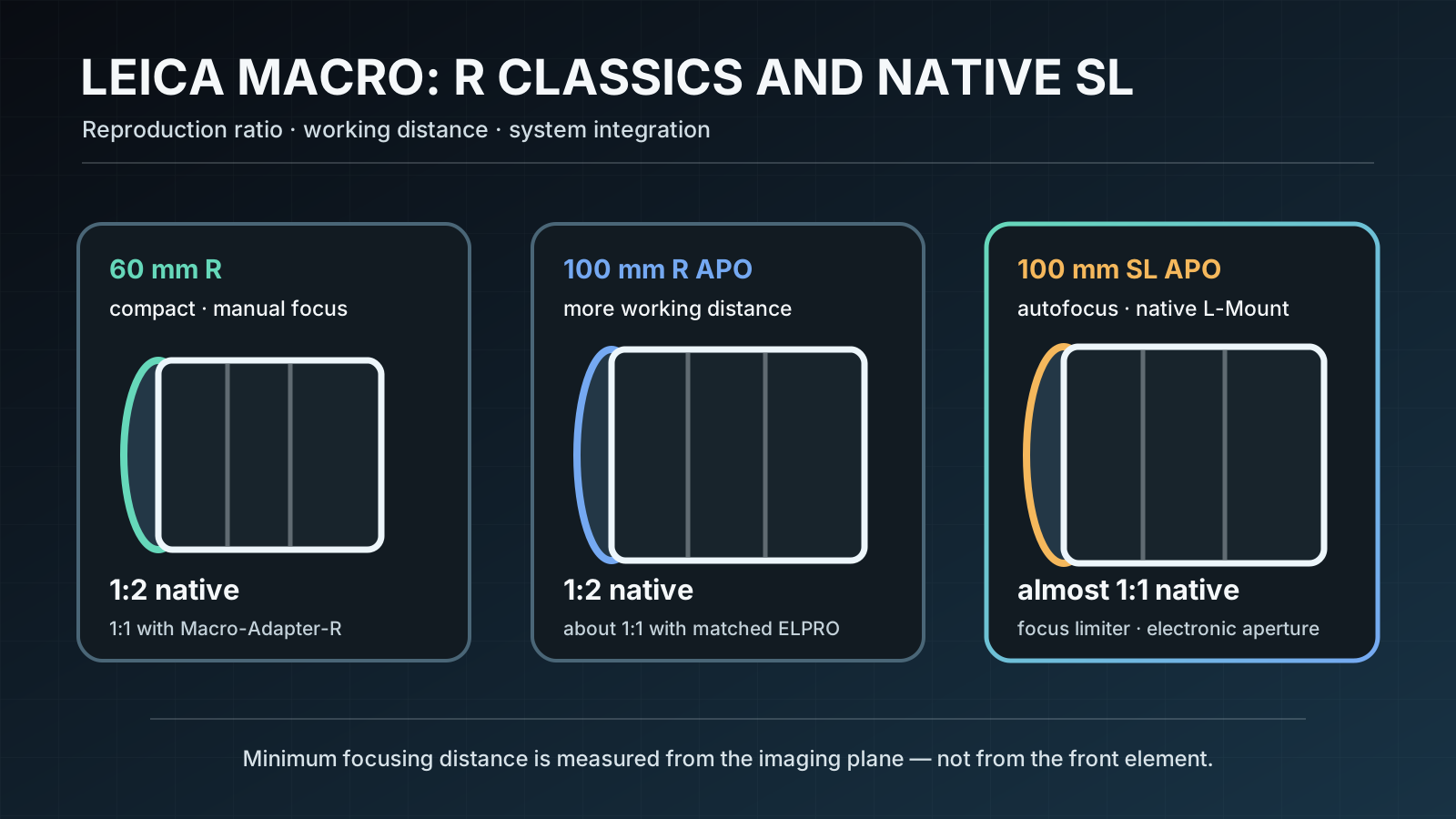
Own schematic teaching graphic for the R and SL macro-lens concepts. The lens shapes are symbolic and are not scale product drawings.
| Feature | Macro-Elmarit-R 60 mm f/2.8 | APO-Macro-Elmarit-R 100 mm f/2.8 | APO-Macro-Elmarit-SL 100 f/2.8 |
|---|---|---|---|
| System | Leica R | Leica R | Leica L-Mount / SL |
| Introduction | 1972 | 1987 according to Leica | Announced 25 June 2026 |
| Order number | Several versions, including 11203, 11205, 11212, 11347 and 11253 | Depends on version; 11210 is documented as a 3-cam version | 11125, black anodised |
| Actual focal length according to data sheet | 61.4 mm | 100 mm | 100 mm |
| Maximum aperture | f/2.8 | f/2.8 | f/2.8 |
| Minimum aperture | f/22 | f/22 | f/22 |
| Optical design | 6 elements in 5 groups | 8 elements in 6 groups | 17 elements in 12 groups |
| Angle of view, diagonal/horizontal/vertical | 40° / 33° / 23° | 24° / 20° / 13.7° | 22.7° / 19.6° / 13° |
| Minimum focusing distance | 0.27 m | 0.45 m | 0.29 m |
| Maximum reproduction ratio without accessories | 1:2 | 1:2 | 1:0.997, effectively 1:1 |
| Maximum reproduction ratio with accessories | Up to 1:1 with Macro-Adapter-R | Up to 1.1:1 with the dedicated ELPRO | 1:1 without optical close-up accessories |
| Smallest object field | 48 × 72 mm | 48 × 72 mm | 23.9 × 35.9 mm |
| Focusing | Manual | Manual | Autofocus or manual |
| Focus limiter | No | No | Near or far range selectable |
| Aperture control | Mechanical, automatic diaphragm | Mechanical, automatic diaphragm | Electronic via the camera |
| Filter | E55 on the later data-sheet version; earlier versions differ | E60 | E67 |
| Lens hood | Separate or integrated depending on version; deeply recessed front element | Integrated and retractable | Separate hood included |
| Protection | No current IP rating | No current IP rating | Dust- and splash-resistant; AquaDura coating on the outer element |
| Length without adapter or hood | Approx. 62.3 mm | Approx. 104.5 mm | Approx. 137 mm |
| Diameter | Approx. 67.5 mm | Approx. 73 mm | Approx. 77 mm |
| Weight | Approx. 400 g; reviewed sample measured about 394 g | Approx. 760 g | Approx. 801 g without or 862 g with lens hood |
| Lens firmware | Not applicable | Not applicable | Updatable through the camera |
| Optical image stabilisation | No | No | Not specified in Leica's data sheet; suitable SL cameras stabilise by moving the sensor |
The minimum focusing distance is measured from the sensor or film plane. It is not the same as the free distance between the front element and the subject. This working distance is considerably shorter in practice and should be checked before photographing wildlife or arranging lighting with a diffuser.
¶ Interactive Leica macro-lens finder
Use the search and selection fields for a quick preselection. The result is not a laboratory ranking: condition and mechanical version remain decisive for a used R lens, while long-term production-sample experience is still pending for the new SL lens.
3 of 3 macro lenses
| Lens | System | Native ratio | Focus | Best fit |
|---|---|---|---|---|
| Macro-Elmarit-R 60 f/2.8 | Leica R | 1:2; 1:1 with adapter | Manual | Compact all-round macro, reproduction and analogue R use |
| APO-Macro-Elmarit-R 100 f/2.8 | Leica R | 1:2; about 1:1 with ELPRO | Manual | Greater working distance, APO correction and deliberate focusing |
| APO-Macro-Elmarit-SL 100 f/2.8 | Leica SL / L-Mount | 1:0.997 | Autofocus or manual | Native integration, focus limiter, almost 1:1 and portraits |
| No matching macro lens. Change or reset the filters. | ||||
Technical requirement: Search and filters use the centrally installed filter-table component. Without JavaScript, the complete three-lens table remains visible and readable.
¶ 3. The decisive difference: 1:2 or 1:1
A reproduction ratio of 1:2 means that a 20 mm subject is rendered 10 mm wide on the film or sensor. At 1:1, the subject is reproduced at its actual size on the imaging surface.
¶ Macro-Elmarit-R 60
The 60 mm lens reaches 1:2 on its own. The matched Macro-Adapter-R extends the lens and enables 1:1 reproduction. Unlike the accessory for the 100 mm R lens, it does not use an optical close-up element. The automatic diaphragm remains operational with the designated adapter.
¶ APO-Macro-Elmarit-R 100
The 100 mm R lens reaches 1:2 on its own. The specifically matched Leica ELPRO 1:2–1:1 is required to reach approximately 1:1. This optical close-up accessory modifies the complete optical system for the larger reproduction ratio. An arbitrary extension tube or third-party close-up lens is not equivalent.
¶ APO-Macro-Elmarit-SL
According to the data sheet, the SL lens reaches 1:0.997. In photographic practice, this is almost exactly 1:1. No accessory is required. The smallest object field of 23.9 × 35.9 mm is approximately the size of a 35 mm negative.
¶ Practical relevance
| Subject | 60 mm R | 100 mm R | 100 mm SL |
|---|---|---|---|
| Flower or mushroom | Versatile environmental view, short working distance | More distance from the subject | More distance and autofocus |
| Rock structure | Natural perspective | Stronger compression | Stronger compression and 1:1 |
| Jewellery and watch detail | 1:1 with Macro-Adapter-R | 1:1 with ELPRO | 1:1 without an accessory |
| Reproducing a 35 mm negative | 1:1 with Macro-Adapter-R | With the appropriate ELPRO and careful alignment | Can fill the frame without an accessory |
| Very small insect | 1:1 possible, but short distance | Greater distance is advantageous | 1:1, autofocus and focus limiter |
¶ 4. Assessing image quality correctly
The historical Leica data sheets describe the R lenses as particularly strong in sharpness, contrast, vignetting and distortion at different focusing distances. These are manufacturer claims. They are not independent comparative measurements of used lenses available today.
¶ Protected practical test: Macro-Elmarit-R 60 on the Leica SL3
The supplied twelve-page review examines one 3-cam Macro-Elmarit-R 60 mm f/2.8, probably manufactured in 1978. It was used on a Leica SL3 with a 60-megapixel sensor. According to the author, the DNG files were generally processed without a lens profile or additional noise reduction and with Lightroom's standard sharpening. The findings are valuable for practical use, but the age and condition of the individual lens and the camera and firmware combination mean that they must not be transferred uncritically to every sample.
| Test area | Summary of the protected review |
|---|---|
| Construction | Very solid metal construction; the reviewed sample weighed approximately 394 g. |
| Focusing | The long focus throw enables precise adjustment. The ring on the reviewed sample was stiff, however, probably because the lubricant had aged. Professional servicing may be advisable. |
| Centre | Very high detail reproduction even at f/2.8, improving further at f/4 and f/5.6. |
| Edges and corners | Good at f/2.8, very good at f/4 and excellent from f/5.6 to f/8. |
| Diffraction | A slight reduction in resolution became visible in direct comparison from f/8. This does not make f/8 unusable; it means that maximum detail and depth of field must be balanced. |
| Vignetting | Moderately visible at f/2.8, considerably lower at f/4 and largely unproblematic when stopped down further. |
| Distortion | Only slight barrel distortion, unobtrusive with many subjects and easy to correct with a profile. |
| Chromatic aberration | The non-apochromatic 60 mm lens showed colour fringing at f/2.8, especially in strong backlight. Stopping down reduced it considerably. |
| Backlight | The reviewed sample produced visible veiling flare, lifting the blacks and reducing contrast. Stopping down did not eliminate this effect completely. |
| Contrast and colour | Rather gentle, non-aggressive rendering with moderate saturation. This can be attractive for portraits, black-and-white work and organic subjects, but requires deliberate contrast control in harsh light. |
| Bokeh | The out-of-focus areas were judged calm and appealing in the review. |
| SL3 lens profile | Manually selecting the R 60/2.8 profile had little effect on vignetting. A cyan tendency in the reviewed combination remained. |
| Exposure metering | The SL3's Highlight Priority metering usually worked reliably in the test, although some subjects still required exposure compensation. |
The lens made surprisingly good use of the SL3's high sensor resolution in this test. Its character is not defined solely by maximum microcontrast: high precision is combined with comparatively gentle tonal and contrast rendering. This can be attractive for black-and-white photography, while colour photographers should monitor colour fringing and the cyan tendency observed in the review.
¶ Backlight: manufacturer information conflicts with the practical review
The historical Leica document effectively describes the 60 mm lens as highly resistant to flare. The old sample used in the protected test showed pronounced veiling flare on the Leica SL3. These statements must not be combined into a falsely unambiguous assessment. Possible factors include:
- the specific lens generation and coating,
- the age, internal cleanliness and condition of the sample,
- the angle and intensity of the light source,
- interaction with the sensor, cover glass and microlenses,
- the lens hood used and bright areas just outside the frame.
Practical tip: Before buying a used Macro-Elmarit-R 60, test it not only with a test chart but also in direct and oblique backlight. One SL3 test demonstrates a possible weakness of the reviewed combination, not an identical characteristic of every sample produced.
For the SL lens, the data sheet provides MTF curves at f/2.8, f/5.6 and f/8 at long focusing distances. These curves illustrate the design objectives but are no substitute for a practical test at 1:1. At macro distances, the following should also be examined:
- sharpness and contrast at 1:1,
- field curvature with flat originals,
- focus shift when stopping down,
- colour fringing in front of and behind the plane of focus,
- bokeh against a busy background,
- autofocus accuracy at very shallow depth of field,
- effective focal-length behaviour at close range,
- behaviour in backlight and with reflective surfaces.
¶ Test status of the new SL lens
On 30 July 2026, the lens is between announcement and regular availability. Leica's German press release states the end of 2026 as the planned worldwide launch. Manufacturer specifications and initial demonstrations are therefore available, but broad long-term experience with production samples is not.
Assessment rule: Reliable statements about production variation, autofocus performance, close-range sharpness and serviceability can be added only after regular retail samples have been tested.
¶ 5. Light loss and effective aperture at macro distances
As the reproduction ratio increases, the optical extension grows or the internal focusing system changes. The effective lens speed therefore decreases. The data sheet for the SL lens documents this effect unusually clearly.
| Approximate reproduction ratio | Focusing distance | Effective aperture at nominal f/2.8 | Light loss |
|---|---|---|---|
| 1:13 | 1.50 m | Approx. f/3.13 | +0.20 EV |
| 1:5.2 | 0.70 m | Approx. f/3.45 | +0.49 EV |
| 1:3.2 | 0.50 m | Approx. f/3.79 | +0.76 EV |
| 1:2.2 | 0.40 m | Approx. f/4.21 | +1.06 EV |
| About 1:1 | 0.30 m | Approx. f/5.75 | +1.96 EV |
These figures are particularly important for:
- manually set flash power,
- external light metering,
- focus stacks with constant illumination,
- comparisons between close and distant subjects,
- planning ISO and shutter speed.
Through-the-lens metering measures the light actually reaching the camera. In a completely manual flash or exposure workflow, however, the close-range light loss must not be ignored.
Important distinction: The figures in the table apply only to the new APO-Macro-Elmarit-SL 100. They must not be transferred to the Macro-Elmarit-R 60 or APO-Macro-Elmarit-R 100. With the mechanical R lenses, meter through the lens or determine the actual close-range light loss with the camera used or a documented test.
¶ 6. Working with the Leica R macro lenses
¶ On a Leica R 6.2
For the Leica R 6.2 – German, choose an appropriate 3-cam, R-only or ROM version of the 60 or 100 mm lens. The R 6.2 does not use the additional ROM information, but it requires the correct mechanical R controls.
Recommended workflow:
- Mount the camera on a stable tripod.
- Determine the subject distance and required reproduction ratio.
- Make the initial adjustment with the focusing ring.
- Fine-tune focus by carefully moving the camera or a focusing rail.
- Select the working aperture for the required depth of field.
- Check shutter speed, wind and subject movement.
- Use mirror lock-up and a cable release when the subject and camera permit.
- With film, allow for exposure bracketing or a documented test exposure.
¶ 60 or 100 mm on the R 6.2?
| Criterion | Macro-Elmarit-R 60 | APO-Macro-Elmarit-R 100 |
|---|---|---|
| Rendering | More normal perspective and more context | Tighter perspective and stronger compression |
| Weight | About 400 g | About 760 g |
| Working distance | Shorter at the same reproduction ratio | Greater and therefore more favourable for lighting or timid subjects |
| 1:1 | With Macro-Adapter-R | With the appropriate ELPRO |
| Colour fringing | Not APO; check at wide apertures and in backlight | Apochromatically corrected |
| General use | Also suitable as a versatile normal lens | Primarily macro, detail and short telephoto |
¶ Adapted to a Leica SL
Both R lenses can be used on suitable Leica SL cameras with the Leica R-Adapter L. Focusing is manual with viewfinder magnification or focus peaking. ROM-equipped lenses may be recognised depending on the adapter and camera configuration; other versions may require manual lens selection.
Advantages of adapted use:
- an existing R lens remains usable,
- direct manual focusing,
- electronic viewfinder with magnification,
- in-body image stabilisation,
- characteristic mechanical operation.
Disadvantages:
- no autofocus,
- maximum 1:2 without the appropriate macro accessory,
- additional adapter length,
- no native sealing of the complete combination,
- lens condition and adapter tolerances influence the result.
¶ Findings for the 60 mm R lens on the SL3
The protected test shows that manually selecting the R 60/2.8 profile does not automatically eliminate all optical or colour characteristics of the old lens. For a repeatable test of your own:
- Record the current camera firmware and raw-converter version.
- Compare the lens profile switched off and on.
- Use a fixed white balance or grey card.
- Check vignetting and any cyan tendency separately.
- Compare Highlight Priority with standard multi-field metering.
- Make backlit exposures at f/2.8, f/5.6 and f/8.
- Adopt corrections as defaults only after reviewing the DNG files.
¶ 7. Working with the APO-Macro-Elmarit-SL
The SL lens is designed for direct communication with the camera. Aperture, focus, lens data and firmware are integrated electronically.
¶ Using the focus limiter effectively
The focus limiter separates the very short macro range of approximately 0.30 to 0.50 m from the range of 0.50 m to infinity. The autofocus system therefore does not need to search through the complete focus range.
| Subject | Appropriate focus range |
|---|---|
| 1:1 detail, flower, small object | Near range |
| Portrait, landscape detail, reproduction from a greater distance | Far range |
| Changing distances | Check the full range or the appropriate camera setting |
¶ Autofocus or manual focus?
| Situation | Recommendation |
|---|---|
| Static subject on a tripod | Manual focus with viewfinder magnification |
| Hand-held close-up | Test AF-S or AF-C; use continuous shooting sparingly |
| Slightly moving insect | AF-C, sufficiently short shutter speed and focus limiter |
| Focus stacking | Use repeatable manual steps or check camera-assisted functions for the current firmware |
| Portrait | AF-C with eye detection; limit the focusing range to far |
At 1:1, depth of field is extremely shallow. Autofocus does not replace parallel alignment for reproduction work or a deliberate choice of the plane of focus.
¶ 8. Aperture, diffraction and focus stacking
Stopping down increases depth of field but may reduce fine detail through diffraction. The higher effective aperture at macro distances intensifies this effect.
¶ Practical starting points
| Subject | Starting point | Note |
|---|---|---|
| Flat reproduction | f/5.6 to f/8 | Align the sensor and original parallel to each other |
| Flower or mushroom | f/5.6 to f/11 | Watch the background and subject movement |
| Hand-held insect | f/5.6 to f/8 | A short shutter speed is more important than maximum depth of field |
| Rock structure | f/8 | Raking light reveals relief more clearly |
| Product detail | f/8 plus focus stack | Use repeatable lighting |
| Portrait | f/2.8 to f/5.6 | Check eye focus and background distance |
For a completely sharp three-dimensional subject, focus stacking is usually more effective than routinely stopping down to f/16 or f/22. Moving animals, plants in the wind and changing light restrict the method.
¶ 9. Use in Project Franconia
For rocks and caves, all three macro lenses are primarily tools for details. They do not replace a wide-angle lens for conveying the complete space, but they reveal:
- fossils and limestone structures,
- weathering and watercourses,
- lichens, mosses and plants,
- tool marks and historical details,
- isolated rock formations at a medium telephoto perspective.
¶ Black-and-white practice
Sideways raking light is often more important than maximum magnification for rock surfaces. It emphasises edges, cracks and relief. A light mounted frontally on the camera can flatten these structures.
Recommended setup:
- Align the camera and lens securely.
- Position a small LED light to the side and slightly above the subject.
- Check bright limestone surfaces for retained detail.
- Focus on the most important structure.
- Compare exposures at f/5.6, f/8 and, if appropriate, f/11.
- Make a focus stack when the subject is static.
- Observe nature-conservation, cave-protection and access rules.
¶ Choosing a lens for rocks, caves and woodland
| Task | Appropriate choice | Reason |
|---|---|---|
| Structure with recognisable surroundings | Macro-Elmarit-R 60 | More natural angle of view and compact construction |
| Small rock structure in restricted space | Macro-Elmarit-R 60 | Short focal length; 1:1 with Macro-Adapter-R |
| Isolated detail from a greater distance | APO-Macro-Elmarit-R 100 | Greater working distance and precise manual focus |
| Moving natural detail on an SL camera | APO-Macro-Elmarit-SL 100 | Autofocus, focus limiter and native communication |
| Black-and-white work with gentle tonal rendering | Test the Macro-Elmarit-R 60 | The protected review describes comparatively mild contrast rendering |
| Maximum technical repeatability | SL 100 after testing a production sample | 1:1 without accessories, but long-term experience is still outstanding |
¶ 10. Macro lenses beyond close-up work
On full frame, the 60 mm R lens is a slightly longer normal lens or short telephoto. The two 100 mm lenses provide a natural working distance for head-and-shoulders portraits.
¶ Macro-Elmarit-R 60
- versatile for reportage, travel, reproduction and details,
- includes more of the surroundings than a 100 mm lens,
- precise manual focusing,
- the protected review describes highly detailed but comparatively gentle rendering,
- calm out-of-focus areas can support portraits and natural details,
- backlight and colour fringing at wide apertures should be checked.
¶ APO-Macro-Elmarit-R 100
- deliberate, precise manual focusing,
- easy to control for static portraits,
- focus travel is designed for close-range precision and is therefore slower,
- adapted use benefits from viewfinder magnification and peaking.
¶ SL lens
- the camera's autofocus and eye detection can be used,
- the focus limiter reduces unnecessary focus travel,
- according to Leica, eight aperture blades and the optical design are intended to produce a harmonious background,
- the weight of approximately 801 g without the lens hood remains noticeable during longer sessions.
Macro lenses reveal skin texture very clearly. Lighting, distance, post-processing and the intended visual statement should therefore be coordinated deliberately.
¶ 11. Buying decision: keep the R lens or buy the SL lens?
| Priority | More suitable choice |
|---|---|
| Compact R macro and versatile 60 mm focal length | Macro-Elmarit-R 60 |
| Analogue use on the Leica R 6.2 | Macro-Elmarit-R 60 or APO-Macro-Elmarit-R 100 |
| Continue using an existing R lens digitally | R lens plus R-Adapter L |
| Greater working distance in the R system | APO-Macro-Elmarit-R 100 |
| Native 1:1 capture without an accessory | APO-Macro-Elmarit-SL |
| Autofocus and eye detection | APO-Macro-Elmarit-SL |
| Fully mechanical operation | Either R lens |
| Lower system cost | Examine used R offers; assess condition and suitable macro accessories separately |
| Current sealing and firmware integration | APO-Macro-Elmarit-SL |
| 1:1 with an existing 60 mm R lens | Macro-Adapter-R 14198 |
| Approximately 1:1 with an existing 100 mm R lens | Appropriate ELPRO 1:2–1:1 |
| Reproducing 35 mm negatives | SL natively at 1:1; additionally test flatness and field curvature |
According to Leica, the SL lens has an introductory price of €2,450 including VAT. Used prices for the R lenses vary considerably according to condition, version, included accessories, macro equipment and dealer warranty. The protected report, first published in September 2025, quoted a price range of US$400 to US$600 for the 60 mm lens at that time. This is neither a current German price recommendation nor a reliable market survey.
¶ 12. Buying a used Leica R macro lens
- Exact version and product number documented
- Mount, control cams and, if present, ROM contacts photographed
- Focus movement even throughout the long focusing range
- No unusually stiff or hardened focusing mechanism on the 60 mm lens
- Aperture ring and automatic diaphragm working
- No oil on the aperture blades
- No haze, separation, fungus or severe scratches
- Lens hood present, or integrated hood moving freely
- Filter thread appropriate to the specific lens generation and undamaged
- Infinity focus tested
- Close range tested at 1:2
- Centring checked using a flat subject
- Backlight and colour fringing checked at f/2.8
- Macro-Adapter-R or ELPRO clearly identified as the appropriate model
- Right of return or dealer warranty available
A famous optical design is no guarantee of a good individual sample. After several decades, storage, impacts and previous repairs may be more important than theoretical specifications.
¶ 13. Comparative test after availability
For a fair comparison on a Leica SL3 or SL3-P:
- Use both R lenses with the same Leica R-Adapter L and the SL lens natively.
- Use a tripod, electronic shutter or self-timer, and identical light.
- Test all three lenses with the same subject framing.
- Use DNG, a fixed white balance and the same ISO setting.
- Make exposures at f/2.8, f/4, f/5.6, f/8 and f/11.
- Test close range, medium distance and infinity separately.
- Compare the centre, edges and corners.
- Examine colour fringing in front of and behind the plane of focus.
- Test bokeh against both calm and busy backgrounds.
- Additionally test AF-S, AF-C and the focus limiter on the SL lens.
- Test the 60 mm R lens at 1:2 and at 1:1 with the Macro-Adapter-R.
- Test the 100 mm R lens at 1:2 and with the appropriate ELPRO.
- With the 60 mm R lens, compare the profile on and off, Highlight Priority and standard metering.
- Photograph a dark subject edge with the sun just inside and just outside the frame.
- Assess the results only after identical raw processing.
Important: The same focusing-ring position or focusing distance does not necessarily produce the same framing because the lenses use different focusing designs. The actual reproduction ratio must be matched for a valid comparison.
¶ 14. Strengths and limitations
¶ Macro-Elmarit-R 60 mm f/2.8
Strengths
- compact and, at around 400 g, considerably lighter than the two 100 mm lenses,
- high detail reproduction from f/2.8 on the reviewed SL3 sample,
- very good performance across the frame at medium apertures,
- only slight distortion,
- calm out-of-focus areas,
- versatile 60 mm focal length for macro, reproduction, everyday work and portraits,
- 1:1 with the appropriate Macro-Adapter-R.
Limitations
- no APO designation; visible colour fringing may occur at wide apertures and in strong backlight,
- pronounced veiling flare and reduced contrast in backlight on the reviewed sample,
- moderate vignetting at f/2.8,
- age-related condition of the focusing mechanism and lubricant can be critical,
- short working distance at large reproduction ratios,
- in the protected test, the manually selected SL3 lens profile did not fully correct either vignetting or the observed cyan tendency.
¶ APO-Macro-Elmarit-R 100 mm f/2.8
Strengths
- precise mechanical focusing,
- historically sophisticated APO macro design,
- versatile for macro, natural details and portraits,
- usable on Leica R cameras and adapted to Leica SL cameras,
- integrated lens hood.
Limitations
- only 1:2 without the dedicated ELPRO,
- no autofocus,
- no electronic integration on early versions,
- condition and compatibility must be checked when buying used,
- no current weather-sealing specification.
¶ APO-Macro-Elmarit-SL 100 f/2.8
Strengths
- nearly 1:1 without an accessory,
- autofocus and focus limiter,
- electronic aperture and lens integration,
- apochromatic correction,
- all-metal housing, AquaDura and protection against dust and splashes,
- also intended as a portrait telephoto lens.
Limitations
- high weight of approximately 801 g without the lens hood,
- no optical stabilisation specified in the data sheet,
- introductory price of €2,450,
- broad independent experience with production samples is not yet available before launch,
- at 1:1, close-range light loss changes the effective f/2.8 aperture to approximately f/5.75.
¶ 15. Frequently asked questions
¶ Is the new SL lens optically identical to the R lens?
No. Neither the Macro-Elmarit-R 60 nor the APO-Macro-Elmarit-R 100 is optically identical to the new SL lens. The 60 mm R lens contains 6 elements in 5 groups, the 100 mm R lens contains 8 elements in 6 groups, and the SL lens contains 17 elements in 12 groups. Autofocus, internal focusing, electronic aperture control, 1:1 reproduction and L-Mount require an independent design.
¶ Does the Macro-Elmarit-R 60 reach 1:1?
On its own it reaches 1:2. According to Leica documentation, the dedicated Macro-Adapter-R 14198 enables 1:1; the automatic diaphragm and exposure metering remain functional on a compatible R camera.
¶ Does the APO-Macro-Elmarit-R 100 reach 1:1?
Without accessories, it reaches 1:2. With the specifically matched Leica ELPRO 1:2–1:1, the data sheet gives a maximum reproduction ratio of 1.1:1.
¶ Does the SL lens really reach 1:1?
Leica states 1:0.997 in the data sheet. In photographic practice, this is almost exactly 1:1.
¶ Can the R lenses be used on a Leica SL3?
Yes, with an appropriate Leica R-Adapter L and manual focusing. The specific lens version must be checked against Leica's compatibility information. The protected PDF documents the practical use of an old 3-cam 60 mm sample on an SL3.
¶ Is the 60 mm R lens better than the 100 mm R lens?
Not categorically. The 60 mm lens is lighter, more versatile and includes more context. The 100 mm lens provides a greater working distance, stronger subject isolation and apochromatic correction. The 60 mm can be especially practical for reproduction and small objects; the 100 mm often has an advantage for timid animals, lighting modifiers and isolated details.
¶ Does the protected SL3 test apply to every Macro-Elmarit-R 60?
No. The test covered a single, decades-old 3-cam sample on one particular camera and software combination. Resolution, focusing feel, veiling flare and colour deviation may be affected by lens generation, condition, servicing, adapter, sensor and raw processing.
¶ Does the SL lens have image stabilisation?
Leica's data sheet does not specify optical stabilisation in the lens. Suitable Leica SL cameras stabilise by moving the sensor.
¶ Is f/22 useful for greater depth of field?
Only to a limited extent. Depth of field increases, but so does diffraction blur. A focus stack is often a better solution for static, three-dimensional subjects.
¶ Has the SL lens already been tested comprehensively?
Not yet over a meaningful period. On 30 July 2026 it has been announced, but according to Leica's German press release worldwide availability is planned only for the end of 2026. Manufacturer specifications must therefore not be described as an independent long-term review.
¶ 16. Related pages in the Photographers' Wiki
- Leica R lenses – overview and compatibility – German
- Leica R lens reviews – German
- Special-purpose lenses: macro, tilt-shift and other designs – German
- Mounts and adapters – German
- Leica SL system overview – German
- Leica SL3 – German
- Leica SL3-P – German
- Project Franconia: cave photography – German
¶ 17. Sources and review basis
¶ Manufacturer sources
- Leica Camera AG – APO-Macro-Elmarit-SL 1:2.8/100 technical data, June 2026
- Leica Camera AG – press release for the SL3-P and new SL lenses, 25 June 2026
- Leica Camera AG – APO-Macro-Elmarit-SL 100 f/2.8 international product page
- Leica Camera AG – APO-Macro-Elmarit-R 100 mm f/2.8 technical data, archived manufacturer document
- Leica Camera AG – Macro-Elmarit-R 60 mm f/2.8 technical data, archived manufacturer document
- Leica Wiki – Macro-Elmarit-R 60 mm versions and order numbers
- Leica Wiki – Macro-Adapter-R 14198
- Leica Classic – R system and current used offers
¶ Protected research source
- Leitz Wetzlar Macro-Elmarit-R 60/2.8 on Leica SL3, twelve-page review first published on 26 September 2025; PDF supplied by the wiki owner.
- The test findings were independently summarised and contextualised for this public page.
- No photographs, extended verbatim passages or complete tables were reproduced from the protected document.
¶ Source assessment
- Technical specifications are taken primarily from the relevant Leica data sheets.
- The introduction, price and announced availability of the SL lens are taken from Leica's press release.
- Manufacturer statements about image quality are treated as manufacturer claims.
- The review findings for the Macro-Elmarit-R 60 relate to a single old sample on a Leica SL3 and do not constitute a universally applicable laboratory assessment.
- The conflict between Leica's historical statement on flare resistance and the veiling flare observed in the protected practical test remains transparently documented.
- Individual Leica Classic listings are used only to identify versions, not as a general market-price survey.
- An independent long-term or laboratory test of a regular production SL sample remains to be added as of the review date.
¶ 18. Maintenance notes
Update this page when:
- the APO-Macro-Elmarit-SL 100 becomes regularly available in Germany,
- an English-language instruction manual or new firmware is released,
- independent tests of production lenses are published,
- original DNG comparison images from the 60 mm R, 100 mm R and 100 mm SL lenses become available,
- further Macro-Elmarit-R 60 samples from different generations have been tested on the same digital camera,
- Leica changes information about service, spare parts or compatibility.
¶ Version history
| Version | Date | Change |
|---|---|---|
| 1.2 EN | 4 August 2026 | Reconciled with German version 1.2; added a nine-row review traffic light, enlargable title image, new English teaching graphic, filterable three-lens finder, explicit warnings and language routing; official Leica data and internal links reviewed. |
| 1.0 EN | 30 July 2026 | Complete English translation of German version 1.1; technical data, protected test findings, source distinctions and locale-specific links retained |
| 1.1 DE | 30 July 2026 | Added the Macro-Elmarit-R 60 mm with specifications, 1:1 reproduction via Macro-Adapter-R, extensively paraphrased findings from the protected SL3 practical review, the backlight conflict, buying checks and an expanded three-lens comparison |
| 1.0 DE | 30 July 2026 | Created the SEO-oriented comparison and practical guide to the APO-Macro-Elmarit-R 100 mm f/2.8 and the new APO-Macro-Elmarit-SL 100 f/2.8 from official data sheets and the Leica press release |