¶ ZEISS ZM Lenses for Leica M: Detailed Guide
Language note: This is the English version of the page. The corresponding German page is available at ZEISS ZM-Objektive für Leica M – Deutsch.
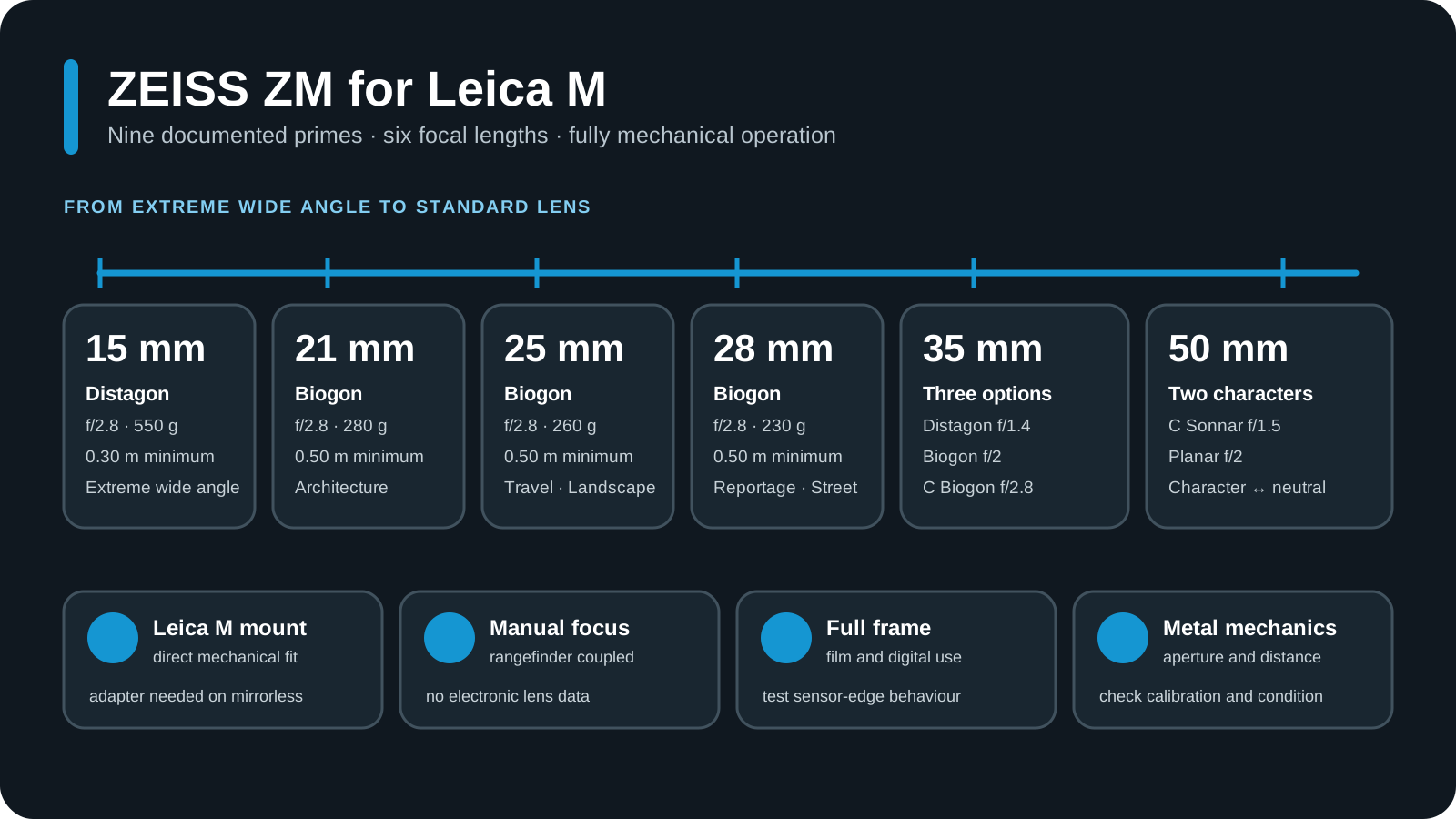
The documented ZM family from 15 to 50 mm. Original technical infographic by the Photographer Wiki; open it in a new tab for a larger view.
ZEISS ZM lenses are manual-focus prime lenses with a Leica M mount. They combine classic optical names such as Biogon, Distagon, Planar and Sonnar with fully mechanical operation for rangefinder cameras. They can generally be used on compatible analogue and digital Leica M cameras as well as other M-mount cameras.
This detailed page places the ZM range documented by ZEISS, discontinued models found on the used market and their most important practical characteristics into context. It also explains which focal length suits which subject, how these lenses behave on digital Leica M cameras and what to inspect when buying used. Availability must always be checked for the specific model and market.
In brief: ZM is particularly relevant to photographers who want fully mechanical M operation, distinct optical designs and an alternative to Leica M lenses. Nominal sharpness alone is not enough: rangefinder calibration, sensor behaviour, finder blockage, profile selection and the condition of the individual sample matter too.
Status reviewed 4 August 2026: ZEISS documents nine ZM lens data sheets. The official ZEISS Photography Store lists eight models; the Biogon 21 mm f/2.8, Biogon 25 mm f/2.8 and Distagon 35 mm f/1.4 are currently marked out of stock. “Documented”, “listed in the shop” and “available for immediate delivery” are therefore three different status descriptions.
¶ Document Information
| Field | Content |
|---|---|
| Document ID | FW-OBJ-ZEI-01 |
| Title | ZEISS ZM Lenses for Leica M |
| Section | Equipment – Lenses – ZEISS |
| Page type | Manufacturer, system and selection guide |
| Responsible | Wiki owner |
| Version | 2.1 EN |
| Translation basis | German content version 2.1 dated 2 August 2026 |
| Last reviewed | 4 August 2026 |
| Document status | Public – editorially reviewed |
| Classification | Public |
| Source status | Official ZEISS data sheets and ZEISS Photography Store reviewed on 4 August 2026 |
| Next review | 4 February 2027, or when the product range, shop listing or data sheets change |
| Wiki.js path | /Fotografen-Wiki/Ausruestung/Objektive/ZEISS/FW-OBJ-ZEI-01_ZEISS_ZM_Objektive |
| SEO title | ZEISS ZM Lenses for Leica M: Models and Buying Guide |
| Meta description | ZEISS ZM lenses for Leica M: all models, specifications, rendering, rangefinder use, digital-sensor behaviour and buying used. |
¶ Review Traffic Light
| Review area | Status | Result |
|---|---|---|
| Page structure and SEO | 🟢 | One H1, descriptive metadata and a clear section hierarchy are present. |
| Official model range | 🟢 | Nine ZEISS data sheets and eight current shop listings were cross-checked. |
| Technical specifications | 🟢 | Focal length, aperture, construction, close focus, filter, length and weight are documented. |
| Availability | 🟠 | Shop status is a dated snapshot and can vary by country, finish and dealer. |
| Rangefinder and sensor compatibility | 🟠 | Mechanical fit is established; focus and edge behaviour require a camera-specific test. |
| Original graphics | 🟢 | Two local, enlargable English technical infographics are included. |
| Interactive lens finder | 🟢 | All nine documented lenses can be searched, filtered and sorted. |
| Internal and external links | 🟢 | Wiki targets and official ZEISS sources were checked. |
| Used-market condition | 🟠 | Calibration, decentring, fungus, haze and serviceability depend on the individual sample. |
¶ 1. Quick Overview
| Feature | Classification |
|---|---|
| Mount | Leica M mount, designated ZM by ZEISS |
| Image format | 35 mm film or full frame |
| Focusing | manual, mechanically coupled to the rangefinder |
| Aperture control | mechanical aperture ring |
| Autofocus | no |
| Image stabilisation | no |
| Electronic data transmission | no |
| Typical strengths | high microcontrast, robust metal construction, precise handling and distinctive optical concepts |
| Particularly important checks | rangefinder calibration, frame lines, colour shifts at wide-angle image edges, profile selection and actual availability |
¶ 2. What Does ZM Mean?
ZEISS uses the designation ZM for lenses with a Leica M mount. They are not Leica L-mount lenses and should not be confused with ZEISS designations for other camera mounts.
| Designation | Mount or system |
|---|---|
| ZM | Leica M mount for rangefinder cameras |
| ZE / ZF.2 | discontinued SLR mounts for Canon EF and Nikon F respectively |
| Loxia | Sony E |
| Batis | Sony E |
| Otus ML | current mirrorless mounts, not Leica M |
ZM lenses have no electronic contacts. Focusing distance, aperture and focal length are not transmitted automatically to the camera. Rangefinder coupling and frame-line selection work mechanically.
¶ 3. ZM Lenses Currently Documented by ZEISS
The following table is based on the official ZEISS ZM product page. Weight and dimensions may vary slightly depending on finish or the specific data sheet.
| Lens | Aperture | Elements/groups | Minimum focus | Filter | Length | Weight | Typical use |
|---|---|---|---|---|---|---|---|
| Distagon T* 2.8/15 ZM | f/2.8–f/22 | 11/9 | 0.30 m | M72 | 86 mm | 550 g | extreme ultra-wide angle; external finder or Live View required |
| Biogon T* 2.8/21 ZM | f/2.8–f/22 | 9/7 | 0.50 m | M46 | 64 mm | 280 g | landscape, architecture and confined interiors |
| Biogon T* 2.8/25 ZM | f/2.8–f/22 | 9/7 | 0.50 m | M46 | 60 mm | 260 g | wide-angle reportage, landscape and architecture |
| Biogon T* 2.8/28 ZM | f/2.8–f/22 | 8/6 | 0.50 m | M46 | 51 mm | 230 g | travel, street and reportage |
| Distagon T* 1.4/35 ZM | f/1.4–f/16 | 10/7 | 0.70 m | M49 | 65 mm | 381 g | available light, subject separation and high 35 mm performance |
| Biogon T* 2/35 ZM | f/2–f/22 | 9/6 | 0.70 m | M43 | 56 mm | 240 g | versatile reportage lens |
| C Biogon T* 2.8/35 ZM | f/2.8–f/22 | 7/5 | 0.70 m | M43 | 55 mm | 200 g | compact travel and landscape option |
| C Sonnar T* 1.5/50 ZM | f/1.5–f/16 | 6/4 | 0.90 m | M46 | 45 mm | 250 g | classic rendering and available-light photography |
| Planar T* 2/50 ZM | f/2–f/22 | 6/4 | 0.70 m | M43 | 68 mm | 230 g | versatile standard lens with a more technical rendering |
¶ How to Interpret Availability
On 4 August 2026, the official ZEISS store listed eight ZM lenses:
- Biogon 21 mm f/2.8,
- Biogon 25 mm f/2.8,
- Biogon 28 mm f/2.8,
- Distagon 35 mm f/1.4,
- Biogon 35 mm f/2,
- C Biogon 35 mm f/2.8,
- C Sonnar 50 mm f/1.5,
- Planar 50 mm f/2.
The Distagon 15 mm f/2.8 remains documented on the general ZEISS product page but does not appear in this shop list. The 21 mm f/2.8, 25 mm f/2.8 and 35 mm f/1.4 were marked as out of stock in the official US store. This snapshot says nothing about stock held by dealers or in other countries. Current dealer inventory and the exact finish must therefore be checked before purchase.
¶ Interactive ZM Lens Finder
This technical component filters all nine documented ZM lenses by field of view, speed and weight. It provides a shortlist, not a substitute for a focus and sensor test with the intended camera.
9 of 9 ZM lenses
| Strength | Check especially | Typical use | ||
|---|---|---|---|---|
| Distagon T* 2.8/15 ZM | 15 mm | extreme field of view | edges, external finder, size | architecture, caves, interiors |
| Biogon T* 2.8/21 ZM | 21 mm | wide perspective, low distortion | edge colour, finder, 0.50–0.70 m | landscape, architecture |
| Biogon T* 2.8/25 ZM | 25 mm | controlled wide-angle effect | precise framing, digital edges | travel, landscape, architecture |
| Biogon T* 2.8/28 ZM | 28 mm | compact reportage focal length | close range and edge correction | street, travel, reportage |
| Distagon T* 1.4/35 ZM | 35 mm | speed and subject isolation | wide-open focus, weight, finder blockage | available light, reportage |
| Biogon T* 2/35 ZM | 35 mm | versatile compromise | rangefinder calibration and profile effect | everyday, street, travel |
| C Biogon T* 2.8/35 ZM | 35 mm | small and light | speed and edge rendering | daylight, zone focus, travel |
| C Sonnar T* 1.5/50 ZM | 50 mm | classic wide-open rendering | focus position, focus shift, 0.90 m | portrait, available light |
| Planar T* 2/50 ZM | 50 mm | neutral all-rounder | rangefinder calibration, flare | reportage, everyday, monochrome |
| No ZM lens matches the current selection. | ||||
Technical requirement: Search, filtering and sorting use the centrally installed Filterable Comparison Tables component from the Head HTML injection and its CSS in CSS override. Without JavaScript, all nine lenses remain visible.
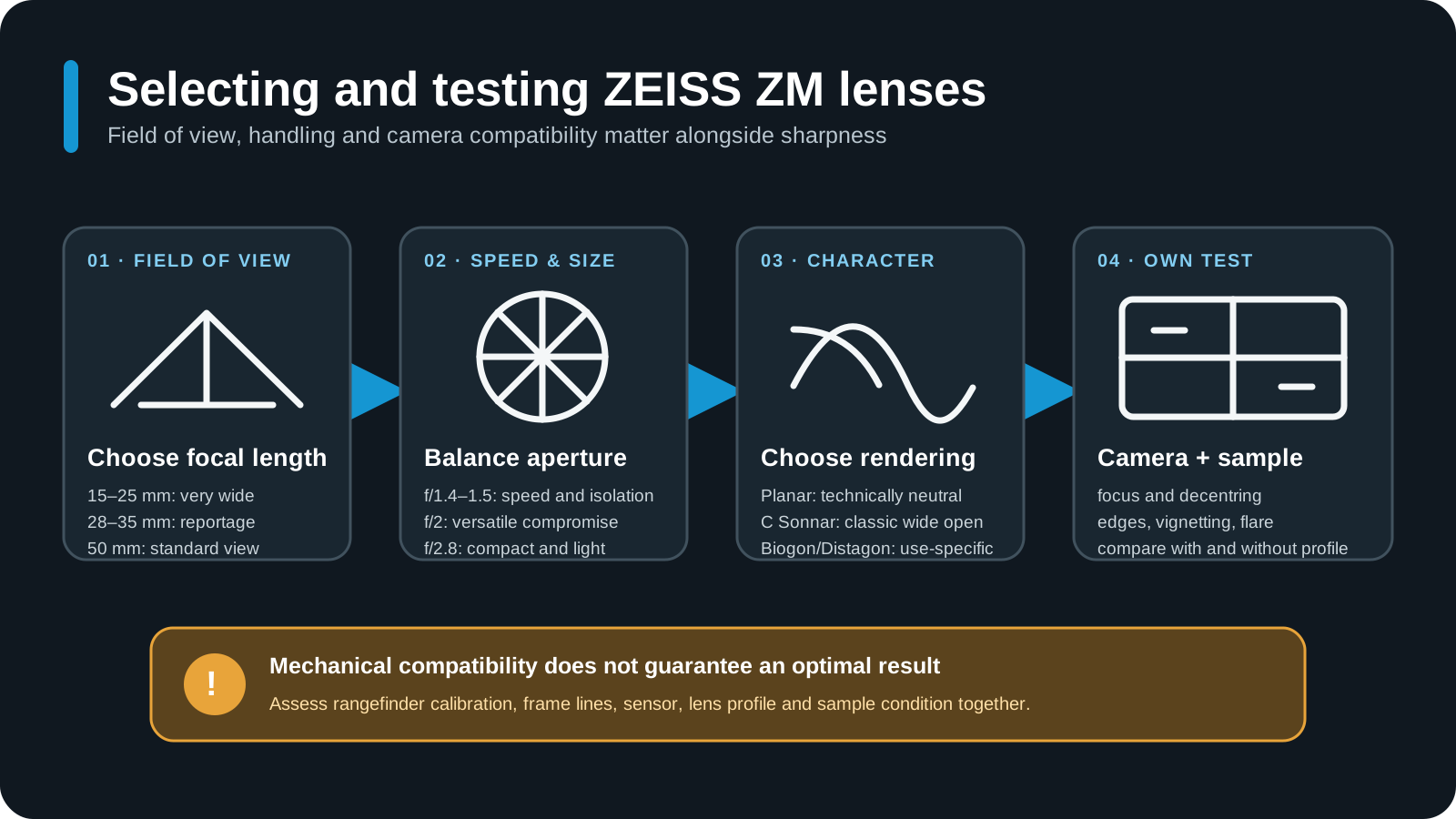
Focal length, speed, rendering character and an individual test together form the buying decision. Original technical infographic by the Photographer Wiki; open it in a new tab for a larger view.
¶ 4. Understanding the ZEISS Lens Names
¶ Biogon
Biogon lenses use symmetrical or near-symmetrical wide-angle designs. Typical design aims include:
- low geometric distortion,
- compact construction,
- high detail resolution,
- suitability for landscape, architecture and reportage.
On digital M cameras, older or very wide designs may show edge colour casts, vignetting or weaker corners depending on the sensor. The specific lens should be tested on the camera with which it will be used.
¶ Distagon
Distagon is the ZEISS name associated with designs that provide greater clearance behind the lens. Within the documented ZM range, the name appears on:
- the extreme 15 mm f/2.8,
- the fast 35 mm f/1.4.
The 35 mm f/1.4 Distagon is noticeably larger and heavier than traditional compact 35 mm M lenses. In return, it offers high speed and a modern level of optical correction.
¶ Planar
The Planar T* 2/50 ZM is a classically derived standard lens with six elements in four groups. It is the more technically neutral 50 mm option in the ZM family:
- high performance from maximum aperture,
- natural perspective,
- 0.70 m minimum focusing distance,
- well suited to reportage, everyday photography, travel and black and white.
¶ Sonnar
The C Sonnar T* 1.5/50 ZM draws on the classic Sonnar character:
- high speed,
- compact dimensions,
- a more pronounced character at maximum aperture,
- gentler transitions than the more technically neutral Planar.
When buying, test the actual focus position of the individual lens at f/1.5, f/2 and f/2.8. The optimum plane of focus may shift slightly as the lens is stopped down. Rangefinder calibration, shooting distance and the photographer’s preferred working aperture all affect the result.
¶ What Does the “C” Mean?
The C in C Biogon and C Sonnar refers to a deliberately compact or classically orientated design. It does not indicate a lower quality grade.
¶ T* Coating
ZEISS uses T* for its multi-layer anti-reflective coating. The coating is intended to reduce reflections and stray light and to preserve contrast and colour under difficult illumination. A coating cannot prevent every flare artefact: the position of the light source, cleanliness of the lens and the use of a suitable hood remain important.
¶ 5. Classification by Focal Length
¶ 15 to 25 mm: Ultra-Wide Angle
These focal lengths suit:
- architecture,
- caves and interiors,
- dramatic landscapes,
- strong foreground-to-background relationships.
The optical Leica M finder has no built-in frame lines for 15, 21 or 25 mm. Depending on camera and working method, photographers need:
- a suitable external finder,
- Live View,
- an electronic Visoflex finder,
- or a deliberately estimated field of view.
¶ 28 mm: Reportage and Travel
The 28 mm f/2.8 Biogon is a balanced travel focal length. It combines:
- a wide but still controllable angle of view,
- compact dimensions,
- a 0.50 m minimum focusing distance,
- an M46 filter size shared by several ZM lenses.
Below approximately 0.70 m, the traditional Leica M rangefinder is no longer coupled on many camera models. Live View or an electronic finder is therefore required to use the shortest focusing distance precisely.
¶ 35 mm: The Broadest Choice
| Model | Strength | Limitation |
|---|---|---|
| Distagon 35 mm f/1.4 | highest speed and modern optical correction | large, heavy and greater viewfinder blockage |
| Biogon 35 mm f/2 | good balance of speed, size and performance | larger than the C Biogon |
| C Biogon 35 mm f/2.8 | small, light and low distortion | one stop slower than the f/2 Biogon |
For street, travel and daylight work, the C Biogon offers the most compact package. The f/2 Biogon is more versatile in lower light. The f/1.4 Distagon is attractive when subject separation and available-light performance matter more than minimum dimensions.
¶ 50 mm: Character or Neutrality
| Model | Visual approach | Practical implications |
|---|---|---|
| C Sonnar 50 mm f/1.5 | classic character, high speed and gentler rendering wide open | test focus at several apertures; 0.90 m minimum focus |
| Planar 50 mm f/2 | more neutral, contrasty and technically orientated | versatile; 0.70 m minimum focus |
¶ 6. Using ZM Lenses on Leica M Cameras
¶ Rangefinder Coupling
ZM lenses are focused mechanically through the camera’s rangefinder. For precise results, three components must agree:
- calibration of the camera rangefinder,
- calibration of the lens cam,
- the photographer’s eyesight and correct dioptre adjustment.
Critical situations include:
- the 35 mm f/1.4 at short distances,
- the 50 mm f/1.5 at maximum aperture,
- high-resolution digital M cameras,
- a consistent lateral or longitudinal focusing error.
¶ Frame Lines
The attached lens activates a frame-line pair through the mount. Frame lines provide only an approximation of the captured field and become less exact at shorter distances.
| Focal length | Finder practice |
|---|---|
| 15–25 mm | external finder, Live View or EVF |
| 28 mm | 28 mm frame lines on a suitable camera |
| 35 mm | 35 mm frame lines |
| 50 mm | 50 mm frame lines |
¶ Six-Bit Coding and Lens Profiles
ZEISS ZM lenses are normally supplied without Leica six-bit coding. A digital Leica M therefore cannot identify the exact lens automatically.
Possible procedure:
- set lens detection to manual,
- select only a genuinely suitable Leica profile,
- compare test images with and without the profile,
- record the chosen setting in a personal lens register.
A Leica profile with a similar focal length is not automatically an optical match. An unsuitable correction may worsen corner brightness or colour gradients.
Profile warning: Never copy a Leica six-bit code or manual Leica profile solely because the focal length appears similar. Only a DNG comparison without a profile and with the selected profile shows whether corner brightness and colour gradients actually improve.
¶ 7. Digital Leica M: Sensor and Edge Behaviour
Wide-angle rangefinder lenses may send light towards the sensor at steep angles. On digital cameras this can produce:
- magenta or cyan edge casts,
- asymmetrical colour shifts,
- increased vignetting,
- blurred corners or field curvature,
- different results from one sensor generation to another.
¶ Recommended Test
- Photograph a uniformly bright sky or neutral wall.
- Record a DNG with automatic profile correction disabled.
- Compare maximum aperture, f/4, f/5.6 and f/8.
- Inspect the left and right sides separately.
- Repeat with a manually selected profile.
- Document only the better, repeatable setting.
This test is particularly important with the 15, 21, 25 and 28 mm ZM lenses and discontinued C Biogon designs.
¶ Colour Cameras and Monochrome Cameras
On a colour sensor, an oblique ray path can produce coloured corners as well as luminance fall-off. On a monochrome sensor, there is no colour information from which a magenta or cyan cast could be formed. Vignetting, corner sharpness, field curvature and flare nevertheless remain visible. “No colour cast” therefore does not mean “no digital edge issue”.
¶ 8. Analogue Leica M
Sensor-specific colour casts do not occur on film. The following points remain relevant:
- the actual finder coverage,
- vignetting at maximum aperture,
- focus position and rangefinder calibration,
- flare and veiling glare,
- filter size and lens hood.
The Planar 50 mm f/2, Biogon 35 mm f/2 and compact C Biogon 35 mm f/2.8 are especially interesting as general-purpose lenses for black-and-white film. The C Sonnar 50 mm f/1.5 lends itself to a deliberately more classical rendering.
When using colour negative or reversal film, select exposure and filtration for the film rather than for a digital profile. Six-bit coding has no effect on an analogue exposure.
¶ 9. ZEISS ZM on the Leica M11 Monochrom
The Leica M11 Monochrom places high demands on focus accuracy and lens performance. Colour edge shifts are not visible on its monochrome sensor; luminance fall-off, edge resolution, stray light and focusing errors remain relevant.
¶ Practical Recommendations
- At f/1.4 or f/1.5, verify focus carefully.
- For static subjects, use magnified Live View or the Visoflex.
- Protect highlights because a clipped monochrome value cannot be reconstructed from another colour channel.
- Use a hood and test flare deliberately.
- Begin with restrained sharpening and clarity settings.
- Use the distance and depth-of-field scales for zone focusing.
The Planar 50 mm f/2 is suited to a technically clear black-and-white rendition. The C Sonnar 50 mm f/1.5 creates a gentler, more character-driven result at maximum aperture. At 35 mm, the choice is largely determined by the balance between speed, size and viewfinder blockage.
¶ 10. Filters and Lens Hoods
| Filter size | ZM lenses |
|---|---|
| M43 | Biogon 35 mm f/2, C Biogon 35 mm f/2.8, Planar 50 mm f/2 |
| M46 | Biogon 21 mm f/2.8, Biogon 25 mm f/2.8, Biogon 28 mm f/2.8, C Sonnar 50 mm f/1.5 |
| M49 | Distagon 35 mm f/1.4 |
| M72 | Distagon 15 mm f/2.8 |
Before buying a hood, verify the exact model, filter thread and possible finder blockage. A large hood may obstruct the optical finder even though it does not intrude into the captured image.
¶ Black-and-White Filters
Yellow, orange, red and green filters alter tonal relationships at the time of exposure on black-and-white film and dedicated monochrome sensors. The filter factor must be considered. TTL metering may compensate approximately, but a controlled test is advisable, especially with dense red filters.
¶ 11. Discontinued ZM Lenses on the Used Market
In addition to the nine currently documented lenses, discontinued ZM lenses can be found:
| Lens | Classification | Particular checks |
|---|---|---|
| C Biogon T* 4.5/21 ZM | very compact and low in distortion | pronounced edge colour casts on some digital M cameras |
| Distagon T* 4/18 ZM | compact ultra-wide lens between 15 and 21 mm | external finder, digital corners, flare and accessories |
| Sonnar T* 2/85 ZM | fast, rare telephoto | focus, weight, finder precision, serviceability and price |
| Tele-Tessar T* 4/85 ZM | compact, light telephoto | limited speed and rangefinder precision |
ZEISS continues to provide historical data sheets for the 18 mm Distagon, 85 mm f/2 Sonnar and 85 mm f/4 Tele-Tessar. This confirms the models but does not imply current production or a promise of spare parts. Used offers must be assessed by exact model name. Family, finish, production version and included accessories may differ.
¶ 12. Used-Buying Checklist
- full model name and focal length confirmed
- native ZM mount rather than another ZEISS mount
- front and rear elements free from scratches, fungus, haze and separation
- focusing ring moves evenly and without play
- aperture ring clicks correctly in one-third stops
- aperture blades are clean, dry and even
- mount and rangefinder cam are undamaged
- focus checked at maximum aperture at short, medium and long distances
- both sides of the image compared for decentring
- vignetting and edge colour checked on the intended digital camera
- hood, caps and filter thread inspected
- return option or personal inspection agreed
¶ Cosmetic Wear Versus Functional Wear
Paint loss on a focusing ring may be purely cosmetic. Rough focusing, play in the barrel, impact marks near the mount or an uneven rangefinder cam are functionally more important. A clean exterior is not proof of correct optical alignment.
¶ 13. Personal ZM Test
| Camera | Lens | Aperture | Distance | Subject | Focus | Centre | Edge | Backlight | Profile | Result |
|---|---|---|---|---|---|---|---|---|---|---|
¶ Useful Test Sequence
- Maximum aperture on a high-contrast detail at short distance.
- Repeat at f/2.8, f/4, f/5.6 and f/8.
- Infinity subject with fine detail in all four corners.
- Light source just outside and inside the image.
- Uniform surface for vignetting and edge colour.
- Exposure with and without a manually selected profile.
- Practical series in the photographer’s preferred genre.
¶ Interpreting the Result
Do not judge only from a single 100 per cent crop. Consider the complete image, intended print size, viewing distance and normal working aperture. A lens with slightly weaker extreme corners may still be the better tool if its handling, size and rendering suit the project.
¶ 14. Which ZEISS ZM Focal Length Is Suitable?
| Requirement | Likely choice | Points to consider |
|---|---|---|
| architecture and wide landscape | Biogon 21 or 25 mm | external finder or Live View; test digital corners |
| travel and street with a wide view | Biogon 28 mm f/2.8 | close-focus range below normal rangefinder limit |
| smallest possible 35 mm | C Biogon 35 mm f/2.8 | lower speed |
| versatile 35 mm | Biogon 35 mm f/2 | balanced compromise |
| available light at 35 mm | Distagon 35 mm f/1.4 | size, weight and finder blockage |
| neutral 50 mm | Planar 50 mm f/2 | less classical rendering at maximum aperture |
| characterful 50 mm | C Sonnar 50 mm f/1.5 | focus position and 0.90 m minimum distance |
| rare compact telephoto | used Tele-Tessar 85 mm f/4 | limited speed and focus accuracy |
¶ Compact Two-Lens Sets
| Priority | Suggested combination | Rationale |
|---|---|---|
| very compact travel set | C Biogon 35 mm f/2.8 + Planar 50 mm f/2 | two small lenses with shared M43 filters |
| wide reportage | Biogon 28 mm f/2.8 + Planar 50 mm f/2 | clear separation between wide and normal views |
| low-light reportage | Distagon 35 mm f/1.4 + C Sonnar 50 mm f/1.5 | maximum speed, but more weight and demanding focus |
| landscape and architecture | Biogon 21 or 25 mm + C Biogon 35 mm f/2.8 | wide coverage with a compact 35 mm complement |
¶ 15. The Nine Documented ZM Lenses in Detail
¶ Distagon T* 2.8/15 ZM
The 15 mm Distagon is a specialist lens for pronounced spatial effects. Its diagonal angle of view is 110 degrees. Even a small deviation from a level camera creates strongly converging verticals in architecture. The short 0.30 m minimum distance expands creative possibilities but lies outside normal Leica M rangefinder coupling.
Suitable for:
- caves, confined interiors and dramatic landscapes,
- architecture with carefully levelled camera position,
- strong foregrounds and deliberately exaggerated depth.
Considerations:
- no matching frame line in the optical M finder,
- large M72 filter thread,
- at 550 g, the heaviest ZM lens documented here,
- digital M cameras require a particularly careful corner test.
¶ Biogon T* 2.8/21 ZM
The 21 mm Biogon is a classic super-wide lens for landscape, architecture and documentary interior photography. Its design aims to control geometric distortion. The 0.50 m minimum distance permits dynamic foregrounds; below the coupled rangefinder limit, focus with Live View or an EVF.
Character: wide field, pronounced depth and high demands on the image edges.
Practice: keep the camera level, compose foreground and edges deliberately and check colour shifts on digital colour cameras.
¶ Biogon T* 2.8/25 ZM
The 25 mm focal length sits between the dramatic 21 mm view and the more familiar 28 mm reportage perspective. It is particularly useful for travel, landscape and architecture when a clear wide-angle effect is wanted without making every scene look extreme.
Strengths: moderate weight, M46 filters, 0.50 m minimum focus and versatile field of view.
Limitation: Leica M bodies do not provide a dedicated 25 mm frame line; an external finder, EVF or Live View improves framing precision.
¶ Biogon T* 2.8/28 ZM
The 28 mm Biogon is a compact reportage lens. It includes distinctly more context than a 35 mm lens while usually appearing more natural than a 21 mm. It therefore works well for travel, street, landscape and environmental portraiture.
Strengths: 230 g, M46 filters and 0.50 m minimum focus.
Limitation: the range between 0.50 m and approximately 0.70 m requires Live View or an EVF for exact focus on many M cameras.
¶ Distagon T* 1.4/35 ZM
The 35 mm Distagon is the fastest and most complex 35 mm option in the ZM line. Its f/1.4 aperture supports low-light work and visibly shallower depth of field. This optical performance comes with greater bulk, a weight of 381 g and more obstruction of the optical finder.
Suitable for: low-light reportage, interiors, environmental portraits and subject separation.
Important: test focus at maximum aperture on the intended camera; hood and barrel may partly cover the 35 mm frame.
¶ Biogon T* 2/35 ZM
The 35 mm f/2 Biogon is the balanced middle option among the three 35 mm ZM lenses. It is one stop faster than the C Biogon f/2.8 but considerably smaller and lighter than the f/1.4 Distagon. For many photographers it is the most versatile ZM for a one-lens kit.
Suitable for: everyday photography, street, travel, reportage and environmental portraiture.
Trade-off: more speed than the C Biogon, less subject separation than the Distagon.
¶ C Biogon T* 2.8/35 ZM
The C Biogon 35 mm f/2.8 prioritises compactness. At 200 g, it is the lightest of the ZM lenses currently documented. For daylight, travel and zone focusing, its lower speed is often no disadvantage.
Suitable for: compact M kits, landscape, daytime street and black-and-white film.
Trade-off: minimum size and weight in exchange for one stop less light than the f/2 Biogon.
¶ C Sonnar T* 1.5/50 ZM
The C Sonnar 50 mm f/1.5 is the character-orientated 50 mm choice. At maximum aperture, smooth transitions and a classical appearance take priority; technical clarity increases when the lens is stopped down. Minimum focus is 0.90 m.
A rangefinder does not focus through the taking lens at the working aperture. Potential focus shift when stopping down therefore matters more than it does with Live View. Test the individual lens at f/1.5, f/2, f/2.8 and f/4 at typical shooting distances.
¶ Planar T* 2/50 ZM
The Planar 50 mm f/2 is the more neutral and predictable 50 mm option. ZEISS states high imaging performance at maximum aperture and identifies minimised focus shift as a design objective of the ZM line. Its 0.70 m minimum distance corresponds to the normal limit of many modern Leica M bodies.
Suitable for: reportage, everyday photography, travel, portraiture, black and white and a technically clear rendering.
Trade-off: less speed and less pronounced character than the C Sonnar, but greater versatility.
¶ 16. Compatibility Matrix
| Camera system | Mechanical use | Focusing | Lens data | Important notes |
|---|---|---|---|---|
| analogue Leica M | direct M mount | coupled rangefinder within its limits | no electronic transmission | consider camera frame lines and metering |
| Leica M9/M240 | direct | rangefinder; Live View from M240 | normally manual lens selection | test wide angles for edge colour and profile effects |
| Leica M10/M10-R | direct | rangefinder; Live View or Visoflex available | no automatic exact ZM identification | high resolution reveals misfocus and decentring clearly |
| Leica M10/M11 Monochrom | direct | rangefinder; Live View or Visoflex available | manual selection when useful | no colour casts, but vignetting and corner sharpness remain |
| Leica M11/M11-D | direct | rangefinder; display on M11, FOTOS or Visoflex support on M11-D | no electronic transmission | high sensor resolution requires accurate calibration |
| Leica SL/SL2/SL3 | M-Adapter L required | EVF with magnification and peaking | none or limited, depending on adapter | no rangefinder coupling; precise maximum-aperture focus is possible |
| other full-frame mirrorless cameras | suitable M adapter required | EVF or display | normally no data | sensor cover glass and corner behaviour may differ significantly |
Important: A lens that fits mechanically does not automatically provide optimum frame lines, correction profile or sensor-edge performance.
¶ 17. Focus, Focus Shift and Rangefinder Calibration
¶ Why a Correct Lens May Still Appear Unsharp
The Leica M rangefinder does not measure focus directly on the image sensor. Camera and lens form a mechanical system. A repeatable focusing error can therefore result from:
- a miscalibrated camera,
- a lens cam outside tolerance,
- focus shift when stopping down,
- insufficient finder magnification for the focal length,
- incorrect dioptre adjustment,
- photographer movement at very shallow depth of field.
¶ Quick Test Procedure
- Place the camera on a stable tripod.
- Select a high-contrast, flat subject at a distance of two to three metres.
- Focus with the rangefinder at maximum aperture.
- Without refocusing, expose at each full aperture.
- Repeat the series using Live View or the EVF as a reference.
- Compare the results at 100 per cent.
If only the rangefinder series is displaced, the coupling or calibration is the likely cause. If the best plane of focus moves as the lens is stopped down, focus shift is more likely. If only one side is weaker, inspect the lens for decentring.
¶ C Sonnar 50 mm f/1.5
This test is especially useful with the C Sonnar. A blanket statement such as “front focus” or “back focus” is insufficient because shooting distance, working aperture, camera calibration and the adjustment of the individual lens interact. What matters is whether the lens focuses repeatably at the photographer’s most frequently used distances and apertures.
¶ 18. Recommended Practical Workflow
¶ One-Time Setup
- Record the lens designation, serial number, filter and hood.
- Determine the appropriate frame line or external finder.
- Test focus at maximum aperture and two typical distances.
- Compare digital wide angles with and without a manual profile.
- Save the preferred camera settings as a user profile if the camera supports this.
¶ While Shooting
- Set aperture and distance directly on the lens.
- With 15 to 25 mm, inspect image edges carefully.
- With 35 mm f/1.4 and 50 mm f/1.5, focus precisely and minimise body movement.
- Use a hood when it does not obstruct the finder excessively.
- For zone focus, consider not only the engraved scale but also output size and the desired impression of sharpness.
¶ After the Exposure
- Evaluate the DNG before applying aggressive lens corrections.
- Correct vignetting only as far as the image requires.
- Inspect corners separately from the centre.
- Record profile, aperture and observations in the personal test table.
¶ 19. Related Wiki Pages
| Topic | Link |
|---|---|
| ZEISS ZM lens tests | Open FW-OBJ-ZEI-02 – German |
| Third-party M-mount lenses | Open FW-OBJ-M-01 – German |
| Lens overview | Open FW-OBJ-01-01 – German |
| Third-party lenses on Leica M | Open FW-OBJ-01-06 – German |
| Leica M lens coding | Open FW-OBJ-LEI-M-01 – German |
| DNG Opcodes and lens corrections | Open FW-WIS-NB-05 – German |
| Rangefinder World lens tests | Open FW-NW-AT-02 – German |
| Leica M | Open FW-KAM-LEI-02 – German |
| Leica M11 Monochrom | Open English page |
| Leica zone focusing | Open FW-WIS-AT-06 – German |
| Photographic filters | Open FW-ZUB-01-03 – German |
¶ 20. Sources and Review Status
¶ Official ZEISS Sources
- ZEISS – ZM lenses and technical data
- ZEISS Photography Store – ZM range and availability
- ZEISS – ZM lens brochure
- ZEISS data sheet – Biogon T* 2.8/28 ZM
- ZEISS data sheet – C Sonnar T* 1.5/50 ZM
- ZEISS historical data sheet – Distagon T* 4/18 ZM
- ZEISS historical data sheet – Sonnar T* 2/85 ZM
- ZEISS historical data sheet – Tele-Tessar T* 4/85 ZM
- ZEISS Lenspire – depth of field and manual focusing
- ZEISS Lenspire – the Distagon, Sonnar and Tessar names
¶ Supplementary Practical Assessments
- Messsucherwelt – M Files 5: Zeiss Ikon and ZM lenses
- Messsucherwelt – Biogon 21 and 28 plus Tele-Tessar 85
- Messsucherwelt – ZEISS ZM C lenses
Technical data, model range and shop status were reviewed on 4 August 2026. Manufacturer information describes construction and intended use; editorial field tests supplement it but do not replace a test on the photographer’s own camera. Official product documentation and actual availability are not identical. Prices have therefore not been treated as permanent product specifications.
¶ 21. Frequently Asked Questions
¶ Do ZEISS ZM Lenses Fit Directly on a Leica M?
Yes. ZM denotes the Leica M mount in this context. Before purchase, nevertheless verify that the specific lens activates the desired frame line and focuses correctly with the intended camera.
¶ Do ZM Lenses Have Autofocus or Electronic Contacts?
No. Focusing and aperture are set mechanically. The lens does not transmit focal length or aperture electronically.
¶ Are ZM Lenses Six-Bit Coded?
Normally not. A manual lens profile can be selected on compatible digital Leica M cameras when useful. A profile that only approximately matches should be evaluated with comparison exposures.
¶ Which 35 mm ZM Is the Most Versatile?
The 35 mm f/2 Biogon is the balanced middle option. The f/2.8 C Biogon is smaller and lighter; the f/1.4 Distagon provides more speed and subject separation but is larger and heavier.
¶ Planar 50 mm f/2 or C Sonnar 50 mm f/1.5?
The Planar is the more technically neutral all-round lens and focuses to 0.70 m. The C Sonnar is faster and produces a more classical result at maximum aperture, but requires greater attention to focus position and its 0.90 m minimum distance.
¶ Do the Wide-Angle Lenses Perform Equally on Every Digital Leica M?
No. Sensor generation, cover glass, microlenses, lens profile and the individual lens affect edge colour, vignetting and corner sharpness. A test on the actual camera is more meaningful than a blanket system judgement.
¶ Can ZM Lenses Be Used on the Leica SL3?
They can be mounted mechanically with a suitable Leica M-to-L adapter. Focusing is through the electronic finder; autofocus and electronic aperture control are not available.
¶ Which ZM Lenses Are Especially Suitable for Black and White?
All of them can be used successfully. The Planar 50 mm f/2 and Biogon lenses are attractive for clear, contrast-rich rendering. The C Sonnar 50 mm f/1.5 suits a deliberately gentler, more classical result at maximum aperture. Light, subject, exposure and processing influence the final appearance more than the brand name alone.
¶ 22. Conclusion
ZEISS ZM is not a series with one uniform “look”, but a family of different optical concepts. The Biogon lenses principally provide compact wide-angle and reportage options, the 35 mm f/1.4 Distagon prioritises speed and complex correction, the 50 mm f/2 Planar offers neutral all-round rendering and the 50 mm f/1.5 C Sonnar provides a deliberately more classical character.
Four questions matter more to a buying decision than a simple sharpness ranking:
- Which field of view suits the photographer’s way of working?
- How important are speed, size and finder blockage?
- Will the lens be used on film, a digital colour M or a Monochrom camera?
- Does the individual lens focus reliably on the intended camera?
Photographers who test these points can find durable, fully mechanical lenses for Leica M and adapted mirrorless cameras in the ZM range. The linked FW-OBJ-ZEI-02 page contains detailed test summaries.
¶ 23. Revision History
| Version | Date | Change |
|---|---|---|
| 2.0 EN | 29 July 2026 | Complete English translation of German version 2.0, including all nine documented ZM lenses, discontinued models, compatibility, focus diagnostics, practical workflow, FAQ and current shop status |
| 2.1 EN | 4 August 2026 | Aligned with German version 2.1; added an amber review traffic light, two original enlargable English infographics, the filterable nine-lens finder, profile and compatibility warnings, complete weights, and refreshed official ZEISS availability checks |