¶ FW-ZUB-GOS-01 – GOSSEN Light Meters: Overview and Correct Use
GOSSEN handheld light meters provide camera-independent incident-light, reflected-light, contrast and—depending on the model—flash measurements. This overview links the currently offered photographic meters with practical workflows for digital Leica cameras, film photography, the Zone System, caves and long exposures.
The page separates the current DIGIPRO F2, SIXTOMAT F2, DIGIFLASH 2 and DIGISIX 2 from the discontinued STARLITE 2. It also explains why an approximately 25° reflected-light angle must not be confused with genuine narrow-angle spot metering.
Important distinction: A GOSSEN photographic light meter measures light or exposure. It does not normally display the distance to the subject in metres. An optical or electronic rangefinder is required for distance measurement.
¶ Document information
| Document information | Definition |
|---|---|
| Document ID | FW-ZUB-GOS-01 |
| Title | GOSSEN Light Meters – Overview and Correct Use |
| Area | Equipment – Accessories – Light meters – GOSSEN |
| Document type | Equipment overview and practical guide |
| Responsible | Wiki owner |
| Version | 2.1 EN |
| Translation basis | German version 2.4 dated 4 August 2026 |
| Last reviewed | 4 August 2026 |
| Document status | Editorially and technically reviewed; product range and functions remain model-dependent |
| Classification | Public |
| Scope | Film and digital photography with GOSSEN handheld light meters |
| Wiki.js path | /Fotografen-Wiki/Ausruestung/Zubehoer/Belichtungsmesser/Gossen/FW-ZUB-GOS-01_Gossen_Uebersicht |
| Source basis | Official GOSSEN product category, downloads, product manuals and calibration guidance |
| Last source check | 4 August 2026 |
| Next review | 4 February 2027 or after a change to the GOSSEN product range |
¶ Review Traffic Light
| Review area | Status | Result |
|---|---|---|
| SEO and page structure | 🟢 Current | Page title, description, tags, one H1 and an unambiguous section structure are present. |
| Current product range | 🟢 Checked | GOSSEN currently lists DIGIPRO F2, SIXTOMAT F2, DIGIFLASH 2 and DIGISIX 2 as photographic exposure meters. |
| STARLITE 2 | 🟠 Historical product | The discontinued spot meter remains relevant because of its 1° and 5° reflected-light readings. |
| Metering methods | 🟢 Checked | Incident, reflected, spot, contrast and flash metering are distinguished; model-dependent functions are identified. |
| Measuring angle | 🟢 Checked | The approximately 25° reflected-light angle of the current meters is explicitly not described as narrow spot metering. |
| Zone System and cave workflow | 🟢 Checked | Zone placement, contrast readings and the influence of bright areas within a large measuring field are explained. |
| Leica and film workflow | 🟢 Checked | Leica R6.2, TRI-X 400 and digital M11/Q3 Monochrom procedures are kept separate. |
| Filter corrections | 🟠 Workflow-dependent | ND and colour-filter factors are starting values and must be verified with the actual filter and workflow. |
| Educational graphics | 🟢 Checked | Two local, valid and enlargeable English SVG graphics include alternative text. |
| Internal links | 🟢 Checked | All ten linked Wiki targets were checked against the signed-in page export. |
| External sources | 🟢 Checked | Official product, download, metering-method and calibration pages were reachable on 4 August 2026. |
| Overall status | 🟠 Published with review note | The page is publishable; product availability, functions and manuals require another check after manufacturer changes. |
Overall status: Amber. The current product range and principal functions are confirmed by GOSSEN. The STARLITE 2 is a discontinued product, while correction factors and the usable exposure range remain dependent on the actual equipment and workflow.
¶ SEO data
| SEO field | Content |
|---|---|
| SEO title | GOSSEN light meters: incident, reflected and spot metering |
| Meta description | Learn to use GOSSEN light meters for incident, reflected, spot, contrast and flash metering, the Zone System, caves, film and digital cameras. |
| Primary keyword | GOSSEN light meter |
| Secondary search terms | incident light metering, reflected light metering, GOSSEN STARLITE 2, Zone System light meter, flash metering |
| Search intent | Understand and apply handheld exposure metering correctly |
| Recommended URL slug | gossen-light-meter-incident-reflected-spot-metering |
¶ 1. Purpose
This page covers:
- incident-light metering with a diffuser dome,
- reflected-light metering,
- contrast and spot metering,
- ambient-light and flash measurement,
- exposure placement using the Zone System,
- cave, landscape and black-and-white photography,
- use with the Leica R6.2, Leica M11 Monochrom and Leica Q3 Monochrom,
- calibration for a camera, film and personal workflow.
The meter provides a reproducible starting point. The final exposure still depends on the intended tonal rendering, the camera or film, filters and the photographer’s creative decision.
¶ 2. Metering methods
| Metering method | What is measured? | Meter position | Typical application |
|---|---|---|---|
| Incident-light metering | Light falling onto the subject | As close to the subject as possible | Portrait, product, studio and evenly lit scenes |
| Reflected-light metering | Light reflected by the subject | At the camera position | Landscape, distant subjects and inaccessible areas |
| Spot metering | Reflected light from a small part of the subject | At the camera position | Zone System, high contrast, caves and backlighting |
| Contrast measurement | Brightness difference between several readings | Depends on method and meter | Assessing subject contrast |
| Flash metering | Light produced by one or more flashes | Usually at the subject plane | Studio, fill flash and mixed light |
Not every GOSSEN model supports every method. Always check the manual for the specific meter.
¶ Incident and reflected light in one diagram
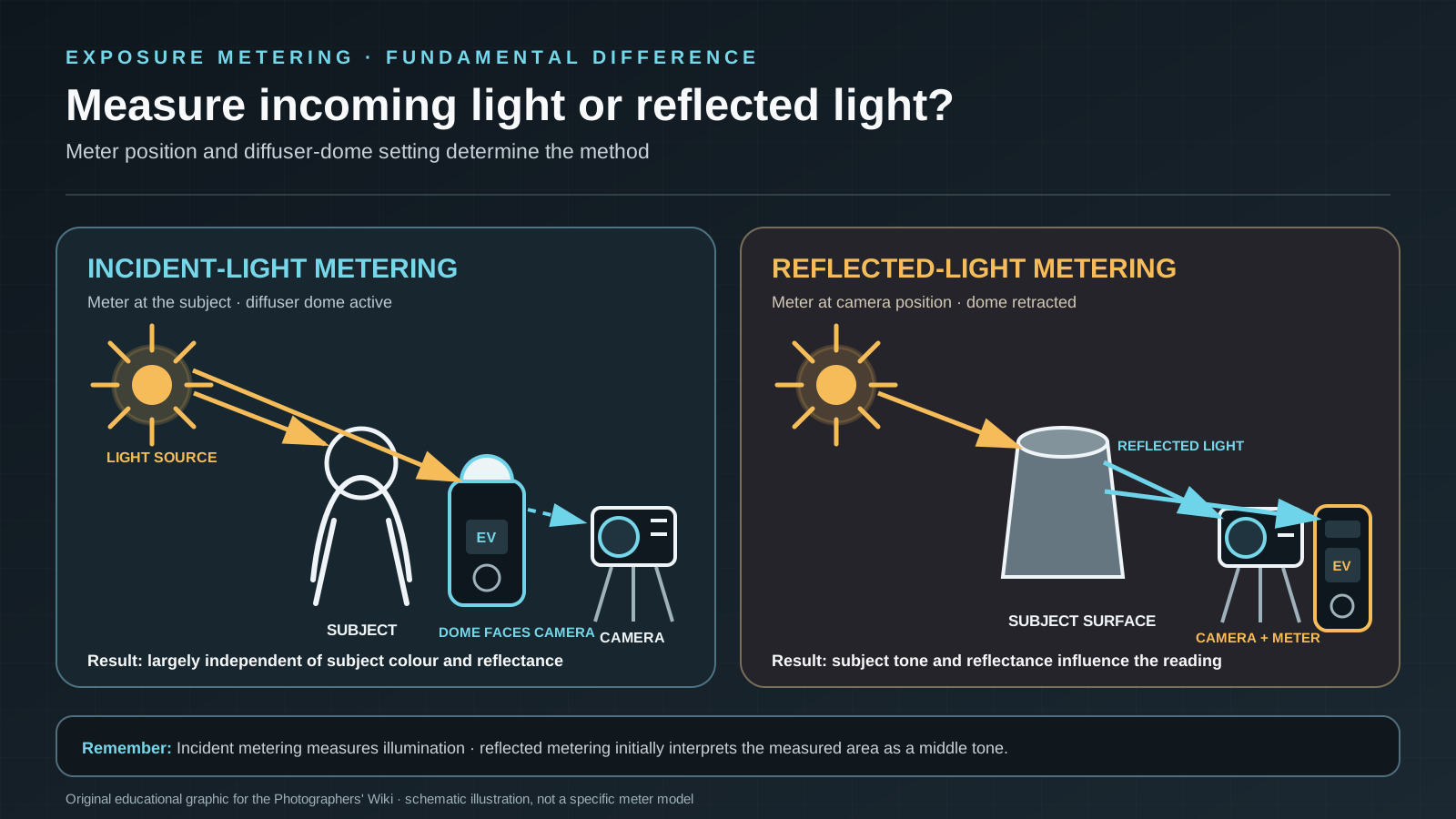
The red arrows show the essential difference:
- With incident-light metering, the light rays fall directly onto the subject and the white diffuser dome.
- With reflected-light metering, the meter reads the light reflected by the subject from the camera position.
Image note: This is an original schematic SVG educational graphic, not a representation of a specific GOSSEN meter. Open it in a new tab for a larger view.
¶ Choosing the appropriate metering method
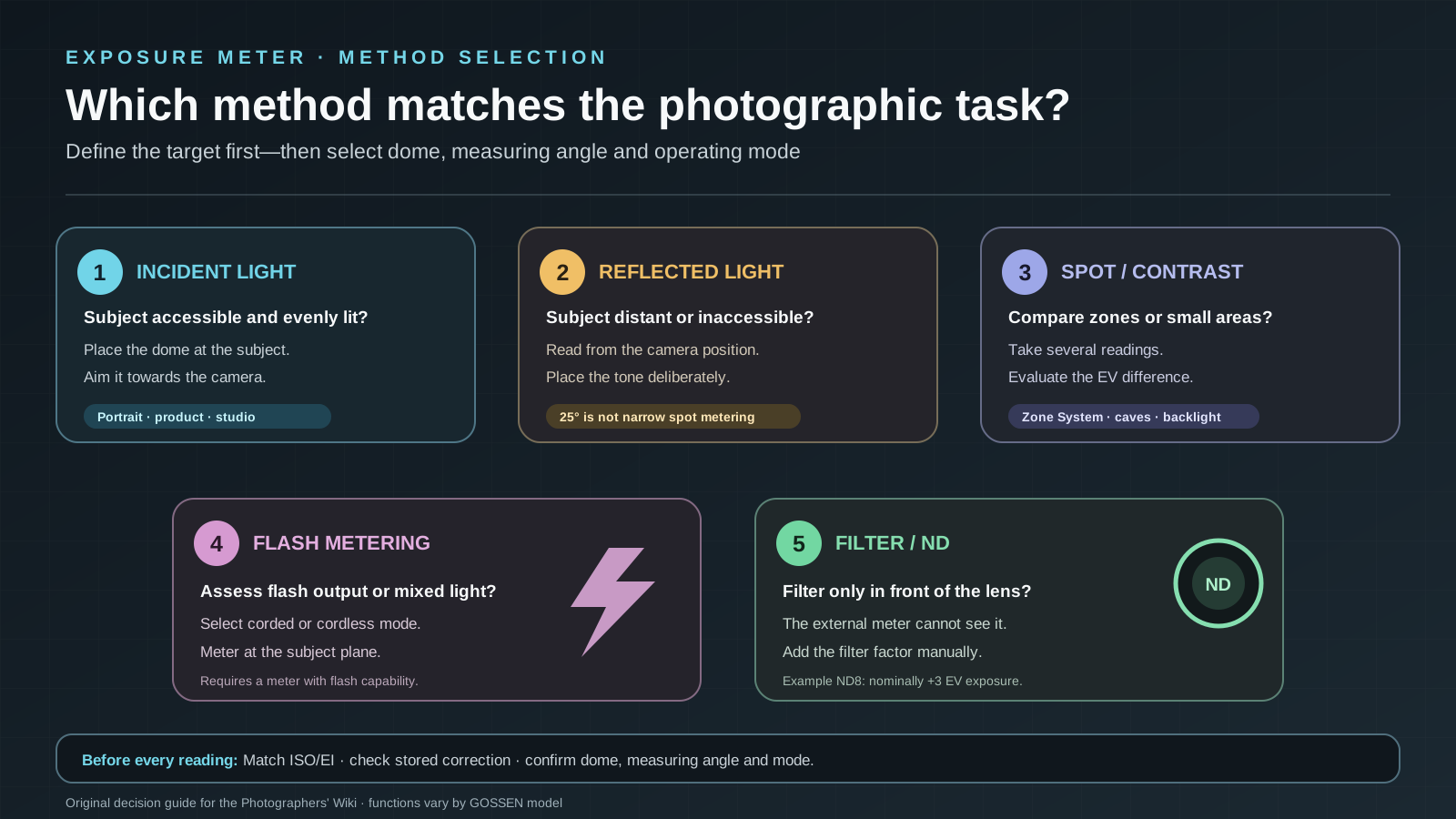
Open the decision graphic directly
The second graphic provides a quick starting point. The actual diffuser position, measuring angle and available operating modes of the specific meter remain decisive.
¶ 3. Model overview
The official GOSSEN exposure-meter category currently lists DIGIPRO F2, SIXTOMAT F2, DIGIFLASH 2 and DIGISIX 2. Functions and availability may change. The STARLITE 2 is shown by GOSSEN among previous photographic devices, but remains particularly relevant because it provides genuine 1° and 5° reflected-light spot metering.
| Model | Incident | Reflected | Flash | Contrast | Distinguishing feature |
|---|---|---|---|---|---|
| DIGIPRO F2 | Yes | Yes, approx. 25° | Yes, corded and cordless | Yes | Swivelling head, ambient-light share, multiple flash and illuminance |
| SIXTOMAT F2 | Yes | Yes, approx. 25° | Yes, corded and cordless | Yes | Extensive ambient and flash operation |
| DIGIFLASH 2 | Yes | Yes, approx. 25° | Yes, cordless | Yes | Very compact, calculator dial and long-exposure timer |
| DIGISIX 2 | Yes | Yes, approx. 25° | No | Yes | Compact ambient-light meter |
| STARLITE 2 | Yes | 1° and 5° | Yes | Yes | Older meter with genuine spot metering |
A reflected-light angle of approximately 25° is not narrow spot metering. It covers a relatively large part of the scene. To isolate a small highlight or shadow, move closer or use a meter with a genuine spot function.
¶ Detailed pages and applications
- GOSSEN STARLITE 2 – operation, spot metering and the Zone System
- Long exposure with ND filters and GOSSEN meters
- Leica M11 and Q3: long exposure with the GOSSEN STARLITE 2
¶ 4. Preparation
Before every measurement:
- Check the battery status.
- Set the same ISO or exposure-index value on the meter and camera.
- Check any stored correction value.
- Disable Auto ISO when the external reading is to be transferred manually.
- Set the camera to manual exposure mode.
- Select the working aperture or shutter speed.
- Select ambient-light or flash measurement correctly.
- Confirm that the diffuser dome and measuring head are positioned for the intended metering method.
¶ Film
For film, the exposure index on the meter must match both the loaded film and the intended development.
Example with Kodak TRI-X 400:
- normal starting point: EI 400,
- use EI 320 only if it matches the laboratory or personal development workflow,
- agree EI 800 or 1600 push processing with the laboratory,
- do not change the exposure index arbitrarily during a roll.
¶ 5. Incident-light metering with the white diffuser dome
Incident-light metering measures the light falling onto the subject. The subject’s colour, brightness and reflectivity have little influence on the reading.
¶ Standard procedure
- Position the spherical white diffuser dome over the sensor.
- Hold the meter at the subject position.
- Point the dome towards the camera.
- Avoid shading the dome with your hand or body.
- Press the measuring button.
- Transfer the displayed aperture-and-shutter-speed combination to the camera.
- Measure again if the light changes.
¶ Direction in directional light
The dome can be aimed differently depending on the desired rendering:
| Direction | Effect |
|---|---|
| Towards the camera | General standard reading for the light visible from the camera position |
| Towards the main light source | Gives greater weight to the key light; shadows may render darker |
| Halfway between camera and main light | A compromise between the two methods |
There is not one universally correct direction for every scene. Choose a method deliberately, make test exposures and remain consistent during later measurements.
¶ When incident-light metering is unsuitable
- The subject cannot be reached.
- The light at the camera differs from the light at the subject.
- Individual tones must be assigned deliberately to a Zone System value.
- The contrast between a cave interior and its entrance must be measured separately.
¶ 6. Reflected-light metering
Reflected-light metering measures the light reflected by the subject. Without correction, the meter treats the measured area approximately as a middle tone.
¶ Procedure
- Retract the diffuser dome or select reflected-light mode.
- Aim at the required part of the subject from the camera position.
- Consider the meter’s measuring angle.
- Shield bright light sources outside the target area.
- Take the reading.
- Apply or correct the reading according to the desired tonal value.
¶ Tonal correction
| Measured area | Uncorrected rendering | Possible starting point |
|---|---|---|
| Middle-grey surface or 18% grey card | Middle tone | 0 EV |
| Light rock, snow or a white surface | Would appear too grey | Approx. +1 to +2 EV |
| Very dark rock or black fabric | Would appear too grey | Approx. −1 to −2 EV |
These values are starting points. Material, intended rendering, film, sensor and contrast range determine the final correction.
¶ Grey-card reading
If incident-light measurement at the subject is impossible:
- Place the grey card in the same light as the subject.
- Measure it from the camera position so that it fills the meter’s measuring field as far as possible.
- Avoid reflections and your own shadow.
- Use the reading without a tonal correction.
¶ 7. Spot metering and the Zone System
Genuine spot metering covers a very small angle, often approximately 1°. Many compact GOSSEN meters instead provide reflected-light metering over approximately 25°.
¶ Zone placement
An uncorrected reflected or spot reading places the measured area approximately on Zone V.
| Intended zone | Correction from meter reading | Typical rendering |
|---|---|---|
| Zone II | −3 EV | Very dark, little texture |
| Zone III | −2 EV | Dark surface with recognisable texture |
| Zone IV | −1 EV | Dark middle tone |
| Zone V | 0 EV | Middle tone |
| Zone VI | +1 EV | Light middle tone |
| Zone VII | +2 EV | Light surface with texture |
| Zone VIII | +3 EV | Very light surface with little texture |
Example: A reading of a dark cave wall gives 1/4 s at f/8. Using that value would render the wall on approximately Zone V. To place it on Zone III, reduce the exposure by two stops, for example to 1/15 s at f/8.
¶ 8. Contrast measurement
Contrast measurement compares the darkest and brightest important areas of the scene.
¶ Procedure
- Measure the darkest important area.
- Measure the brightest important area.
- Read or calculate the difference in EV or stops.
- Compare it with the usable range of the film or sensor.
- Base exposure on the most important tonal value.
- If necessary, adjust the light, composition, filter, exposure bracketing or film development.
A handheld meter cannot automatically know at what point a particular digital camera clips highlights. Determine this limit through test series and RAW evaluation.
¶ 9. Metering inside a cave
A cave often contains extreme contrast between the dark interior and a bright entrance.
¶ Recommended workflow
- Set up the tripod and finalise the composition.
- Match the ISO or film EI on the GOSSEN meter and camera.
- Measure the cave ceiling or rock wall.
- Measure the darkest area that must retain texture.
- Measure the cave entrance or brightest important area.
- Determine the EV difference between shadows and highlights.
- Decide on which zones the areas should be placed.
- Set the exposure and make a test exposure or bracketed series.
¶ Example: ceiling on Zone V, entrance on Zone VI
| Measurement point | Reading at f/8 | Difference | Intended zone |
|---|---|---|---|
| Cave ceiling | 1/4 s | Reference | Zone V |
| Cave entrance | 1/8 s | 1 EV brighter | Zone VI |
In this example, use the ceiling reading directly: 1/4 s at f/8. Because the entrance is one stop brighter, it automatically falls approximately one zone higher.
¶ Caution with 25° reflected-light metering
If the bright entrance is inside the large measuring angle, it affects the reading of the dark wall.
Possible solutions:
- move closer to the wall,
- keep the entrance outside the measuring field,
- use a grey card in the same light as the wall,
- use the camera’s internal spot meter,
- use a genuine 1° spot meter.
¶ 10. Leica R6.2 with Kodak TRI-X 400
Recommended workflow:
- Load TRI-X 400.
- Set the same exposure index on the GOSSEN and Leica R6.2.
- Start at EI 400 for normal development.
- Select incident or reflected metering according to the subject.
- Transfer aperture and shutter speed to the Leica R6.2.
- Bracket difficult scenes.
- Document the exposure index, subject contrast and development.
With black-and-white negative film, sufficient shadow exposure is particularly important. Changes in development primarily affect highlights and overall contrast.
¶ 11. Leica M11 Monochrom and Q3 Monochrom
If highlights clip on a dedicated digital monochrome sensor, they cannot be reconstructed from an unaffected colour channel.
Therefore:
- meter critical bright areas separately,
- calibrate the handheld meter to the personal RAW workflow,
- use the camera’s histogram and highlight warning,
- make an additional darker exposure when uncertain,
- do not apply uncontrolled positive exposure compensation.
The external meter provides a repeatable starting exposure. The actual highlight limit must be tested with the specific camera.
¶ Allowing for colour and ND filters
An external GOSSEN meter does not measure through a filter mounted on the lens. The filter’s light loss is therefore not included in the reading.
| Filter | Procedure with an external meter |
|---|---|
| Yellow, orange, red or green filter | Apply the correction factor for the specific filter and verify it through tests |
| ND filter | Apply the stated number of stops as a correction |
| Polarising filter | Determine the actual light loss by comparison measurement or manufacturer information |
| Unknown or aged filter | Measure the practical correction |
Example: An ND8 nominally reduces the light by three stops. If the GOSSEN reads 1/125 s at f/8 without the filter, the initial filtered setting is 1/15 s at f/8.
Some GOSSEN models can store extension or correction factors. Otherwise, transfer the corrected shutter speed or aperture manually. The camera’s internal TTL meter, by contrast, measures through the mounted filter.
¶ 12. Flash metering
Use this function only on models that support flash measurement.
¶ Cordless measurement
- Select cordless flash mode.
- Set ISO and flash-sync speed.
- Hold the meter with the diffuser dome at the subject position.
- Arm the meter.
- Trigger the flash.
- Transfer the displayed aperture to the camera or adjust the flash output.
¶ Measurement with a sync cable
- Connect the meter and flash with a suitable sync cable.
- Select corded flash mode.
- Trigger the measurement; the meter fires the flash.
- Read and set the aperture.
With mixed light, determine how much ambient light and flash contribute to the total exposure.
¶ 13. Calibrating the meter to the equipment
GOSSEN recommends calibration because cameras, shutter speeds, lens apertures, film, development and RAW processing can differ.
¶ Procedure
- Set identical ISO values on camera and meter.
- Initially reset all correction values to zero.
- Operate the camera manually; disable Auto ISO, HDR and automatic image optimisation.
- Select a constant subject containing highlights, middle tones and shadows.
- Take an incident-light reading with the diffuser dome.
- Transfer the reading to the camera.
- Make a bracketed series around the reading.
- Compare RAW files on a calibrated monitor, or compare processed film.
- Determine the most suitable correction value.
- Store and document the correction in the meter.
The resulting correction initially applies only to the tested combination of camera, lens, film or RAW-processing workflow.
¶ 14. Common mistakes
| Mistake | Consequence | Remedy |
|---|---|---|
| Using the GOSSEN as a distance meter | No usable focusing distance | Use a separate rangefinder or camera focusing system |
| Different ISO on camera and meter | Systematic exposure error | Match ISO or exposure index |
| Incorrect dome position for incident metering | Unsuitable exposure | Check metering method and direction |
| Treating 25° reflected metering as spot metering | Several areas affect the reading | Isolate the field or use a genuine spot meter |
| Measuring a white or black subject without correction | Subject renders as middle grey | Place the tone deliberately |
| Casting your own shadow on the dome | Overexposure | Keep the meter fully in the subject light |
| Cave entrance included in the wall reading | Wall reading is distorted | Exclude the entrance from the measuring field |
| Trusting only the handheld meter for digital capture | Highlights may still clip | Add histogram and RAW tests |
| Overlooking a stored meter correction | Every reading is shifted | Check the correction value before use |
¶ 15. Quick guide
¶ Incident-light metering
Match ISO → activate dome → meter at subject → choose direction → transfer reading
¶ Reflected-light metering
Match ISO → retract dome → aim at area → consider measuring angle → correct tonal placement
¶ Cave
Meter wall → meter shadows → meter entrance → check EV range → assign zones → test exposure
¶ 16. Related Wiki pages
| Topic | Link |
|---|---|
| Photography equipment overview | Open English page |
| Aperture, shutter speed and ISO | Open German page |
| Long exposure with ND filters and GOSSEN | Open English page |
| Leica M11 and Q3 with GOSSEN STARLITE 2 | Open German page |
| Leica Zone Focusing | Open English page |
| Hyperfocal distance | Open German page |
| Cave photography – Projekt Fränkische | Open German page |
| Leica R6.2 | Open German page |
| Analogue film | Open German page |
¶ 17. Sources
| Source | Used for |
|---|---|
| GOSSEN – DIGIPRO F2 | Functions and technical data |
| GOSSEN – current exposure meters | Current photographic product range |
| GOSSEN – photography downloads | Manuals and catalogues for the current meters |
| GOSSEN – previous photographic devices | Classification of the STARLITE 2 as a previous device |
| GOSSEN – incident rather than reflected-light metering | Metering methods |
| GOSSEN – calibrating the light meter | Calibration procedure |
The product range and linked manufacturer pages were checked on 4 August 2026. Always use the manual for the actual meter as the authoritative operating reference.
¶ 18. Change history
| Version | Date | Change |
|---|---|---|
| 1.0 EN | 30 July 2026 | Complete English translation of German version 2.2 created; internal links made locale-specific; English incident-versus-reflected-light diagram generated from the German teaching layout, compressed below 1 MB and transparently identified as an AI-assisted schematic. |
| 2.1 EN | 4 August 2026 | Synchronized with German version 2.4; added a twelve-row vertical review traffic light, verified the current four-model GOSSEN range and STARLITE 2 status, replaced the previous raster graphic with two original enlargeable English SVG educational graphics, and rechecked internal links and official sources. |