¶ Leica Zone Focusing – Depth of Field and Hyperfocal Distance
Language note: This English page is aligned with the reviewed German version 1.9. Open the German page.
¶ Document information
| Document information | Definition |
|---|---|
| Document ID | FW-WIS-AT-06 |
| Title | Leica zone focusing |
| Area | Photographic knowledge – shooting techniques |
| Document type | Practical guide |
| Responsible | Wiki owner |
| Version | 1.1 EN |
| Translation basis | German version 1.9 |
| Last reviewed | 4 August 2026 |
| Document status | Technically reviewed |
| Classification | Public |
| Scope | Leica M, Leica Q and manually focused lenses with a distance scale |
| Wiki.js path | /Fotografen-Wiki/Fotowissen/Aufnahmetechniken/FW-WIS-AT-06_Leica_Zonenfokus |
| Source status | Official Leica product data and instructions plus documented calculations using c = 0.02 mm; aligned on 4 August 2026 |
| Next review | 1 August 2027 or following new Leica Q models, changed technical data or revised calculation assumptions |
¶ Review Traffic Light
| Review area | Status | Result |
|---|---|---|
| SEO and page structure | 🟢 Reviewed | Page settings, one H1, document information and clearly structured practical sections are present |
| Translation alignment | 🟢 Reviewed | Content is aligned with German version 1.9, including corrections and calculation notes |
| Zone-focus terminology | 🟢 Reviewed | Focus distance, depth of field, zone focusing, prefocusing and hyperfocal distance are separated clearly |
| Calculation basis | 🟢 Reviewed | Tables consistently state the conservative full-frame assumption c = 0.02 mm |
| Leica M and Q workflows | 🟢 Reviewed | Manual M-lens scales and Q manual-focus operation are distinguished from the Q autofocus Zone method |
| Illustrations | 🟢 Reviewed | Two independent local SVG teaching diagrams load and open at full size in a new tab |
| Internal links | 🟢 Reviewed | Locale-specific targets were checked against the signed-in Wiki.js export dated 3 August 2026 |
| Important limitations | 🟢 Reviewed | Macro range, infinity focus, negative far limits and high-resolution output are marked explicitly |
| Official references | 🟢 Reviewed | Leica product data and instructions are separated from the page's own calculated practice values |
| Practical responsibility | 🟡 Check in use | Engraved scales and calculated zones remain approximations and must be verified with the actual lens and output size |
Overall status: Green with a practical-use reservation. The method, terminology, calculations, graphics and internal links are reviewed. The photographer must still verify the selected zone with the actual lens, focusing tolerance and intended output size.
¶ 1. Purpose
With zone focusing, the distance and aperture are set before the photograph is taken so that a chosen range appears acceptably sharp. At the decisive moment, there is no need to focus precisely again.
The method is particularly suitable for:
- street and reportage photography,
- predictable areas of movement,
- photographing while moving,
- unobtrusive work,
- situations in which autofocus or rangefinder focusing would be too slow,
- analogue and digital Leica M cameras,
- Leica Q cameras in manual-focus mode.
Important: Zone focusing does not mean that the complete range is technically and perfectly sharp. Sharpness gradually decreases in front of and behind the focused distance.
¶ 2. Distinguishing the terms
| Term | Meaning |
|---|---|
| Focus distance | The distance at which the lens is actually focused |
| Depth of field | The area in front of and behind the focus distance that appears acceptably sharp |
| Zone focusing | A focus distance and aperture selected in advance for a limited working range |
| Hyperfocal distance | The focus distance at which depth of field extends approximately from half the hyperfocal distance to infinity |
| Prefocusing | Focusing on an expected subject position without necessarily using a larger zone of acceptable sharpness |
| AF Zone | An autofocus-area mode on the Leica Q; it is not the same as manual zone focusing |
¶ Hyperfocal distance illustrated
Open the hyperfocal-distance diagram at full size
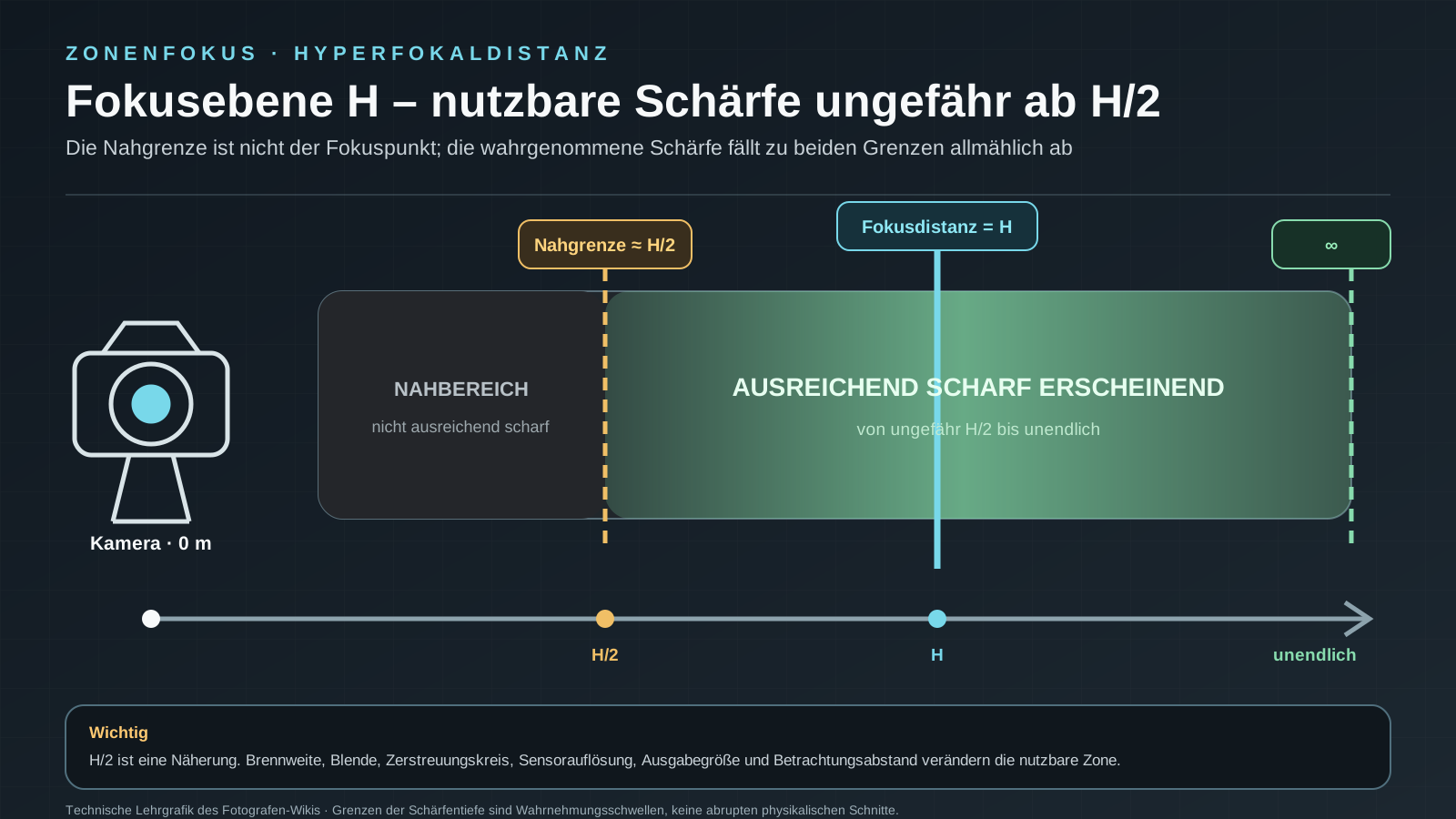
When the lens is focused at the hyperfocal distance H, the acceptably sharp range extends approximately from H/2 to infinity. The actual plane of focus is at H, not at the near limit. “Acceptably sharp” is not an absolute physical boundary: perceived sharpness also depends on focal length, aperture, circle of confusion, sensor resolution, output size and viewing distance.
¶ 3. Why the Leica M is particularly suitable
Open the M-lens scale diagram at full size
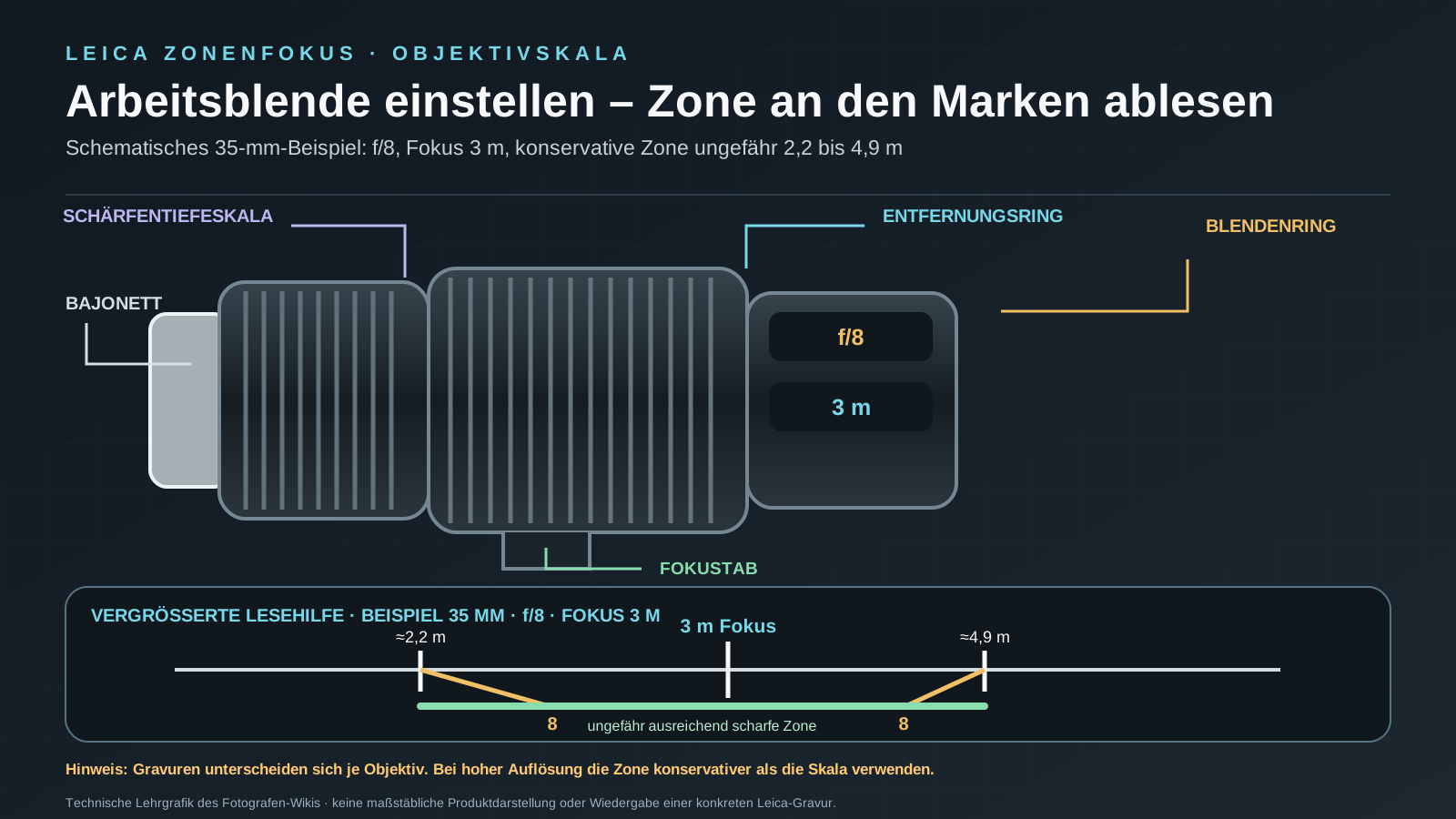
Independent technical teaching diagram rather than a specific lens design. The example shows a conservative zone of approximately 2.2 to 4.9 m at 35 mm, f/8 and a 3 m focus distance.
The illustration is schematic. The position, width, markings and focusing tab differ between Leica M lenses. The underlying principle remains the same:
- The aperture ring sets the working aperture.
- The focusing ring changes the focus distance; a focusing tab, where fitted, makes it easier to set focus by touch and to prefocus.
- The distance scale shows the selected focus distance.
- The paired depth-of-field markings show the approximate range of acceptable sharpness for the selected aperture.
- The mount connects the lens to the camera body.
Many M lenses have:
- a clearly legible distance scale,
- depth-of-field markings on both sides,
- a mechanical focusing ring,
- a directly adjustable aperture.
¶ Reading the depth-of-field scale
- Select the required aperture.
- Set the focus distance with the focusing ring.
- Locate the two markings for the selected aperture on the left and right of the distance index.
- Read the approximate near and far limits between those markings from the distance scale.
- Keep the subject within that zone.
Example: At f/8, the two markings labelled “8” indicate the approximate near and far limits.
¶ Conservative use with high-resolution sensors
The engraved lens scale is a practical approximation. With 60 MP, large prints or 100% viewing, the usable zone may appear smaller.
A conservative approach:
- set the lens to f/8,
- treat only the area between the f/5.6 markings as reliably sharp,
- check a magnified focus sample with critical subjects.
¶ 4. Setting up zone focus on a Leica M
- Choose a focal length: 28 or 35 mm is especially easy; 50 mm requires greater distances or a smaller aperture.
- Define the working zone: for example, people between 2 and 5 m.
- Choose an aperture: often f/8 or f/11 in daylight.
- Set the focus distance: choose it so that the required zone falls between the depth-of-field markings.
- Secure a fast shutter speed: approximately 1/250 s at minimum for walking people, preferably 1/500 s.
- Adjust ISO: use Auto ISO with a sensible upper limit, or set ISO manually.
- Monitor the focusing ring: make sure it is not moved unintentionally.
- Check after the first photograph: inspect sharpness at the actual subject position, not only in the centre of the image.
The rangefinder does not need to be used again for every exposure. It remains useful for confirming the preset distance, focusing more precisely on a static subject and training distance estimation.
¶ 5. Zone focusing on the Leica Q and Q3 Monochrom
The classic 28 mm Leica Q models and the Q3 Monochrom are particularly well suited to this method. The Q3 43, however, uses an actual 43 mm lens; its distance and depth-of-field zone must therefore be recalculated or read from its lens scale. In manual-focus mode, the Q3 Monochrom provides magnification and focus peaking as aids.
¶ Procedure
- Select the normal focusing range rather than the macro range.
- Set the camera to manual focus.
- Set the required distance on the focusing ring.
- Set the aperture to f/8 or f/11.
- Read the distance scale and depth-of-field markings.
- Confirm the setting with viewfinder magnification or focus peaking.
- Leave magnified view and compose the photograph.
- Take care not to move the focusing ring while photographing.
Important: According to Leica's instructions, switching to the macro range changes the distance scales shown on the focusing ring. The street-photography zones given on this page apply to the normal focusing range, not macro work.
¶ Difference from the “Zone” AF method
| Manual zone focusing | “Zone” AF method |
|---|---|
| Distance is preset | The camera focuses automatically within a larger AF area |
| No renewed focusing is needed when the shutter is released | Autofocus may operate again before every photograph |
| Depth of field is planned using aperture and distance | AF-area size does not determine optical depth of field |
| Suitable for predictable distances | Suitable for moving subjects within an area of the frame |
¶ 6. Practical depth-of-field zones
The following figures are rounded approximations for full frame using a conservative circle of confusion of 0.02 mm. Perceived and usable sharpness additionally depends on the lens, focusing accuracy, sensor resolution, output size, viewing distance and subject contrast.
¶ Proven working zones
| Focal length | Aperture | Focused at | Approximately acceptably sharp |
|---|---|---|---|
| 28 mm | f/8 | 2 m | 1.4 to 3.3 m |
| 28 mm | f/8 | 3 m | 1.9 to 7.6 m |
| 28 mm | f/11 | 2 m | 1.3 to 4.4 m |
| 28 mm | f/11 | 3 m | 1.6 to 17.4 m |
| 35 mm | f/8 | 3 m | 2.2 to 4.9 m |
| 35 mm | f/11 | 3 m | 2.0 to 6.4 m |
| 50 mm | f/8 | 5 m | 3.8 to 7.3 m |
| 50 mm | f/11 | 5 m | 3.5 to 8.8 m |
¶ Approximate hyperfocal distances
| Focal length | Aperture | Focus approximately at | Approximate sharp range |
|---|---|---|---|
| 28 mm | f/5.6 | 7.0 m | 3.5 m to infinity |
| 28 mm | f/8 | 4.9 m | 2.5 m to infinity |
| 28 mm | f/11 | 3.6 m | 1.8 m to infinity |
| 35 mm | f/5.6 | 11.0 m | 5.5 m to infinity |
| 35 mm | f/8 | 7.7 m | 3.9 m to infinity |
| 35 mm | f/11 | 5.6 m | 2.8 m to infinity |
| 50 mm | f/5.6 | 22.4 m | 11.2 m to infinity |
| 50 mm | f/8 | 15.7 m | 7.8 m to infinity |
| 50 mm | f/11 | 11.4 m | 5.7 m to infinity |
¶ Addition from an earlier note: Leica Q2
The earlier note contains a Q2 example using 28 mm. Its underlying principle is correct, but the figures depend on the circle of confusion selected:
- At 28 mm and f/8, the conservative calculation used on this wiki page with
c = 0.02 mmgives a hyperfocal distance of approximately 4.9 m and a near limit of approximately 2.5 m. - A figure of approximately 4.5 m may result from a different circle of confusion or from rounding.
- According to the official data sheet, the Leica Q2 offers an aperture range of f/1.7 to f/16. The f/22 setting mentioned in the old note is not available on the Q2.
- If the distance scale displays only
∞beyond 2 m, set the actual focus distance, not the near limit of the depth-of-field zone. - For an unmarked distance between 2 m and infinity, focus on a subject at the required distance and confirm the setting with magnification or focus peaking.
Important: The
∞position does not automatically mean that everything from 2 m is sharp. When focused at infinity, the near depth-of-field limit is approximately the relevant hyperfocal distance, not half of it.
¶ Addition: Leica Tri-Elmar-M 16–18–21 mm f/4 ASPH.
The Tri-Elmar provides three actual focal lengths, a focusing range from 0.5 m to infinity and, according to Leica, a minimum aperture of f/22. A separate depth-of-field zone must therefore be calculated for each focal length.
¶ Hyperfocal distance by focal length and aperture
Calculated with c = 0.02 mm:
| Aperture | 16 mm | 18 mm | 21 mm |
|---|---|---|---|
| f/4 | 3.22 m | 4.07 m | 5.53 m |
| f/5.6 | 2.30 m | 2.91 m | 3.96 m |
| f/8 | 1.62 m | 2.04 m | 2.78 m |
| f/11 | 1.18 m | 1.49 m | 2.03 m |
| f/16 | 0.82 m | 1.03 m | 1.40 m |
| f/22 | 0.60 m | 0.75 m | 1.02 m |
¶ Focused at 2 m and f/8
| Focal length | Focus distance | Approximately acceptably sharp |
|---|---|---|
| 16 mm | 2 m | 0.9 m to infinity |
| 18 mm | 2 m | 1.0 m to approximately 67 m |
| 21 mm | 2 m | 1.2 m to approximately 7.0 m |
The focus value of 7.65 m at 16 mm and f/8 quoted in the earlier note is therefore not plausible. The conservative hyperfocal distance is approximately 1.62 m.
For a cave opening about 40 m away and trees beyond it:
- Check the unit; the old note probably meant 40 m, not 40 mm.
- Define the focal length and required near limit.
- At 16 mm and f/8, focus hyperfocally at approximately 1.6 m.
- For maximum detail at the cave opening, focus directly on the opening and check whether the nearer cave interior remains acceptably sharp.
- If both the foreground and distance are critical, consider several focus variants or focus stacking from a tripod.
¶ Negative far limits in calculations
Calculation note: A negative calculated value for the far depth-of-field limit does not mean that the sharp range begins behind the camera. It arises when the denominator of the formula is zero or negative. In a table, the result must then be shown as infinity.
The near limit must still be calculated from focal length, aperture, focus distance and circle of confusion.
¶ Terms used by the “Depth of Field Estimator” app
| App term | Meaning | Practical explanation |
|---|---|---|
| Sensor Size | Sensor size | Sensor format, such as full frame at 36 × 24 mm; generally influences the default circle of confusion |
| Circle of Confusion | Circle of confusion | Largest blur circle that is still considered acceptably sharp under specified viewing conditions |
| Focal Length | Focal length | Actual focal length of the lens: 28 mm on the Q2, or 16, 18 or 21 mm on the Tri-Elmar |
| Focal Ratio | Aperture value | For example f/8 or f/11; a larger number generally increases depth of field |
| Focus Distance | Focus distance | The distance at which the lens is actually focused |
| Near Limit | Near depth-of-field limit | Nearest point that appears acceptably sharp |
| Far Limit | Far depth-of-field limit | Farthest point that appears acceptably sharp; it may be infinity |
| Depth of Field | Depth of field | Range between the near and far limits |
| Hyperfocal Near Limit | Hyperfocal near limit | Near limit when focused at the hyperfocal distance; approximately half the hyperfocal distance |
| Hyperfocal Distance | Hyperfocal distance | Focus distance at which the far depth-of-field limit reaches infinity |
| Hyperfocal Far Limit | Hyperfocal far limit | Infinity when focused at the hyperfocal distance |
The earlier note sometimes used “hyperlocal”. The correct English term is hyperfocal.
¶ Units for the circle of confusion
- 28.8 µm is equal to 0.0288 mm.
- 0.28 µm is equal to 0.00028 mm, one hundred times smaller.
- The circle of confusion is not the same as the sensor's pixel pitch.
0.0288 mmcorresponds to a more traditional full-frame assumption.0.02 mmis the more conservative practical assumption used on this wiki page for high resolution and larger output.
The app set to 28.8 µm and the conservative tables on this page therefore produce different, but mathematically consistent, results.
¶ Correcting the 7.63 m figure
For a Leica Q2 at 28 mm, f/11 and c = 0.0288 mm:
((28 × 28) / (11 × 0.0288) + 28) / 1000 = approximately 2.50 m
This gives:
- hyperfocal distance: approximately 2.50 m,
- hyperfocal near limit: approximately 1.25 m,
- hyperfocal far limit: infinity.
The 7.63 m stated in the earlier note does not match 28 mm, f/11 and 28.8 µm. At least one setting—aperture, focal length, unit or circle of confusion—was probably different.
¶ App example: 16 mm, f/11 and 28.8 µm
With these inputs, the hyperfocal distance is approximately 0.82 m.
| Focus distance | Approximate near limit | Approximate far limit | Assessment |
|---|---|---|---|
| 0.50 m | 0.31 m | 1.2 m | Limited near zone |
| 0.77 m | 0.40 m | About 9 to 12 m, depending on the formula and rounding | Just below hyperfocal |
| 0.82 m | 0.41 m | Infinity | Hyperfocal setting |
| 2.00 m | 0.58 m | Infinity | Focus is beyond the hyperfocal distance |
| 5.00 m | 0.70 m | Infinity | Valid setting; the near range is sacrificed compared with 0.82 m |
The focus distance may therefore be greater than the hyperfocal distance. The result is not invalid: the far limit remains infinity, while the near limit moves farther from the camera.
¶ Focus Distance in the app
The app can be used in two stages:
- Enter focal length, aperture and circle of confusion; this determines the hyperfocal distance.
- Then set the required Focus Distance:
- to the hyperfocal distance for maximum depth extending to infinity,
- closer for a limited near zone,
- farther away when a particular distant subject has priority.
The hyperfocal distance itself does not depend on the Focus Distance selected. Near Limit, Far Limit and actual Depth of Field do change with it.
¶ Cave opening at a distance of 40 m
For the Q2 at 28 mm, f/11 and 28.8 µm:
- focused at approximately 2.5 m: approximately 1.25 m to infinity appears acceptably sharp,
- focused directly on the cave opening 40 m away: the opening and distance receive priority, but the near depth-of-field limit moves farther away,
- use a tripod in a very dark cave and keep ISO as low as practical,
- consider exposure bracketing because the brightness difference between the cave and outdoors may exceed the camera's dynamic range,
- assess focus and exposure separately: hyperfocal focus does not prevent blown highlights outside.
The earlier suggestion of f/22 does not apply to the Q2 because, according to Leica, its lens stops down only to f/16.
¶ Infrared section of the old note
The section about infrared filters is a separate technical subject and has not been adopted as a zone-focusing recommendation. Exposure time, focus shift, white balance and suitability depend on the camera, its internal IR-cut filter and the IR filter used. A separate, model-specific wiki page should be created for this.
¶ Basis of calculation
The hyperfocal distance was approximated using:
H = f² / (N × c) + f
where:
H= hyperfocal distance,f= focal length,N= aperture value,c= assumed circle of confusion of 0.02 mm.
The values in the tables do not replace a practical check with the actual lens.
¶ 7. Four quick Leica presets
¶ Preset 1 – Close street zone with 28 mm
- Aperture f/11
- Focus at 2 m
- Working zone approximately 1.3 to 4.4 m
- Minimum shutter speed 1/500 s
- Suitable for nearby pedestrians and narrow streets
¶ Preset 2 – Universal street zone with 28 mm
- Aperture f/8
- Focus at 3 m
- Working zone approximately 1.9 to 7.6 m
- Minimum shutter speed 1/500 s
- Suitable for photowalks, reportage and groups
¶ Preset 3 – Classic street zone focusing with 35 mm
- Aperture f/11
- Focus at 3 m
- Working zone approximately 2.0 to 6.4 m
- Minimum shutter speed 1/500 s
- Suitable for people photographed from a slightly greater distance
¶ Preset 4 – Zone focusing with 50 mm
- Aperture f/11
- Focus at 5 m
- Working zone approximately 3.5 to 8.8 m
- Minimum shutter speed 1/500 s
- Suitable for more distant individuals and details
¶ 8. Exposure for zone focusing
The required depth-of-field zone often calls for f/8 or f/11. The ISO setting must therefore allow a sufficiently fast shutter speed.
| Light | Aperture | Minimum shutter speed | Suggested ISO starting point |
|---|---|---|---|
| Sunshine | f/8 to f/11 | 1/500 s | Low ISO or Auto ISO |
| Bright overcast sky | f/8 | 1/500 s | Auto ISO with a moderate upper limit |
| Dark overcast sky | f/5.6 to f/8 | 1/250 to 1/500 s | Raise Auto ISO |
| Rain | f/5.6 to f/8 | 1/250 to 1/500 s | Use a higher Auto ISO limit |
| Twilight | f/4 to f/5.6 | 1/250 s | Accept a smaller zone or raise ISO considerably |
¶ Leica M11 Monochrom
- Auto ISO starts at ISO 125.
- For movement with 28 or 35 mm, use at least 1/250 s, preferably 1/500 s.
- An Auto ISO shutter-speed limit of 1/(4f) can be a conservative starting point.
- Without image stabilisation, a faster shutter speed also provides additional protection against camera shake.
¶ Leica Q3 Monochrom
- Auto ISO starts at ISO 200 in photo mode.
- The fixed 28 mm lens is very well suited to zone focusing.
- Optical stabilisation reduces camera shake but does not freeze subject movement.
- For walking people, 1/500 s remains a safe starting point.
¶ 9. Zone focusing and hyperfocal distance
| Zone focusing | Hyperfocal setting |
|---|---|
| Optimised for a limited subject range | Includes infinity in the depth-of-field zone |
| Ideal for people at defined distances | Ideal for landscape, travel and general views |
| Can control the near and far range more tightly | Often allocates part of the depth of field beyond infinity |
| Focus, for example, at 2 or 3 m | Focus farther away depending on focal length and aperture |
For street photography, a deliberately selected range of approximately 2 to 6 m is often more useful than a hyperfocal setting extending to infinity.
¶ Zone focusing and hyperfocal distance as a workflow
¶ 10. Training distance estimation
- Select an object.
- Estimate its distance.
- Set the lens to that value.
- Check with the rangefinder, Live View or focus peaking.
- Record the deviation.
- Repeat the exercise at 1.5 m, 2 m, 3 m, 5 m and 10 m.
A known stride length, typical pavement widths and fixed shooting zones are helpful. Begin practising with 28 or 35 mm at f/8.
¶ 11. Common mistakes
| Mistake | Consequence | Corrective action |
|---|---|---|
| Opening the aperture without checking the zone again | The sharp range becomes smaller | Read the scale again after every aperture change |
| Moving the focusing ring unintentionally | The complete preset zone shifts | Check the focus index regularly |
| Confusing AF Zone with zone focusing | The camera focuses differently from the plan | Use manual focus for genuine zone focusing |
| Selecting hyperfocal focus instead of the subject zone | An important near area remains unsharp | Prioritise the working range rather than infinity |
| Shutter speed too slow | A correctly focused subject is blurred by movement | Use at least 1/250 or 1/500 s |
| Reading the lens scale too optimistically | Sharpness is insufficient for large output | Read the scale one stop more conservatively |
| Judging a 60 MP file only at 100% | Small deviations appear excessively significant | Consider the final output size |
| Activating the Q's macro range | The normal distance scale no longer applies | Use the normal focusing range for street photography |
| Retaining a focus distance after changing lenses | The zone is no longer correct | Set each focal length independently |
¶ 12. Checklist before a photowalk
- Is manual focus active?
- Is the normal focusing range selected on the Leica Q?
- Have focal length, aperture and focus distance been documented?
- Does the selected zone cover the expected subject distance?
- Is the minimum shutter speed fast enough for movement?
- Is the Auto ISO upper limit sufficient for f/8 or f/11?
- Has the zone been selected conservatively for high resolution?
- Has the focusing ring been checked for accidental movement?
- Has a magnified test exposure been inspected?
- Will the setting be reassessed when the light or distance changes?
¶ 13. Related wiki pages
| Subject | Link |
|---|---|
| Leica M | Open FW-KAM-LEI-02 – German |
| Leica M11 Monochrom | Open FW-KAM-LEI-M11M-01 – English |
| M11 Monochrom settings and comparison with the Q3 Monochrom | Open FW-KAM-LEI-M11M-02 – German |
| Q3 Monochrom settings | Open FW-KAM-LEI-Q3M-01 – German |
| Cave photography: Project Franconia | Open FW-GEN-01-06 – German |
| Voigtländer VM lenses | Open FW-OBJ-VOI-01 – German |
| Sharpness and depth of field | Open FW-WIS-GR-03 – German |
| Aperture, shutter speed and ISO | Open FW-WIS-GR-02 – German |
¶ 14. Official sources
- Leica Camera – M lenses
- Leica Camera – the rangefinder explained
- Leica Q2 – technical specifications
- Leica Tri-Elmar-M 16–18–21 mm f/4 ASPH. – technical specifications
- Leica M11 Monochrom – instructions (German PDF)
- Leica Q3 Monochrom – technical specifications
- Leica Q3 Monochrom – instructions (English PDF)
The specific depth-of-field zones were calculated as conservative practical approximations. They are not Leica manufacturer specifications.
¶ 15. Change history
| Version | Date | Change |
|---|---|---|
| 1.1 EN | 4 August 2026 | Aligned with reviewed German version 1.9; added freshness status, vertical review traffic light, warning blocks, independent SVG diagrams with full-size links, Mermaid workflow and locale-aware link validation |
| 1.0 EN | 30 July 2026 | Complete English translation of German version 1.5; all three documented illustrations included with verified lowercase public paths, English alternative text and transparent AI labelling |
| 1.0 DE | 24 July 2026 | Created the practical guide to Leica zone focusing with M and Q workflows, conservative depth-of-field zones, hyperfocal distances, exposure recommendations, presets, exercises and common errors |
| 1.1 DE | 24 July 2026 | Reviewed an earlier personal note and added corrected information for the Q2, Tri-Elmar 16–18–21, cave opening and far depth-of-field limits |
| 1.2 DE | 24 July 2026 | Reviewed a second earlier note and added app terminology, circle-of-confusion units, corrected 7.63 m calculation, Focus Distance use and the cave-opening example |
| 1.3 DE | 24 July 2026 | Linked the Project Franconia cave-photography article FW-GEN-01-06 |
| 1.4 DE | 24 July 2026 | Added the educational graphic for hyperfocal distance with camera, near limit, focus distance and sharp range to infinity |
| 1.5 DE | 24 July 2026 | Added the educational graphic for the aperture ring, focusing ring, depth-of-field scale, focusing tab and mount of a manual M lens |
¶ FW-WIS-AT-06 – Leica Zone Focusing
¶ Document information
| Document information | Definition |
|---|---|
| Document ID | FW-WIS-AT-06 |
| Title | Leica zone focusing |
| Area | Photographic knowledge – shooting techniques |
| Document type | Practical guide |
| Responsible | Wiki owner |
| Version | 1.0 EN |
| Translation basis | German version 1.5 |
| Last reviewed | 30 July 2026 |
| Document status | Draft |
| Classification | Public |
| Scope | Leica M, Leica Q and manually focused lenses with a distance scale |
| Wiki.js path | /Fotografen-Wiki/Fotowissen/Aufnahmetechniken/FW-WIS-AT-06_Leica_Zonenfokus |
¶ 1. Purpose
With zone focusing, the distance and aperture are set before the photograph is taken so that a chosen range appears acceptably sharp. At the decisive moment, there is no need to focus precisely again.
The method is particularly suitable for:
- street and reportage photography,
- predictable areas of movement,
- photographing while moving,
- unobtrusive work,
- situations in which autofocus or rangefinder focusing would be too slow,
- analogue and digital Leica M cameras,
- Leica Q cameras in manual-focus mode.
Zone focusing does not mean that the complete range is technically and perfectly sharp. Sharpness gradually decreases in front of and behind the focused distance.
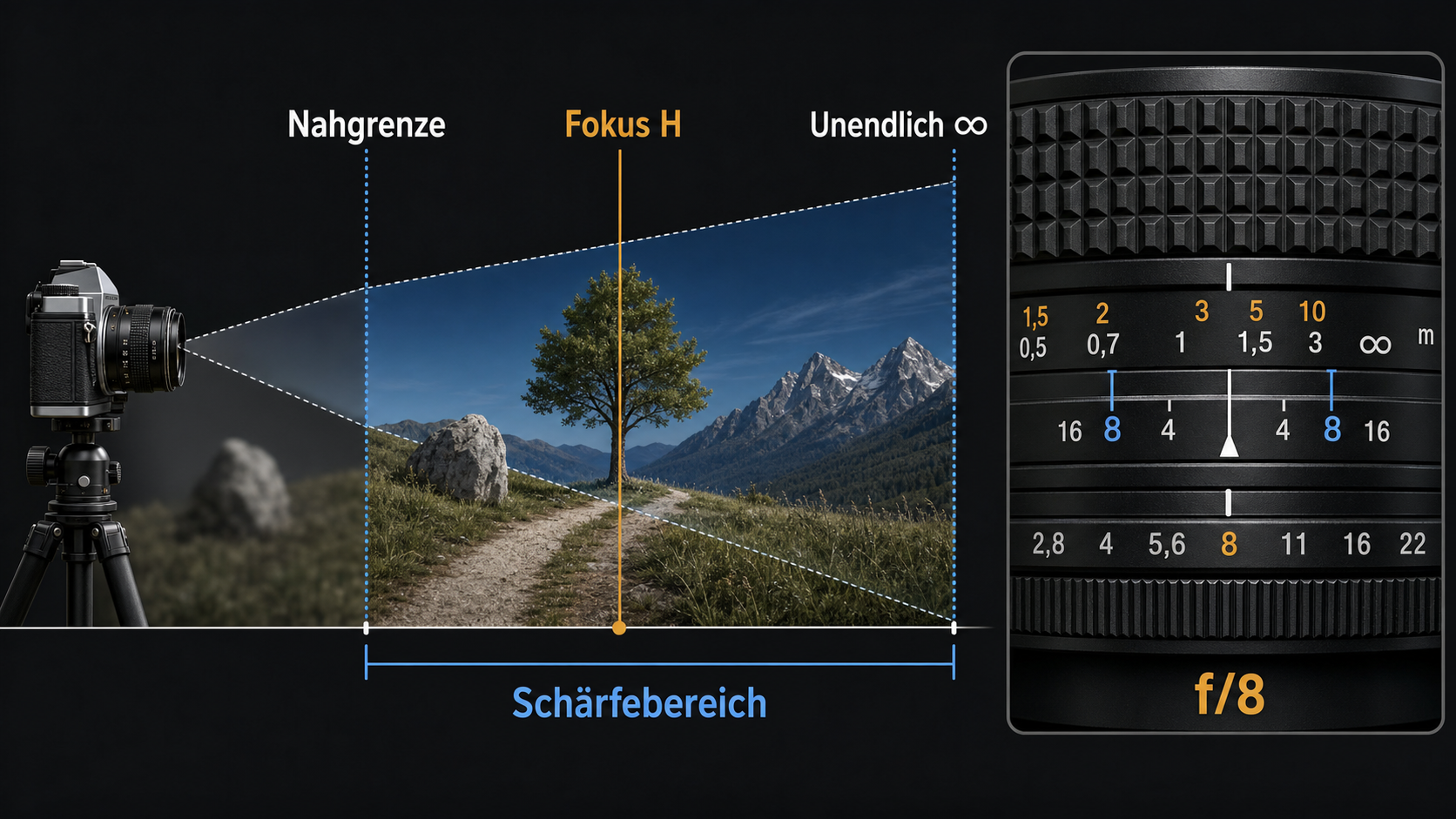
Zone focusing and hyperfocal distance illustrated from the camera to infinity. AI-generated educational illustration used temporarily; it will be replaced with an original photograph or an independently created diagram.
¶ 2. Distinguishing the terms
| Term | Meaning |
|---|---|
| Focus distance | The distance at which the lens is actually focused |
| Depth of field | The area in front of and behind the focus distance that appears acceptably sharp |
| Zone focusing | A focus distance and aperture selected in advance for a limited working range |
| Hyperfocal distance | The focus distance at which depth of field extends approximately from half the hyperfocal distance to infinity |
| Prefocusing | Focusing on an expected subject position without necessarily using a larger zone of acceptable sharpness |
| AF Zone | An autofocus-area mode on the Leica Q; it is not the same as manual zone focusing |
¶ Hyperfocal distance illustrated
Open the hyperfocal-distance illustration directly
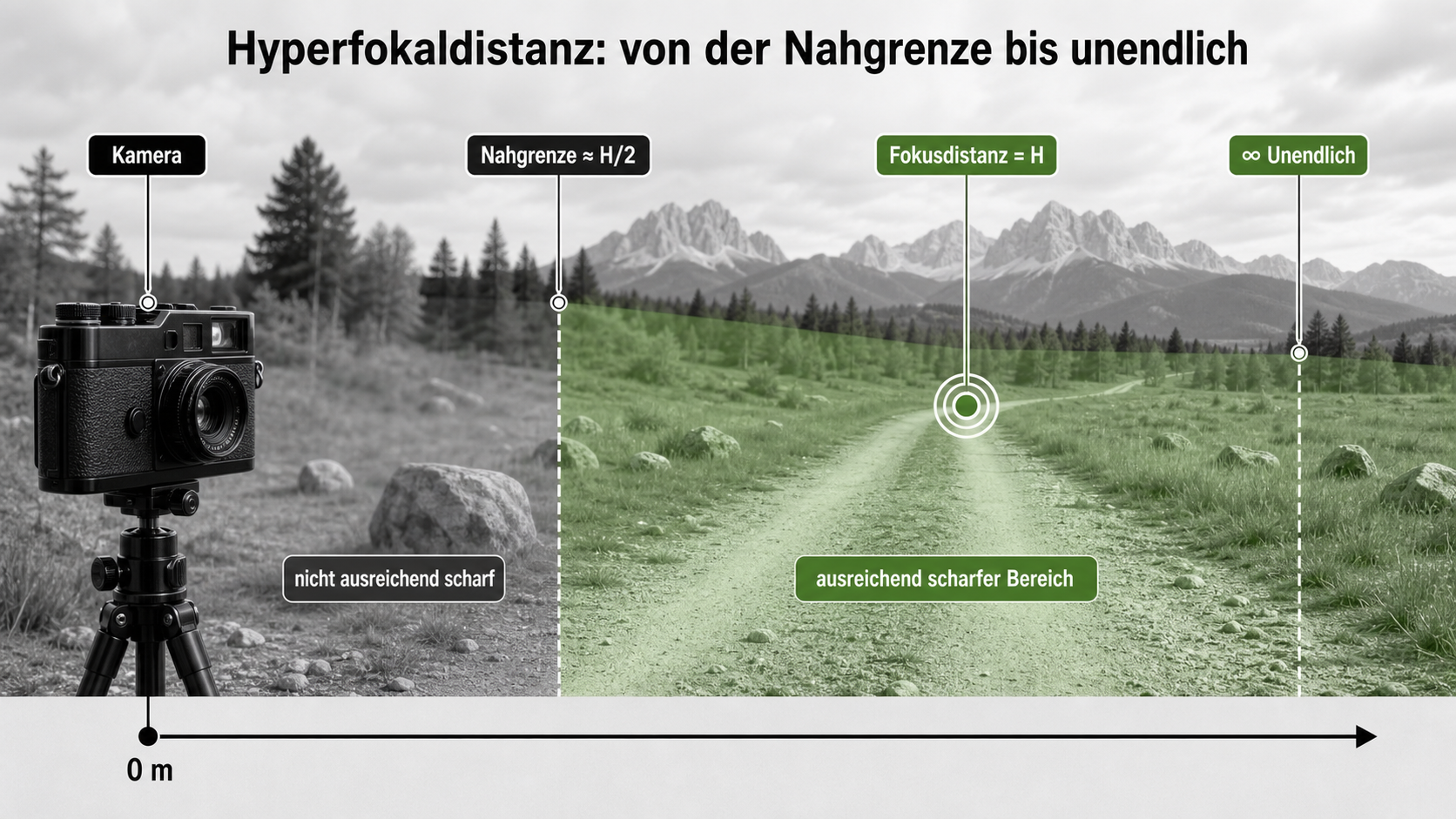
AI-generated educational diagram showing the camera, near limit, focus distance and acceptable sharpness extending to infinity. It is a temporary illustration and will later be replaced with an independently created diagram.
When the lens is focused at the hyperfocal distance H, the acceptably sharp range extends approximately from H/2 to infinity. The actual plane of focus is at H, not at the near limit. “Acceptably sharp” is not an absolute physical boundary: perceived sharpness also depends on focal length, aperture, circle of confusion, sensor resolution, output size and viewing distance.
¶ 3. Why the Leica M is particularly suitable
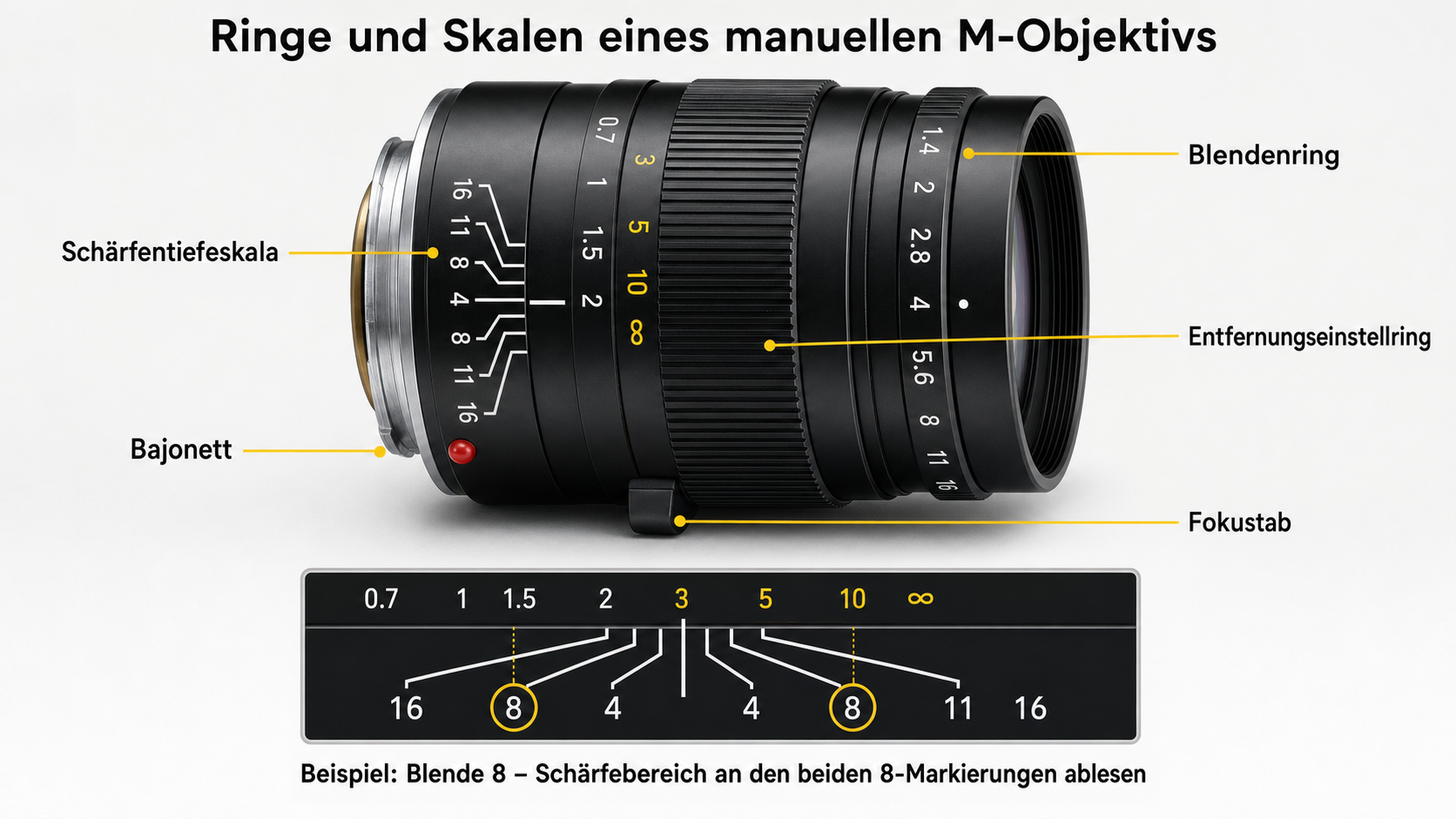
Open the educational diagram of the rings and scales of a manual M lens
Schematic AI-generated educational illustration of a manual M-style lens. The position and design of the controls differ between actual lenses; the illustration will later be replaced with an original photograph or independently created diagram.
The illustration is schematic. The position, width, markings and focusing tab differ between Leica M lenses. The underlying principle remains the same:
- The aperture ring sets the working aperture.
- The focusing ring changes the focus distance; a focusing tab, where fitted, makes it easier to set focus by touch and to prefocus.
- The distance scale shows the selected focus distance.
- The paired depth-of-field markings show the approximate range of acceptable sharpness for the selected aperture.
- The mount connects the lens to the camera body.
Many M lenses have:
- a clearly legible distance scale,
- depth-of-field markings on both sides,
- a mechanical focusing ring,
- a directly adjustable aperture.
¶ Reading the depth-of-field scale
- Select the required aperture.
- Set the focus distance with the focusing ring.
- Locate the two markings for the selected aperture on the left and right of the distance index.
- Read the approximate near and far limits between those markings from the distance scale.
- Keep the subject within that zone.
Example: At f/8, the two markings labelled “8” indicate the approximate near and far limits.
¶ Conservative use with high-resolution sensors
The engraved lens scale is a practical approximation. With 60 MP, large prints or 100% viewing, the usable zone may appear smaller.
A conservative approach:
- set the lens to f/8,
- treat only the area between the f/5.6 markings as reliably sharp,
- check a magnified focus sample with critical subjects.
¶ 4. Setting up zone focus on a Leica M
- Choose a focal length: 28 or 35 mm is especially easy; 50 mm requires greater distances or a smaller aperture.
- Define the working zone: for example, people between 2 and 5 m.
- Choose an aperture: often f/8 or f/11 in daylight.
- Set the focus distance: choose it so that the required zone falls between the depth-of-field markings.
- Secure a fast shutter speed: approximately 1/250 s at minimum for walking people, preferably 1/500 s.
- Adjust ISO: use Auto ISO with a sensible upper limit, or set ISO manually.
- Monitor the focusing ring: make sure it is not moved unintentionally.
- Check after the first photograph: inspect sharpness at the actual subject position, not only in the centre of the image.
The rangefinder does not need to be used again for every exposure. It remains useful for confirming the preset distance, focusing more precisely on a static subject and training distance estimation.
¶ 5. Zone focusing on the Leica Q and Q3 Monochrom
The classic 28 mm Leica Q models and the Q3 Monochrom are particularly well suited to this method. The Q3 43, however, uses an actual 43 mm lens; its distance and depth-of-field zone must therefore be recalculated or read from its lens scale. In manual-focus mode, the Q3 Monochrom provides magnification and focus peaking as aids.
¶ Procedure
- Select the normal focusing range rather than the macro range.
- Set the camera to manual focus.
- Set the required distance on the focusing ring.
- Set the aperture to f/8 or f/11.
- Read the distance scale and depth-of-field markings.
- Confirm the setting with viewfinder magnification or focus peaking.
- Leave magnified view and compose the photograph.
- Take care not to move the focusing ring while photographing.
According to Leica's instructions, switching to the macro range changes the distance scales shown on the focusing ring. The street-photography zones given on this page apply to the normal focusing range, not macro work.
¶ Difference from the “Zone” AF method
| Manual zone focusing | “Zone” AF method |
|---|---|
| Distance is preset | The camera focuses automatically within a larger AF area |
| No renewed focusing is needed when the shutter is released | Autofocus may operate again before every photograph |
| Depth of field is planned using aperture and distance | AF-area size does not determine optical depth of field |
| Suitable for predictable distances | Suitable for moving subjects within an area of the frame |
¶ 6. Practical depth-of-field zones
The following figures are rounded approximations for full frame using a conservative circle of confusion of 0.02 mm. Perceived and usable sharpness additionally depends on the lens, focusing accuracy, sensor resolution, output size, viewing distance and subject contrast.
¶ Proven working zones
| Focal length | Aperture | Focused at | Approximately acceptably sharp |
|---|---|---|---|
| 28 mm | f/8 | 2 m | 1.4 to 3.3 m |
| 28 mm | f/8 | 3 m | 1.9 to 7.6 m |
| 28 mm | f/11 | 2 m | 1.3 to 4.4 m |
| 28 mm | f/11 | 3 m | 1.6 to 17.4 m |
| 35 mm | f/8 | 3 m | 2.2 to 4.9 m |
| 35 mm | f/11 | 3 m | 2.0 to 6.4 m |
| 50 mm | f/8 | 5 m | 3.8 to 7.3 m |
| 50 mm | f/11 | 5 m | 3.5 to 8.8 m |
¶ Approximate hyperfocal distances
| Focal length | Aperture | Focus approximately at | Approximate sharp range |
|---|---|---|---|
| 28 mm | f/5.6 | 7.0 m | 3.5 m to infinity |
| 28 mm | f/8 | 4.9 m | 2.5 m to infinity |
| 28 mm | f/11 | 3.6 m | 1.8 m to infinity |
| 35 mm | f/5.6 | 11.0 m | 5.5 m to infinity |
| 35 mm | f/8 | 7.7 m | 3.9 m to infinity |
| 35 mm | f/11 | 5.6 m | 2.8 m to infinity |
| 50 mm | f/5.6 | 22.4 m | 11.2 m to infinity |
| 50 mm | f/8 | 15.7 m | 7.8 m to infinity |
| 50 mm | f/11 | 11.4 m | 5.7 m to infinity |
¶ Addition from an earlier note: Leica Q2
The earlier note contains a Q2 example using 28 mm. Its underlying principle is correct, but the figures depend on the circle of confusion selected:
- At 28 mm and f/8, the conservative calculation used on this wiki page with
c = 0.02 mmgives a hyperfocal distance of approximately 4.9 m and a near limit of approximately 2.5 m. - A figure of approximately 4.5 m may result from a different circle of confusion or from rounding.
- According to the official data sheet, the Leica Q2 offers an aperture range of f/1.7 to f/16. The f/22 setting mentioned in the old note is not available on the Q2.
- If the distance scale displays only
∞beyond 2 m, set the actual focus distance, not the near limit of the depth-of-field zone. - For an unmarked distance between 2 m and infinity, focus on a subject at the required distance and confirm the setting with magnification or focus peaking.
The ∞ position does not automatically mean that everything from 2 m is sharp. When focused at infinity, the near depth-of-field limit is approximately the relevant hyperfocal distance, not half of it.
¶ Addition: Leica Tri-Elmar-M 16–18–21 mm f/4 ASPH.
The Tri-Elmar provides three actual focal lengths, a focusing range from 0.5 m to infinity and, according to Leica, a minimum aperture of f/22. A separate depth-of-field zone must therefore be calculated for each focal length.
¶ Hyperfocal distance by focal length and aperture
Calculated with c = 0.02 mm:
| Aperture | 16 mm | 18 mm | 21 mm |
|---|---|---|---|
| f/4 | 3.22 m | 4.07 m | 5.53 m |
| f/5.6 | 2.30 m | 2.91 m | 3.96 m |
| f/8 | 1.62 m | 2.04 m | 2.78 m |
| f/11 | 1.18 m | 1.49 m | 2.03 m |
| f/16 | 0.82 m | 1.03 m | 1.40 m |
| f/22 | 0.60 m | 0.75 m | 1.02 m |
¶ Focused at 2 m and f/8
| Focal length | Focus distance | Approximately acceptably sharp |
|---|---|---|
| 16 mm | 2 m | 0.9 m to infinity |
| 18 mm | 2 m | 1.0 m to approximately 67 m |
| 21 mm | 2 m | 1.2 m to approximately 7.0 m |
The focus value of 7.65 m at 16 mm and f/8 quoted in the earlier note is therefore not plausible. The conservative hyperfocal distance is approximately 1.62 m.
For a cave opening about 40 m away and trees beyond it:
- Check the unit; the old note probably meant 40 m, not 40 mm.
- Define the focal length and required near limit.
- At 16 mm and f/8, focus hyperfocally at approximately 1.6 m.
- For maximum detail at the cave opening, focus directly on the opening and check whether the nearer cave interior remains acceptably sharp.
- If both the foreground and distance are critical, consider several focus variants or focus stacking from a tripod.
¶ Negative far limits in calculations
A negative calculated value for the far depth-of-field limit does not mean that the sharp range begins behind the camera. It arises when the denominator of the formula is zero or negative. In a table, the result must then be shown as infinity.
The near limit must still be calculated from focal length, aperture, focus distance and circle of confusion.
¶ Terms used by the “Depth of Field Estimator” app
| App term | Meaning | Practical explanation |
|---|---|---|
| Sensor Size | Sensor size | Sensor format, such as full frame at 36 × 24 mm; generally influences the default circle of confusion |
| Circle of Confusion | Circle of confusion | Largest blur circle that is still considered acceptably sharp under specified viewing conditions |
| Focal Length | Focal length | Actual focal length of the lens: 28 mm on the Q2, or 16, 18 or 21 mm on the Tri-Elmar |
| Focal Ratio | Aperture value | For example f/8 or f/11; a larger number generally increases depth of field |
| Focus Distance | Focus distance | The distance at which the lens is actually focused |
| Near Limit | Near depth-of-field limit | Nearest point that appears acceptably sharp |
| Far Limit | Far depth-of-field limit | Farthest point that appears acceptably sharp; it may be infinity |
| Depth of Field | Depth of field | Range between the near and far limits |
| Hyperfocal Near Limit | Hyperfocal near limit | Near limit when focused at the hyperfocal distance; approximately half the hyperfocal distance |
| Hyperfocal Distance | Hyperfocal distance | Focus distance at which the far depth-of-field limit reaches infinity |
| Hyperfocal Far Limit | Hyperfocal far limit | Infinity when focused at the hyperfocal distance |
The earlier note sometimes used “hyperlocal”. The correct English term is hyperfocal.
¶ Units for the circle of confusion
- 28.8 µm is equal to 0.0288 mm.
- 0.28 µm is equal to 0.00028 mm, one hundred times smaller.
- The circle of confusion is not the same as the sensor's pixel pitch.
0.0288 mmcorresponds to a more traditional full-frame assumption.0.02 mmis the more conservative practical assumption used on this wiki page for high resolution and larger output.
The app set to 28.8 µm and the conservative tables on this page therefore produce different, but mathematically consistent, results.
¶ Correcting the 7.63 m figure
For a Leica Q2 at 28 mm, f/11 and c = 0.0288 mm:
((28 × 28) / (11 × 0.0288) + 28) / 1000 = approximately 2.50 m
This gives:
- hyperfocal distance: approximately 2.50 m,
- hyperfocal near limit: approximately 1.25 m,
- hyperfocal far limit: infinity.
The 7.63 m stated in the earlier note does not match 28 mm, f/11 and 28.8 µm. At least one setting—aperture, focal length, unit or circle of confusion—was probably different.
¶ App example: 16 mm, f/11 and 28.8 µm
With these inputs, the hyperfocal distance is approximately 0.82 m.
| Focus distance | Approximate near limit | Approximate far limit | Assessment |
|---|---|---|---|
| 0.50 m | 0.31 m | 1.2 m | Limited near zone |
| 0.77 m | 0.40 m | About 9 to 12 m, depending on the formula and rounding | Just below hyperfocal |
| 0.82 m | 0.41 m | Infinity | Hyperfocal setting |
| 2.00 m | 0.58 m | Infinity | Focus is beyond the hyperfocal distance |
| 5.00 m | 0.70 m | Infinity | Valid setting; the near range is sacrificed compared with 0.82 m |
The focus distance may therefore be greater than the hyperfocal distance. The result is not invalid: the far limit remains infinity, while the near limit moves farther from the camera.
¶ Focus Distance in the app
The app can be used in two stages:
- Enter focal length, aperture and circle of confusion; this determines the hyperfocal distance.
- Then set the required Focus Distance:
- to the hyperfocal distance for maximum depth extending to infinity,
- closer for a limited near zone,
- farther away when a particular distant subject has priority.
The hyperfocal distance itself does not depend on the Focus Distance selected. Near Limit, Far Limit and actual Depth of Field do change with it.
¶ Cave opening at a distance of 40 m
For the Q2 at 28 mm, f/11 and 28.8 µm:
- focused at approximately 2.5 m: approximately 1.25 m to infinity appears acceptably sharp,
- focused directly on the cave opening 40 m away: the opening and distance receive priority, but the near depth-of-field limit moves farther away,
- use a tripod in a very dark cave and keep ISO as low as practical,
- consider exposure bracketing because the brightness difference between the cave and outdoors may exceed the camera's dynamic range,
- assess focus and exposure separately: hyperfocal focus does not prevent blown highlights outside.
The earlier suggestion of f/22 does not apply to the Q2 because, according to Leica, its lens stops down only to f/16.
¶ Infrared section of the old note
The section about infrared filters is a separate technical subject and has not been adopted as a zone-focusing recommendation. Exposure time, focus shift, white balance and suitability depend on the camera, its internal IR-cut filter and the IR filter used. A separate, model-specific wiki page should be created for this.
¶ Basis of calculation
The hyperfocal distance was approximated using:
H = f² / (N × c) + f
where:
H= hyperfocal distance,f= focal length,N= aperture value,c= assumed circle of confusion of 0.02 mm.
The values in the tables do not replace a practical check with the actual lens.
¶ 7. Four quick Leica presets
¶ Preset 1 – Close street zone with 28 mm
- Aperture f/11
- Focus at 2 m
- Working zone approximately 1.3 to 4.4 m
- Minimum shutter speed 1/500 s
- Suitable for nearby pedestrians and narrow streets
¶ Preset 2 – Universal street zone with 28 mm
- Aperture f/8
- Focus at 3 m
- Working zone approximately 1.9 to 7.6 m
- Minimum shutter speed 1/500 s
- Suitable for photowalks, reportage and groups
¶ Preset 3 – Classic street zone focusing with 35 mm
- Aperture f/11
- Focus at 3 m
- Working zone approximately 2.0 to 6.4 m
- Minimum shutter speed 1/500 s
- Suitable for people photographed from a slightly greater distance
¶ Preset 4 – Zone focusing with 50 mm
- Aperture f/11
- Focus at 5 m
- Working zone approximately 3.5 to 8.8 m
- Minimum shutter speed 1/500 s
- Suitable for more distant individuals and details
¶ 8. Exposure for zone focusing
The required depth-of-field zone often calls for f/8 or f/11. The ISO setting must therefore allow a sufficiently fast shutter speed.
| Light | Aperture | Minimum shutter speed | Suggested ISO starting point |
|---|---|---|---|
| Sunshine | f/8 to f/11 | 1/500 s | Low ISO or Auto ISO |
| Bright overcast sky | f/8 | 1/500 s | Auto ISO with a moderate upper limit |
| Dark overcast sky | f/5.6 to f/8 | 1/250 to 1/500 s | Raise Auto ISO |
| Rain | f/5.6 to f/8 | 1/250 to 1/500 s | Use a higher Auto ISO limit |
| Twilight | f/4 to f/5.6 | 1/250 s | Accept a smaller zone or raise ISO considerably |
¶ Leica M11 Monochrom
- Auto ISO starts at ISO 125.
- For movement with 28 or 35 mm, use at least 1/250 s, preferably 1/500 s.
- An Auto ISO shutter-speed limit of 1/(4f) can be a conservative starting point.
- Without image stabilisation, a faster shutter speed also provides additional protection against camera shake.
¶ Leica Q3 Monochrom
- Auto ISO starts at ISO 200 in photo mode.
- The fixed 28 mm lens is very well suited to zone focusing.
- Optical stabilisation reduces camera shake but does not freeze subject movement.
- For walking people, 1/500 s remains a safe starting point.
¶ 9. Zone focusing and hyperfocal distance
| Zone focusing | Hyperfocal setting |
|---|---|
| Optimised for a limited subject range | Includes infinity in the depth-of-field zone |
| Ideal for people at defined distances | Ideal for landscape, travel and general views |
| Can control the near and far range more tightly | Often allocates part of the depth of field beyond infinity |
| Focus, for example, at 2 or 3 m | Focus farther away depending on focal length and aperture |
For street photography, a deliberately selected range of approximately 2 to 6 m is often more useful than a hyperfocal setting extending to infinity.
¶ 10. Training distance estimation
- Select an object.
- Estimate its distance.
- Set the lens to that value.
- Check with the rangefinder, Live View or focus peaking.
- Record the deviation.
- Repeat the exercise at 1.5 m, 2 m, 3 m, 5 m and 10 m.
A known stride length, typical pavement widths and fixed shooting zones are helpful. Begin practising with 28 or 35 mm at f/8.
¶ 11. Common mistakes
| Mistake | Consequence | Corrective action |
|---|---|---|
| Opening the aperture without checking the zone again | The sharp range becomes smaller | Read the scale again after every aperture change |
| Moving the focusing ring unintentionally | The complete preset zone shifts | Check the focus index regularly |
| Confusing AF Zone with zone focusing | The camera focuses differently from the plan | Use manual focus for genuine zone focusing |
| Selecting hyperfocal focus instead of the subject zone | An important near area remains unsharp | Prioritise the working range rather than infinity |
| Shutter speed too slow | A correctly focused subject is blurred by movement | Use at least 1/250 or 1/500 s |
| Reading the lens scale too optimistically | Sharpness is insufficient for large output | Read the scale one stop more conservatively |
| Judging a 60 MP file only at 100% | Small deviations appear excessively significant | Consider the final output size |
| Activating the Q's macro range | The normal distance scale no longer applies | Use the normal focusing range for street photography |
| Retaining a focus distance after changing lenses | The zone is no longer correct | Set each focal length independently |
¶ 12. Checklist before a photowalk
- Is manual focus active?
- Is the normal focusing range selected on the Leica Q?
- Have focal length, aperture and focus distance been documented?
- Does the selected zone cover the expected subject distance?
- Is the minimum shutter speed fast enough for movement?
- Is the Auto ISO upper limit sufficient for f/8 or f/11?
- Has the zone been selected conservatively for high resolution?
- Has the focusing ring been checked for accidental movement?
- Has a magnified test exposure been inspected?
- Will the setting be reassessed when the light or distance changes?
¶ 13. Related wiki pages
| Subject | Link |
|---|---|
| Leica M | Open FW-KAM-LEI-02 – German |
| Leica M11 Monochrom | Open FW-KAM-LEI-M11M-01 – English |
| M11 Monochrom settings and comparison with the Q3 Monochrom | Open FW-KAM-LEI-M11M-02 – German |
| Q3 Monochrom settings | Open FW-KAM-LEI-Q3M-01 – German |
| Cave photography: Project Franconia | Open FW-GEN-01-06 – German |
| Voigtländer VM lenses | Open FW-OBJ-VOI-01 – German |
| Sharpness and depth of field | Open FW-WIS-GR-03 – German |
| Aperture, shutter speed and ISO | Open FW-WIS-GR-02 – German |
¶ 14. Official sources
- Leica Camera – M lenses
- Leica Camera – the rangefinder explained
- Leica Q2 – technical specifications
- Leica Tri-Elmar-M 16–18–21 mm f/4 ASPH. – technical specifications
- Leica M11 Monochrom – instructions (German PDF)
- Leica Q3 Monochrom – technical specifications
- Leica Q3 Monochrom – instructions (English PDF)
The specific depth-of-field zones were calculated as conservative practical approximations. They are not Leica manufacturer specifications.
¶ 15. Change history
| Version | Date | Change |
|---|---|---|
| 1.0 EN | 30 July 2026 | Complete English translation of German version 1.5; all three documented illustrations included with verified lowercase public paths, English alternative text and transparent AI labelling |
| 1.0 DE | 24 July 2026 | Created the practical guide to Leica zone focusing with M and Q workflows, conservative depth-of-field zones, hyperfocal distances, exposure recommendations, presets, exercises and common errors |
| 1.1 DE | 24 July 2026 | Reviewed an earlier personal note and added corrected information for the Q2, Tri-Elmar 16–18–21, cave opening and far depth-of-field limits |
| 1.2 DE | 24 July 2026 | Reviewed a second earlier note and added app terminology, circle-of-confusion units, corrected 7.63 m calculation, Focus Distance use and the cave-opening example |
| 1.3 DE | 24 July 2026 | Linked the Project Franconia cave-photography article FW-GEN-01-06 |
| 1.4 DE | 24 July 2026 | Added the educational graphic for hyperfocal distance with camera, near limit, focus distance and sharp range to infinity |
| 1.5 DE | 24 July 2026 | Added the educational graphic for the aperture ring, focusing ring, depth-of-field scale, focusing tab and mount of a manual M lens |