¶ Street Photography – Camera Settings, Composition and Photographic Law
Street photography observes everyday life in public spaces. Light, movement, gestures, architecture, chance and the right moment combine to produce photographs that reveal more than a simple street scene. Good street photography is not about secretly collecting arbitrary passers-by; it grows from attention, clear composition and respect for people.
This page explains a complete street workflow: recognising subjects, choosing position and focal length, preparing exposure, working with autofocus or zone focusing, developing a photographic series and selecting images in a legally and ethically responsible manner.
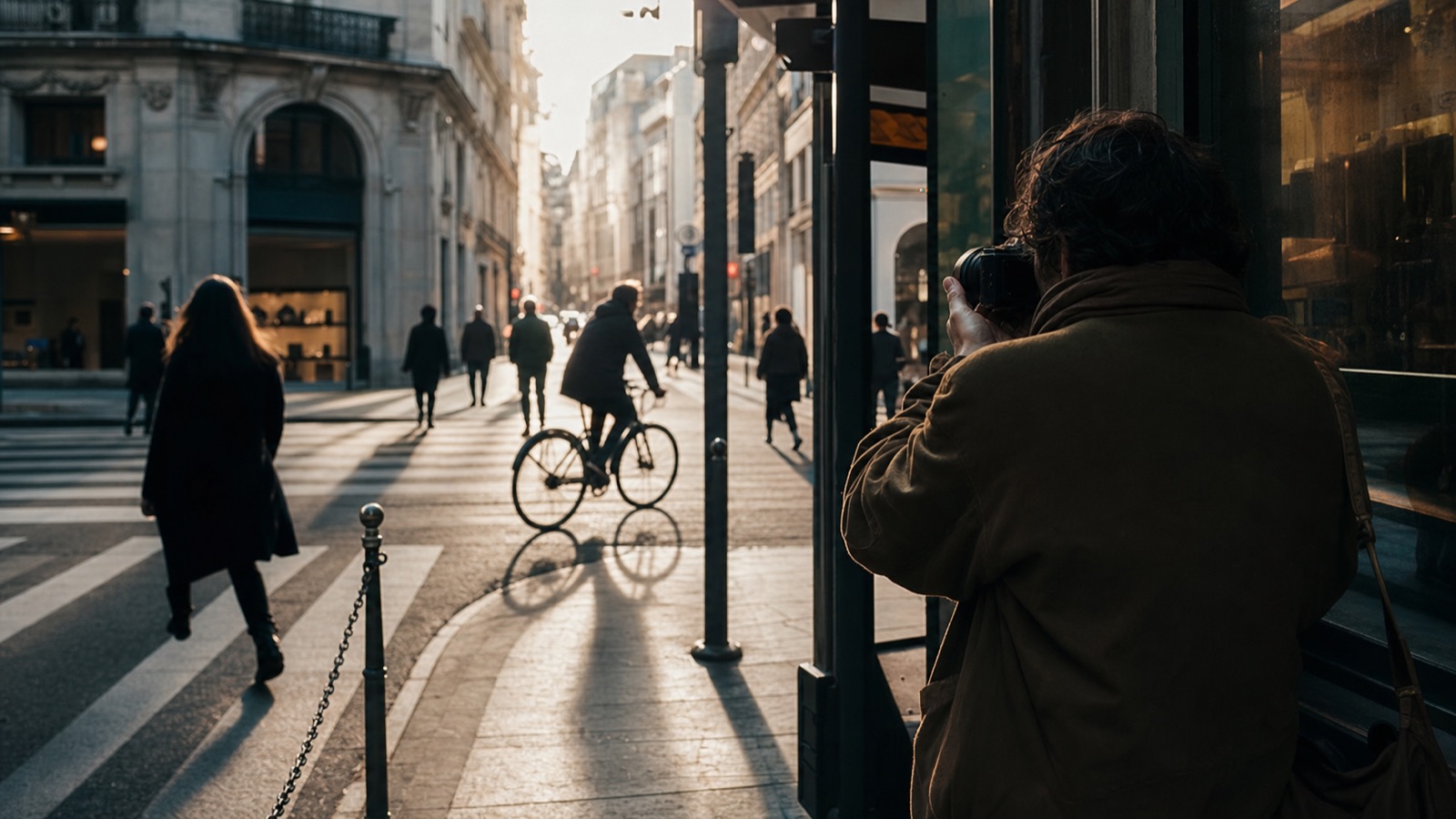
Street photography combines observation, geometry, light and the decisive moment. This is a temporary AI-generated symbolic illustration without identifiable real people, not an authentic documentary photograph. It will later be replaced with the author's own legally usable street photograph.
¶ Document information
| Document information | Definition |
|---|---|
| Document ID | FW-GEN-01-03 |
| Title | Street photography – camera settings, composition and photographic law |
| Area | Photography genres – street photography |
| Document type | Public specialist and practical guide |
| Responsible | Wiki owner |
| Version | 1.1 EN |
| Translation basis | German version 1.1 |
| Last reviewed | 4 August 2026 |
| Document status | Editorially reviewed – legal situation, house rules and specific publication must still be assessed case by case |
| Classification | Public |
| Focus keyword | Street photography |
| SEO title | Street photography: settings, visual ideas and photographic law |
| Meta description | Learn street photography: camera settings, 28, 35 and 50 mm focal lengths, zone focusing, Leica practice, composition and photographic law. |
| Wiki.js tags | street photography, street camera settings, zone focusing, Leica street photography, composition, image rights, photowalk |
| Next content review | 4 August 2027 or following material changes to legislation or case law |
| Wiki.js path | /Fotografen-Wiki/Genres/FW-GEN-01-03_Streetfotografie |
¶ Review traffic light
| Review area | Status | Result |
|---|---|---|
| Page structure and SEO | 🟢 reviewed | One H1, focus keyword, description, tags, meta description and an unambiguous Wiki.js path are present. |
| Photographic fundamentals | 🟢 reviewed | Composition, light, focal lengths, exposure, focusing, series development and post-processing are presented consistently. |
| Camera settings | 🟠 starting values | Shutter speeds, apertures and ISO values are starting points that depend on subject movement, light and camera. |
| Photographic law and publication | 🟠 case-by-case review | Capture, storage and publication must be assessed separately; consent, exceptions, personality rights, data protection and context must be reviewed for each image. |
| House rules and local restrictions | 🟠 verify on location | Publicly accessible places may still be subject to house rules, event conditions or specific photography restrictions. |
| Image and disclosure | 🟢 reviewed | Local symbolic image, 1600 × 900 pixels and 268 KB, with alternative text, transparent AI disclosure and enlargement link. |
| Internal links | 🟢 reviewed | Twelve distinct internal destinations were checked against the Wiki.js page export. |
| Official legal sources | 🟢 reviewed | Sections 22 and 23 KunstUrhG, section 201a StGB and Federal Constitutional Court decision 1 BvR 2112/15 were checked on 4 August 2026. |
Important: The label “street photography” does not provide blanket permission to photograph or publish recognisable people. The specific situation, intended use and rights of the person depicted must always be assessed individually.
¶ 1. What is street photography?
Street photography is an observational form of photography in publicly accessible spaces. “Street” does not refer only to a road. Possible locations include:
- squares, pedestrian areas and markets,
- railway stations and public-transport stops,
- cafés and shopfronts,
- subways and arcades,
- public events,
- parks and waterfront promenades,
- transitions between architecture and everyday life.
People may be the main subject, a reference for scale or merely one element in a graphic composition. Street photography can also work entirely without recognisable people: abandoned objects, shadows, traces, posters, reflections or the relationship between architecture and movement can likewise tell stories about public life.
¶ Distinguishing related genres
| Genre | Primary focus |
|---|---|
| Street photography | Spontaneous observation of everyday public life |
| Reportage | Coherent information about a subject or event |
| Documentary photography | Long-term, traceable representation of social reality |
| Travel photography | Visual narrative about a visited place and its culture |
| Portrait photography | A person and their personality are central |
| Architectural photography | Buildings, spaces, form and use are the main subject |
The boundaries are fluid. A single street photograph may become part of a travel reportage or a long-term documentary project.
¶ 2. Attitude: observe rather than hunt
A convincing street photograph usually emerges from an interest in the place, not from a search for the most spectacular strangers. A respectful approach means:
- not pressuring or following people,
- accepting visible refusal immediately,
- not using helplessness, grief or distress merely for effect,
- exercising the greatest restraint with children and especially vulnerable people,
- respecting religious, medical and private situations,
- assessing capture and publication separately,
- asking clearly for permission when making an intentional portrait,
- not altering the meaning through derogatory text or misleading context.
The camera is not a shield. Eye contact, a friendly nod or a brief conversation may be more appropriate than demonstratively looking away.
Principle: A strong photograph does not lose value because it was made respectfully. Crossing a boundary is not legitimised by a successful composition.
¶ 3. Recognising subjects and anticipating situations
Street photography requires less rapid reaction than is often assumed. Many good photographs are made because the photographer first recognises a suitable frame and waits for the right movement.
¶ First the stage, then the moment
- Find an edge of light, a shadow or a reflection.
- Compose the frame without a person.
- Observe possible paths of movement.
- Prepare focus and exposure.
- Wait until a suitable figure or gesture completes the composition.
- Make a short, controlled sequence.
- Clear the position and move on.
¶ Recurring visual triggers
- a single person against a calm surface,
- opposing directions of movement,
- repetition of colours or shapes,
- a visual relationship between people,
- a hand movement or brief gesture,
- shadows creating a second visual layer,
- a reflection in a shop window,
- a frame within the frame,
- a scale contrast between people and architecture,
- a transition from light to shadow,
- a brief alignment of otherwise unrelated elements.
Recognising movement patterns reduces the need for frantic shooting.
¶ 4. Composition in street photography
¶ Main subject and secondary subjects
A street photograph may be complex, but it still needs hierarchy. The viewer should be able to recognise:
- where the eye goes first,
- which second piece of information follows,
- how the surroundings and moment relate to one another.
A bright background behind a bright face, a pole appearing to grow from someone's head or untidy frame edges can weaken even a good moment.
¶ Building layers
Foreground, middle ground and background add depth to a street scene. The foreground may be formed by an out-of-focus person, a window edge, a vehicle or a dark area. It must not obscure the main subject accidentally.
¶ Using geometry
Streets and architecture provide:
- diagonals,
- leading lines,
- frames,
- repetitions,
- rectangles and circles,
- light and dark areas,
- symmetry and deliberate deviation.
The person does not have to stand on a rule-of-thirds line. A central figure can be particularly powerful in symmetrical architecture; a subject near the edge can create tension when its direction of movement is considered.
¶ Checking the edges
Before releasing the shutter, briefly check for:
- cropped hands and feet,
- half faces at the edge,
- bright spots,
- signs and poles,
- reflections of the photographer,
- distracting vehicles,
- elements that appear to grow out of people.
Half a second of edge inspection often improves a photograph more than a higher burst rate.
¶ 5. Light for street photography
¶ Hard sunlight
Hard light creates clear shadows and graphic areas. It is suitable for:
- silhouettes,
- individual people in pools of light,
- strong black-and-white contrast,
- geometric façades,
- reflections and coloured surfaces.
Set exposure for the important highlights. Deep black shadows may be part of the design; uncontrolled blown highlights are much harder to recover.
¶ Overcast sky
Diffuse light reduces harsh shadows and makes it easier to render faces, clothing and fine transitions. To prevent the image from becoming flat, pay greater attention to:
- gestures,
- colour relationships,
- spatial layers,
- calm backgrounds,
- reflections.
¶ Rain
Rain creates reflections, umbrellas, trails of light and compressed movement. Useful approaches include:
- backlight or side light,
- a dark background to make raindrops visible,
- a low camera position for reflections,
- a fast shutter speed for individual drops,
- a slower shutter speed to convey movement.
Protect the camera and lens from moisture. Wet steps, kerbs and tram tracks increase the risk of accidents.
¶ Blue hour and night
Illuminated signs, windows, vehicles and streetlights create strong differences in brightness. With moving people, a sufficiently fast shutter speed takes priority over the lowest possible ISO.
¶ 6. 28, 35 or 50 millimetres?
Focal length affects distance, perspective and the relationship between a person and the surroundings.
| Full-frame focal length | Effect | Working method |
|---|---|---|
| 21–24 mm | Very wide, dynamic, strong edge effects | Move close and control the edges rigorously |
| 28 mm | Considerable context and an immediate viewpoint | Reportage, busy squares and narrow streets |
| 35 mm | Balanced connection between action and location | Versatile street focal length |
| 50 mm | More concentrated and calmer visual space | Observation from a slightly greater distance |
| 75–90 mm | Strong selection and compression | Details and distant gestures; observation is more conspicuous |
¶ 28 mm
28 mm shows considerable context. It works well when the photographer becomes part of the spatial situation. Too much distance often produces small, insignificant figures and empty frame edges.
¶ 35 mm
35 mm is a flexible compromise. The surroundings remain recognisable without requiring the photographer to move very close for every subject. It is especially suitable for a complete series with a consistent visual language.
¶ 50 mm
50 mm narrows the frame. Gestures, layers and areas of light can be isolated more deliberately. The image often appears calmer, but may feel detached if the photographer is too far away.
Exercise: Photograph an entire photowalk with only one focal length. This trains your distance from the subject rather than your equipment choices.
¶ 7. Autofocus, rangefinder or zone focusing
¶ Autofocus
AF-S is suitable for a predefined area of the frame. AF-C is useful when the main subject moves towards or away from the camera.
Possible starting points:
- a single AF point for precise composition,
- a small zone for predictable movement,
- subject tracking only when its behaviour is understood and reliable,
- eye AF for planned portraits at close range,
- focus priority rather than uncontrolled release.
¶ Rangefinder
With a Leica M, the advantage is less about technical speed and more about:
- seeing beyond the bright-line frame,
- manual prefocusing,
- a constant framing display,
- a direct connection between distance, aperture and moment.
Rangefinder focusing becomes demanding at a wide aperture and short distance. For fast movement, a smaller aperture is often more useful than maximum background separation.
¶ Zone focusing
With zone focusing, a distance is selected in advance. Aperture and the depth-of-field scale define the range that appears acceptably sharp. The technique is particularly suitable with:
- 28 or 35 mm lenses,
- good light,
- a predictable subject distance,
- apertures around f/5.6 to f/11,
- fast movement through a prepared area.
Example: focus at approximately three metres and inspect the depth-of-field scale. Do not assume blindly that every person between two markings will appear perfectly sharp at every output size. Sensor resolution, viewing distance and the required quality standard change the practical zone of sharpness.
Leica zone focusing explained in detail
¶ 8. Camera settings for street photography
The following values are starting points. Movement, light, focal length and the intended visual effect matter more than a fixed recipe.
| Situation | Mode | Aperture | Shutter speed | ISO | Note |
|---|---|---|---|---|---|
| Daylight, movement | M + Auto ISO | f/5.6–f/8 | 1/500–1/1000 s | Auto | Freeze movement reliably |
| Zone focus, bright day | M | f/8–f/11 | 1/500 s | To suit the light | Prepare the sharp range |
| Individual in a pool of light | M or A | f/4–f/8 | At least 1/500 s | Auto or fixed | Protect highlights |
| Overcast sky | M + Auto ISO | f/4–f/8 | 1/250–1/500 s | Auto | Organise flat light compositionally |
| Rain | M + Auto ISO | f/4–f/8 | 1/125–1/1000 s | Auto | Choose the movement effect deliberately |
| Blue hour | M + Auto ISO | f/2–f/4 | 1/125–1/500 s | Auto | Prioritise movement of people |
| Night | M + Auto ISO | Wide open to f/4 | 1/125–1/500 s | Auto | Control bright highlights |
| Panning | M | f/5.6–f/11 | 1/15–1/60 s | To suit the light | Track movement in parallel |
| Deliberate motion blur | M | f/5.6–f/11 | 1/4–1/30 s | Low | Use static architecture as a counterpoint |
¶ Preparing Auto ISO
Before the photowalk, define:
- the highest acceptable ISO,
- the longest shutter speed,
- exposure-compensation behaviour,
- the stored profile's ISO limit,
- mechanical or electronic shutter.
¶ Shutter speed
For normal walking movement, 1/250 s is a possible starting point; 1/500 s provides more security. Running people and bicycles often require 1/1000 s or faster. Motion blur is not an error when it intentionally supports the visual statement.
¶ Aperture
Street photography does not have to be made at maximum aperture. Apertures from f/5.6 to f/11:
- increase usable depth of field,
- make zone focusing easier,
- include the surroundings,
- tolerate small focus deviations.
Wide apertures are suitable for night, deliberate separation and calm situations. Excessively shallow depth of field may destroy the context, however.
¶ ISO
A sharp photograph at ISO 3200 or 6400 is usually more valuable than a camera-shaken photograph at ISO 200. Visible noise may suit a black-and-white image, but it does not improve blown highlights or missed focus.
¶ 9. Exposure metering in changing light
Street scenes change quickly between sunlight, shadow, shop windows and backlight.
¶ Three practical working methods
| Method | Advantage | Risk |
|---|---|---|
| Aperture priority | Adapts quickly to changing light | The shutter speed may become too slow unnoticed |
| Manual with Auto ISO | Aperture and movement rendering remain constant | ISO may rise higher than expected |
| Fully manual | Produces a consistent series in constant light | Slower when the light changes |
For many street situations, manual exposure with Auto ISO is practical: the desired aperture and a safe shutter speed remain fixed while the camera compensates through ISO.
¶ Protecting highlights
In backlight or pools of light, pay attention to:
- bright clothing,
- faces in sunlight,
- reflections on vehicles,
- illuminated signs,
- sky between buildings.
The histogram and highlight warning can help with a test exposure. Do not miss the decisive moment by constantly checking the screen.
¶ 10. Colour or black and white?
¶ Colour
Colour can:
- create relationships between clothing, posters and surroundings,
- connect warm and cool areas of light,
- carry cultural and temporal information,
- separate a subject from the background.
Distracting coloured areas at the edge can change the entire visual hierarchy.
¶ Black and white
Black and white concentrates attention on:
- light and shadow,
- gestures and silhouettes,
- geometry,
- texture,
- a timeless effect.
Without colour, tonal values must be separated cleanly. A red dress against a green wall may have almost the same brightness in greyscale and lose its separation.
¶ Monochrome camera
The Leica M11 Monochrom or Q3 Monochrom supports a consistent black-and-white workflow. Their advantages do not replace deliberate exposure. The effect of colour filters cannot be changed retrospectively with the same flexibility as a colour file when using a dedicated monochrome sensor.
Dedicated monochrome cameras overview
¶ 11. Leica M, Leica Q and Leica SL on the street
¶ Leica M
Suitable for photographers who:
- focus manually,
- observe the area beyond the bright-line frame,
- work with prime lenses,
- preset distance and aperture,
- prefer reduced controls.
Useful combinations:
- 28 mm for dense situations,
- 35 mm as a versatile street focal length,
- 50 mm for calmer observation.
¶ Leica Q
The Q series combines a 28 mm angle of view, autofocus, an electronic viewfinder and a macro mode. Advantages include:
- rapid switching between AF and MF,
- viewfinder preview of exposure and black and white,
- a fixed focal length for consistent series,
- a comparatively compact complete solution.
Digital crop frames do not change the perspective of the 28 mm lens and cannot replace changing your camera position.
¶ Leica SL
The SL is suitable for:
- reliable AF-C,
- changing focal lengths,
- events,
- rain and demanding conditions,
- combining street, reportage and commissioned work.
The body and zoom lens may be more noticeable and heavier. A compact prime changes the photographer's presence considerably.
What matters: The best street camera is the one whose controls can be operated without prolonged menu searching and which is actually carried.
¶ 12. The decisive moment and image sequences
A “decisive moment” does not have to be a dramatic climax. It can occur when:
- a person reaches the edge of a pool of light,
- two gestures correspond,
- a reflection becomes complete for an instant,
- movement and architecture achieve balance,
- a glance explains the relationship between figures.
¶ A single photograph instead of indiscriminate bursts
A short sequence of two to five frames may be useful with movement. Prolonged uncontrolled bursts:
- fill the memory card,
- make selection more difficult,
- make the photographer more conspicuous,
- cannot replace anticipation,
- produce many almost identical images.
Try to anticipate the climax and place the brief sequence around that moment.
¶ 13. Developing a street-photography series
A series is more than a collection of good individual photographs. It needs a recognisable question or theme.
¶ Possible project themes
- commuters at a particular station,
- light and shadow in one street,
- setting up a market early in the morning,
- shop windows and reflections,
- hands at work,
- bicycles and urban movement,
- rain in the city centre,
- one square across four seasons,
- traces of analogue everyday life,
- the relationship between people and architecture.
¶ Roles of images within a series
| Image role | Purpose |
|---|---|
| Opening image | Introduces the location and mood |
| Establishing view | Explains the spatial context |
| Medium distance | Shows action and relationships |
| Detail | Condenses material, gesture or information |
| Portrait | Creates closeness when legal and ethical questions have been resolved |
| Transition | Changes pace and viewing direction |
| Closing image | Provides an ending or leaves a question open |
A consistent focal length, colour treatment and contrast curve can hold the series together.
¶ 14. Planning a photowalk
¶ Beforehand
- choose the location and time of day,
- check the weather and position of the sun,
- select only a small amount of equipment,
- check battery and memory card,
- prepare Auto ISO and a user profile,
- review legal or local considerations,
- plan the return route and personal safety.
¶ On location
- Begin by observing without the camera.
- Identify light and paths of movement.
- Make a first, simple photograph.
- Do not remain with every subject for too long.
- Collect establishing views, medium distances and details.
- Create notes or a voice memo for the project.
- Do not treat respectful conversations as an interruption.
¶ Afterwards
- back up the files immediately,
- remove technically failed frames,
- group similar variants,
- initially mark only strong candidates,
- carry out a legal publication review,
- edit the series again after some time has passed.
¶ 15. Approaching people
A spontaneous conversation can transform an observed scene into a planned portrait.
¶ Brief approach
“Hello, I just noticed the light/the situation. May I take your portrait? I would like to use it for my photographic project/my website.”
Important points:
- a clearly explained purpose,
- no concealed commercial use,
- honest answers to questions,
- the opportunity to see the photograph,
- contact details if a copy has been promised,
- documented consent when publication is planned.
Agreement to being photographed does not automatically constitute agreement to every form of publication.
¶ 16. Photographic law and publication
Street photography is situated between artistic freedom, personality rights, data protection, property rights and a person's right to their own image. The term “street photography” does not create a universal exemption.
Before publication, check:
- Is a person recognisable?
- Are they the main subject or genuinely incidental?
- Is there consent or a robust statutory exception?
- Could the depiction expose, endanger or stigmatise them?
- Does the caption change the meaning?
- Is the use artistic, editorial, portfolio, social media or advertising?
- Are children or particularly vulnerable people involved?
- Do house rules or event conditions apply?
Capture, storage and publication are separate review stages. Especially protected situations may already be problematic at the capture stage.
Detailed legal guidance is provided on:
People photography, copyright and freedom of panorama – German
Legal notice: This page provides general guidance and is not legal advice. Specialist assessment of the individual case is advisable for high-reach publication, advertising, exhibitions or disputes.
¶ 17. Safety and unobtrusive equipment
Working unobtrusively does not mean working secretly.
¶ Personal safety
- do not step backwards into the road,
- watch cycle lanes and tram tracks,
- maintain a safe distance on railway platforms,
- keep bags closed and close to the body,
- plan the route and return journey at night,
- do not provoke conflict,
- do not place the camera above your own safety.
¶ Small equipment kit
For many photowalks, the following is sufficient:
- one camera body,
- one prime lens,
- one spare battery,
- one reserve memory card,
- a small cloth,
- compact weather protection.
A smaller kit reduces decisions and physical load. It guarantees neither invisibility nor legal permissibility.
Safety: Never step backwards into a road or cycle lane, enter railway tracks, cross barriers or provoke a conflict for a photograph. Your own safety and the safety of others take priority over the image.
¶ 18. Selection and post-processing
¶ Selection
Do not keep a photograph solely because the moment was rare. Check:
- Is the gesture clear?
- Is the background organised?
- Are the edges clean?
- Does the light or colour contribute to the statement?
- Is the person shown with dignity?
- Does the photograph fit the series?
- Has publication been cleared?
¶ Post-processing
Appropriate processing may include:
- matching exposure and white balance,
- setting contrast deliberately,
- reducing distracting edges with a moderate crop,
- using local brightening and darkening sparingly,
- adapting noise reduction and sharpening to the output format,
- standardising the colour treatment across a series.
Changes that falsify documentary meaning or place people in a misleading context are problematic. Generative additions and the removal of significant people should be disclosed or avoided where documentary integrity is claimed.
¶ 19. Common mistakes
| Mistake | Improvement |
|---|---|
| Arbitrary passers-by without a visual idea | Define the light, background or relationship first |
| Too much distance with 28 mm | Move closer to the spatial situation without pressuring people |
| Maximum aperture in every scene | Choose depth of field as a narrative device |
| Auto ISO without an upper limit | Check the profile before the photowalk |
| Shutter speed too slow | Prioritise movement and accept a higher ISO |
| Photographing only from eye level | Change perspective without obstructing paths or people |
| Untidy frame edges | Inspect the complete frame before release |
| Indiscriminate bursts | Use short, deliberate sequences around the expected moment |
| Black and white as a rescue operation | Plan tonal values and structure at capture |
| Publication without review | Document consent, exceptions, context and protection interests |
| Collecting only individual images | Follow a theme across several photowalks |
¶ 20. Street-photography exercises
¶ Exercise 1: Pool of light
Choose a fixed composition with a clearly defined pool of light. Release the shutter only when a person completes the shape and scale.
¶ Exercise 2: One focal length
Work for two hours with only 35 or 50 mm. Do not crop digitally; change your own position.
¶ Exercise 3: Ten metres of street
Treat a small section of street as a complete subject: establishing view, action, detail, reflection and closing image.
¶ Exercise 4: Zone focusing
Use 28 or 35 mm, f/8 and a prepared distance to photograph within a clearly defined area. Assess the result at the intended output size.
¶ Exercise 5: Without recognisable faces
Create a series about urban life without showing identifiable faces. Work with shadows, hands, silhouettes, movement and traces.
¶ Exercise 6: Five image roles
Create a short series consisting of an opening image, establishing view, action, detail and closing image.
¶ 21. Checklist before the photowalk
- Visual idea or small project theme defined
- One main focal length selected
- Battery and storage checked
- RAW/DNG or RAW+JPEG selected
- Auto ISO upper limit checked
- Safe shutter speed defined
- AF mode or zone focus prepared
- Time, weather and light checked
- Local rules and private property clarified
- Light bag and weather protection prepared
- Return journey and personal safety considered
¶ 22. Checklist before publication
- Recognisability of people checked
- Capture and publication assessed separately
- Consent or a viable exception documented
- Children and vulnerable people reviewed especially carefully
- Caption and context are truthful and respectful
- No private or specially protected situation shown
- Property rights and event conditions observed
- Copyright, artistic rights and freedom of panorama checked
- GPS and unnecessary metadata removed
- Photograph supports the statement of the series
- Publication postponed where doubt remains
¶ 23. FAQ
¶ Which focal length is best?
35 mm is a flexible starting point. 28 mm shows more context and often requires greater proximity. 50 mm concentrates more strongly on individual gestures and layers. The working distance appropriate to the visual idea is decisive.
¶ Which shutter speed should I use?
For normal movement, 1/250 to 1/500 s are useful starting points. Running people and bicycles may require 1/1000 s or faster. For deliberate panning, approximately 1/15 to 1/60 s may work.
¶ Is zone focusing better than autofocus?
Not categorically. Zone focusing is fast and predictable when distance, focal length and aperture are suitable. Autofocus is more flexible when distance changes or depth of field is shallow. Both methods should be practised.
¶ Must street photography be black and white?
No. Colour can be central visual information. Black and white is suited to light, form and gesture. The decision should fit the series and not merely disguise technical weaknesses.
¶ May I simply publish photographs of strangers?
Not as a general rule. The right to one's own image, data protection, personality rights, possible exceptions and legitimate interests must be assessed for the specific image and use.
¶ Is a smartphone suitable for street photography?
Yes, provided that its operation, focal length and file format suit the project. The same legal and ethical limits apply to smartphones.
¶ Should I use continuous shooting?
A short, controlled sequence can help with movement. Indiscriminate bursts replace neither observation nor composition and make selection more difficult.
¶ 24. Related pages in the Photographers' Wiki
| Subject | Internal link |
|---|---|
| Photography genres overview | FW-GEN-01-01 – German |
| Travel photography | FW-GEN-01-08 – German |
| People photography and photographic law | FW-RS-01-02 – German |
| Composition | FW-WIS-BG-01 – German |
| Perspective | FW-WIS-BG-02 – German |
| Leica zone focusing | FW-WIS-AT-06 – English |
| Natural light | FW-WIS-LI-01 – German |
| Sharpness and depth of field | FW-WIS-GR-03 – German |
| Dedicated monochrome cameras | FW-KAM-01-04 – English |
¶ 25. Official legal sources
- Section 22 KunstUrhG – consent for portraits (German)
- Section 23 KunstUrhG – exceptions and protection of legitimate interests (German)
- German Artistic Copyright Act – especially sections 22 and 23
- Section 201a German Criminal Code – protection of the highly personal sphere through restrictions on image capture
- German Federal Constitutional Court, decision of 8 February 2018 – street photography and artistic freedom
Maintenance note: Legislation and case law can change. Publication of identifiable people must always be assessed against the specific photograph, context and purpose. Registers, the image record and internal links were updated with version 1.1 EN.
¶ 26. Change history
| Version | Date | Change |
|---|---|---|
| 1.1 EN | 4 August 2026 | Synchronised with German version 1.1; added the vertical review traffic light, enlargable and transparently disclosed symbolic image, review dates, legal and safety warnings, a direct official section 23 source, and complete image and link checks |
| 1.0 EN | 30 July 2026 | Complete English translation of German version 1.0; the existing title image was visually checked and included with an English alternative text, caption and transparent AI disclosure |
| 1.0 DE | 30 July 2026 | Created the detailed SEO page on street photography, composition, light, focal lengths, camera settings, zone focusing, Leica practice, photographic series, photographic law and photowalk workflow with a dedicated title image |