¶ Dedicated Black-and-White Cameras: Leica Monochrom, Pentax and Phase One
Dedicated monochrome cameras record luminance only. This overview compares current and earlier Leica Monochrom cameras, the Pentax K-3 Mark III Monochrome and Phase One Achromatic backs, and explains which camera concept suits which photographic workflow.
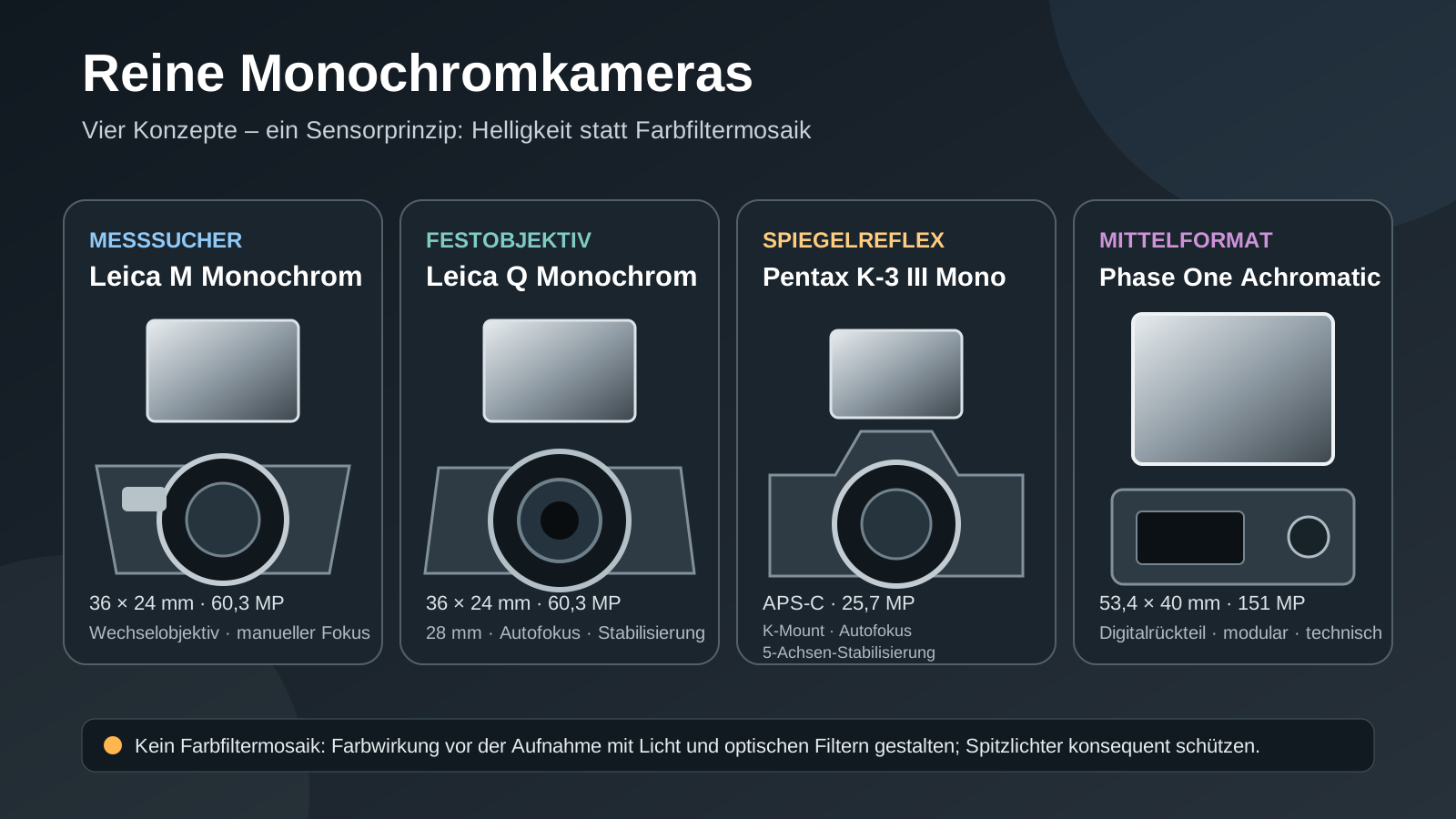
Graphic notice: This is an original schematic teaching graphic. It explains system categories and sensor formats; it is not a dimensionally accurate product illustration.
Language note: This is the English version of the page. The corresponding German page is available at Reine Schwarzweißkameras – Deutsch.
¶ Document Information
| Field | Content |
|---|---|
| Document ID | FW-KAM-01-04 |
| Title | Dedicated Black-and-White Cameras: Leica Monochrom, Pentax and Phase One |
| Section | Equipment – Cameras |
| Page type | Public SEO fundamentals, comparison and selection guide |
| Responsible | Wiki owner |
| Version | 1.1 EN |
| Translation basis | German version 2.0 dated 2 August 2026 |
| Last reviewed | 4 August 2026 |
| Next review | 2 February 2027 or when product, firmware or service status changes |
| Document status | Public – editorially reviewed |
| Classification | Public |
| Focus keyword | dedicated monochrome cameras |
| Source status | Official manufacturer information reviewed on 2 August 2026 |
| Wiki.js path | /Fotografen-Wiki/Ausruestung/Kameras/FW-KAM-01-04_Monochromkameras |
¶ Review traffic light
| Review area | Status | Result |
|---|---|---|
| Translation basis | 🟢 Green | Reconciled with German version 2.0. |
| Sensor principle and model classification | 🟢 Green | Dedicated luminance sensors are separated from colour-camera modes, analogue film and computational monochrome raw files. |
| Main camera data | 🟢 Green | Leica, Pentax and Phase One manufacturer data checked against the German source review of 2 August 2026. |
| Interactive camera finder | 🟢 Green | Nine systems remain readable without JavaScript and can be filtered when the central Wiki.js script is active. |
| Teaching graphics | 🟢 Green | Two local SVG files, each 1600 × 900 pixels and below 7 KB, have alt text and enlargement links. |
| Internal links | 🟢 Green | Existing English pages use /en/; untranslated specialist pages are clearly marked as German fallbacks. |
| Availability, price and service | 🟠 Orange | Market availability, firmware, prices and repair options can change and require periodic rechecking. |
Overall status: Orange. Technology, models, graphics and links have been reviewed. Availability, firmware, prices and serviceability remain dynamic.
Important: A dedicated monochrome camera stores no colour information that can be recovered later. Optical colour filters change tonal relationships during capture, and clipped highlights cannot be reconstructed from another colour channel.
¶ 1. What Is a Dedicated Black-and-White Camera?
A dedicated black-and-white camera, also called a monochrome camera, has an image sensor that records luminance values only. Unlike an ordinary digital camera, there is no red, green and blue colour-filter array over the sensor pixels. The camera cannot produce colour photographs, and colour information cannot be recovered later from its raw file.
This is different from:
- the black-and-white mode of a standard colour camera,
- converting a colour photograph in Lightroom,
- a monochrome JPEG accompanied by a colour raw file,
- an analogue camera that records colour or black and white depending on the loaded film,
- a computational monochrome raw file derived from a colour sensor.
The limitation is permanent. Photographers using a dedicated monochrome camera commit to black and white before releasing the shutter.
¶ 2. Why Is There No Colour-Filter Array?
A conventional colour sensor usually employs a Bayer array. Each pixel receives only part of the incoming light through a red, green or blue filter. The camera then calculates the complete colour and luminance information from neighbouring values. This process is known as demosaicing.
A monochrome sensor needs neither the colour filters nor colour reconstruction. Every pixel measures the quantity of incoming light directly. Depending on the sensor and processing, potential advantages include:
- high detail rendition without Bayer interpolation,
- fine luminance and grey-scale transitions,
- no chromatic noise,
- usually greater light efficiency than a comparable colour sensor,
- clear edge rendition,
- no colour moiré,
- deliberate concentration on light, form, structure and contrast.
Higher theoretical detail does not replace careful technique. Focus errors, camera shake, diffraction, weak lenses and clipped highlights remain visible.
¶ 3. Important Dedicated Monochrome Cameras Compared
¶ Current Systems or Systems Still Documented by Their Manufacturers
| Camera | Introduction | Sensor and resolution | Lens system | Focusing | Distinguishing feature |
|---|---|---|---|---|---|
| Leica M11 Monochrom | 2023 | full-frame BSI CMOS, 60.3 MP | Leica M interchangeable lenses | manual rangefinder; optional Live View and Visoflex | 256 GB internal memory, three DNG resolutions and ISO 125–200,000 |
| Leica Q3 Monochrom | 2025 | full-frame monochrome sensor, 60 MP | fixed Summilux 28 mm f/1.7 ASPH. | hybrid autofocus or manual | stabilisation, macro mode, 8K video and Content Credentials |
| Pentax K-3 Mark III Monochrome | 2023 | APS-C CMOS, 25.73 MP | Pentax K interchangeable lenses | phase-detection AF, Live View AF or manual | optical SLR finder, five-axis stabilisation and ISO 200–1,600,000 |
| Phase One IQ4 150MP Achromatic | 2018 | medium-format BSI CMOS, 151 MP | digital back for XF, XT and technical cameras | depends on the camera system | 53.4 × 40 mm, ISO 200–102,400 and exposures up to 60 minutes |
“Current” means that an official product, support or system page existed on 29 July 2026. Actual availability and regional prices must be checked with the manufacturer or an authorised dealer before purchase.
¶ Important Earlier Models
| Camera | Introduction | Sensor | Concept | Position in 2026 |
|---|---|---|---|---|
| Leica M Monochrom, first generation | 2012 | full-frame CCD, approximately 18 MP | digital M rangefinder | used only; sensor condition and serviceability require particular attention |
| Leica M Monochrom Typ 246 | 2015 | full-frame CMOS, 24 MP | M rangefinder, Live View and black-and-white video | used; moderate file sizes and classic M 240-style body |
| Phase One IQ3 100MP Achromatic | 2017 | medium-format CMOS, 101 MP | modular digital back without a Bayer filter | specialised used market |
| Leica M10 Monochrom | 2020 | full-frame CMOS, 40.89 MP | slim M rangefinder body | used; attractive balance between resolution and M10 handling |
| Leica Q2 Monochrom | 2020 | full-frame CMOS, 47.3 MP | fixed 28 mm f/1.7 lens with autofocus | used or remaining stock; predecessor to the Q3 Monochrom |
Limited Leica editions generally change the design, engraving or supplied accessories rather than the recording principle of the production model.
The following English page covers early Kodak DCS models, dedicated cinema cameras and cultural-heritage, astronomy, industrial and research systems:
Historical and Specialised Monochrome Cameras
¶ 3.1 Interactive Monochrome Camera Finder
The finder classifies nine important current and earlier systems by sensor format, focusing method and market status. It is a preselection tool, not a ranking.
9 of 9 monochrome cameras
| Camera | Format / resolution | Focus | Status in 2026 | Typical use |
|---|---|---|---|---|
| Leica M11 Monochrom | Full frame · 60.3 MP | Rangefinder / manual | Manufacturer documented | Street, reportage, fine art, M lenses |
| Leica Q3 Monochrom | Full frame · 60.3 MP | Hybrid AF | Manufacturer documented | Reportage, travel, street, 28 mm |
| Pentax K-3 Mark III Monochrome | APS-C · 25.7 MP | Phase-detection AF | Manufacturer documented | Nature, macro, telephoto, K mount |
| Phase One IQ4 150MP Achromatic | 53.4 × 40 mm · 151 MP | System-dependent | Manufacturer documented | Fine art, architecture, reproduction |
| Leica M Monochrom (2012) | Full frame · about 18 MP | Rangefinder / manual | Earlier model / used | CCD rendering, collecting and practical use |
| Leica M Monochrom Typ 246 | Full frame · 24 MP | Rangefinder / manual | Earlier model / used | M system, Live View, moderate files |
| Leica M10 Monochrom | Full frame · 40.9 MP | Rangefinder / manual | Earlier model / used | Compact M10 body, high-ISO headroom |
| Leica Q2 Monochrom | Full frame · 47.3 MP | Contrast AF | Earlier model / used | Reportage, travel and fixed 28 mm lens |
| Phase One IQ3 100MP Achromatic | 53.4 × 40 mm · 101 MP | System-dependent | Earlier model / used | Fine art, architecture, UV and IR |
| No matching monochrome camera found. Change or reset the filters. | ||||
Technical requirement: Search and selection fields use the centrally installed filterable-table component. Without JavaScript, all nine entries remain fully readable.
¶ 4. Leica M11 Monochrom
The Leica M11 Monochrom combines a 60.3 MP black-and-white sensor with the manually focused Leica M rangefinder system. It is intended for photographers who work deliberately, focus their lenses manually and reduce their visual language to tone, light and contrast at the time of capture.
¶ Strengths
- very high detail resolution,
- DNG files at 60.4, 36.6 or 18.5 MP,
- ISO 125–200,000,
- 256 GB internal memory in addition to an SD card,
- mechanical and electronic shutters,
- highlight-weighted metering,
- more compact than a professional medium-format system,
- extensive selection of Leica M and compatible M-mount lenses.
¶ Limitations
- manual focus only,
- no in-body image stabilisation,
- the rangefinder must suit the camera, lens and photographer’s eyesight,
- 60 MP reveals focusing errors and camera shake clearly,
- high purchase price,
- lost colour information cannot be restored.
It is particularly attractive for caves, woodland, rocks, architecture, fine art and considered documentary work. Autofocus and stabilised systems are usually more practical for fast telephoto, macro or sports subjects.
Open the Leica M11 Monochrom page
¶ 5. Leica Q3 Monochrom
The Leica Q3 Monochrom is a full-frame camera with a fixed Leica Summilux 28 mm f/1.7 ASPH. It combines dedicated black-and-white capture with autofocus, optical stabilisation, an electronic viewfinder, a tilting touchscreen and a macro setting.
It is easier to use spontaneously than an M rangefinder. Its 28 mm angle of view suits street, reportage, travel, architecture, landscape and photowalks. Digital crops simulate 35, 50, 75 and 90 mm framing, but they do not reproduce the perspective or light-gathering ability of a real lens change.
¶ Strengths
- 60 MP monochrome sensor with three resolution levels,
- ISO 100–200,000,
- fast Summilux 28 mm f/1.7,
- hybrid autofocus,
- optical image stabilisation,
- macro mode down to 17 cm,
- high-resolution viewfinder,
- Content Credentials for signed provenance information,
- black-and-white video up to 8K.
¶ Limitations
- focal length and lens cannot be changed,
- heavy cropping reduces the remaining resolution,
- electronic shutters can show rolling-shutter effects with movement,
- less flexible for pronounced telephoto, macro and specialist-lens work.
Open the detailed report and M11 Monochrom comparison
¶ 6. Pentax K-3 Mark III Monochrome
The Pentax K-3 Mark III Monochrome is a distinctive alternative to Leica: an APS-C digital SLR with an optical viewfinder, autofocus, interchangeable lenses and five-axis sensor-shift stabilisation.
Its 25.73 MP sensor has neither a colour-filter array nor an optical low-pass filter. Ricoh explicitly describes the camera as dedicated to monochrome capture. Each pixel records luminance information directly. Raw files can be stored as PEF or DNG.
¶ Strengths
- extensive Pentax K lens system,
- optical pentaprism finder with approximately 100 per cent coverage,
- phase-detection autofocus with 101 points,
- five-axis image stabilisation,
- mechanical shutter to 1/8,000 s,
- electronic shutter to 1/16,000 s,
- ISO 200–1,600,000,
- two SD-card slots,
- weather-resistant DSLR concept,
- black-and-white video up to 4K.
¶ Limitations
- APS-C rather than full frame,
- larger and heavier than compact rangefinder or fixed-lens cameras,
- the optical finder does not directly preview the grey-scale effect of a colour filter,
- extreme ISO settings are technical options rather than guarantees of high output quality,
- small-batch production can cause fluctuating availability.
The Pentax is particularly interesting for photographers who already own K-mount lenses, prefer an optical SLR viewfinder or require autofocus, stabilisation and longer focal lengths.
¶ 7. Phase One IQ4 150MP Achromatic
The Phase One IQ4 150MP Achromatic is a professional digital medium-format back. It can be used with the Phase One XF system, the XT system or suitable technical cameras. Its 151 MP BSI sensor measures 53.4 × 40 mm and produces files of 14,204 × 10,652 pixels.
Unlike the Leica and Pentax models, the Phase One system is not primarily a compact everyday camera. It is designed for fine-art, landscape, architectural, reproduction and studio applications with very high resolution and output requirements.
¶ Strengths
- 151 MP and substantial large-print capacity,
- up to 15 stops of dynamic range according to Phase One,
- ISO 200–102,400,
- exposures of up to 60 minutes,
- modular use with different camera systems,
- recording beyond the spectrum visible to the human eye,
- strong suitability for fine art, infrared and scientific applications.
¶ Limitations
- very high camera and system cost,
- large files and demanding computer, storage and backup requirements,
- careful filtration required when only visible light should be recorded,
- less suitable for discreet street photography or fast reportage,
- camera system, lens, shutter and compatibility must be assessed together.
The Phase One demonstrates that a monochrome camera does not have to be a Leica. It occupies an entirely different class of size, cost and application.
¶ 8. What Is Not a Dedicated Black-and-White Camera?
¶ Standard Colour Camera in Black-and-White Mode
A colour camera continues to store measurements behind red, green and blue filters. When raw is used, the colour information normally remains available. A later black-and-white conversion allows individual colour channels to be mixed, for example to darken a blue sky or lighten green foliage.
¶ Pixii Monochrome RAW
Pixii offers a special Monochrome DNG mode. According to the manufacturer, a patented process reconstructs a single-plane monochrome raw file with up to 16-bit precision from the Bayer-sensor signal. The same camera can switch the mode off and continue to record colour. It is therefore an interesting monochrome solution, but not a camera restricted to black-and-white photography.
¶ Smartphone with an Additional Monochrome Sensor
An additional monochrome sensor can support a main camera with detail, noise reduction or depth information. As long as the device also records colour photographs, it does not meet the definition used on this page.
¶ Analogue Camera Loaded with Black-and-White Film
A Leica M6, Leica MP, Leica R 6.2 or Nikon F6 becomes a black-and-white camera only through the loaded film. The same body records colour when loaded with colour-negative or transparency film. The analogue approach nevertheless remains a consistent and valuable creative alternative.
¶ 9. Advantages of a Dedicated Monochrome Camera
¶ Technical Advantages
- no Bayer interpolation,
- no colour artefacts around fine structures,
- no chromatic noise component,
- high detail and micro-contrast rendition,
- often strong high-ISO performance,
- direct single-channel raw workflow.
¶ Creative Advantages
- the black-and-white decision is made before capture,
- colour cannot distract from light, form and structure,
- series can maintain a consistent visual language,
- photography becomes more focused on tones and contrast,
- the later question “perhaps this should remain in colour” disappears.
This restriction can improve the photographic process, but it does not guarantee a successful picture. Subject, light, viewpoint, timing and intentional tonal design remain decisive.
¶ 10. Limitations and Common Misconceptions
¶ Colour Is Irretrievably Lost
A DNG from a dedicated monochrome camera contains no hidden colour layer. A second camera is necessary if the subject must also be documented in colour.
¶ Colour Channels Cannot Be Mixed Later
When converting a colour photograph, the brightness of individual colours can be adjusted afterwards. With a dedicated monochrome camera, this separation must be controlled during capture through the subject lighting or physical colour filters.
¶ Highlights Remain Critical
Clipped highlights cannot be rescued from another colour channel. Bright clouds, white plumage, skin reflections, limestone and direct light sources require particularly careful exposure.
¶ High ISO Numbers Are Not Universal Recommendations
The highest available ISO value does not describe the quality suitable for every output. Noise, dynamic range, subject movement and intended appearance must be evaluated together.
¶ More Detail Can Reveal More Errors
Monochrome sensors without a low-pass filter reveal focus errors, moiré, motion blur and weak lens performance clearly. Resolutions of 60 or 151 MP increase the demands on technique and data processing.
¶ 11. Colour Filters on Digital Monochrome Cameras
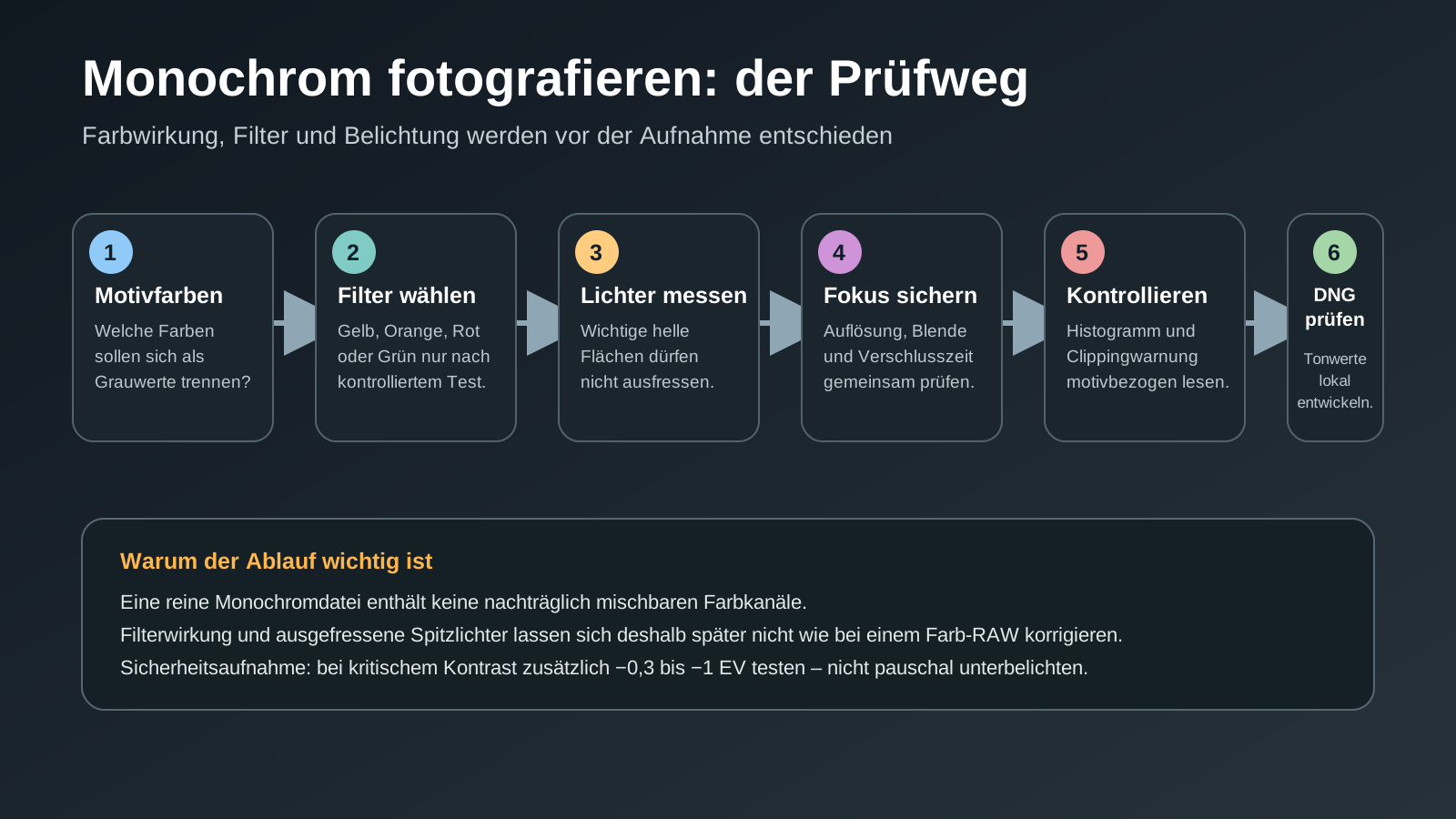
Graphic notice: This original schematic teaching graphic describes the photographic decision process; it does not represent a specific camera menu.
Because colour channels are not available later, a physical filter in front of the lens can change the tonal relationship during capture.
| Filter | Typical effect in the black-and-white image | Suitable use |
|---|---|---|
| Yellow | darkens blue slightly and separates clouds gently from the sky | landscape and natural everyday rendering |
| Orange | darkens blue and cyan more strongly | landscape, architecture and more dramatic clouds |
| Red | lightens red subjects and darkens blue substantially | highly dramatic skies, rocks and graphic effects |
| Green | lightens green foliage and darkens red tones | woodland, plants and selected portraits |
| Blue | lightens blue tones and darkens red or yellow | specialist effects and historical appearance |
| Neutral density | does not target colour-to-tone rendering but reduces light | wide apertures in sunshine and long exposures |
¶ Practical Guidance
- Test the filter effect before an important series.
- Check exposure with the histogram and clipping warning.
- Make an exposure bracket for critical subjects.
- Do not use a red filter indiscriminately for every landscape.
- Skin, lips, freckles and vegetation respond very differently to different filters.
- On systems with extended infrared sensitivity, follow the manufacturer’s information on spectral filtration.
Open the filter overview – German
¶ 12. Which Monochrome Camera Suits Which Application?
| Requirement | Suitable camera | Reason |
|---|---|---|
| manual rangefinder photography and M lenses | Leica M11 Monochrom | dedicated M workflow, high resolution and modern DNG handling |
| compact reportage, street and travel with autofocus | Leica Q3 Monochrom | fixed 28 mm lens, autofocus, stabilisation and integrated viewfinder |
| DSLR, autofocus, stabilisation and longer focal lengths | Pentax K-3 Mark III Monochrome | K mount, optical viewfinder, IBIS and broad lens selection |
| maximum resolution for fine art and very large prints | Phase One IQ4 150MP Achromatic | 151 MP, large sensor and technical-camera compatibility |
| lower-cost entry into Leica Monochrom | used M246, M10 Monochrom or Q2 Monochrom | lower used prices, provided condition and serviceability are verified |
| alternating colour and black and white with one camera | ordinary colour camera or Pixii | a dedicated monochrome camera is unsuitable |
| analogue black-and-white process | analogue camera with TRI-X, HP5, FP4 or another B&W film | negative, development and scanning or darkroom form part of the process |
¶ 13. Exposure Strategy for Monochrome Sensors
A sensible starting point is:
- use raw or DNG,
- choose the native or recommended base ISO of the specific camera,
- use highlight-weighted metering where available and suitable,
- monitor the histogram and overexposure warning,
- protect important highlights,
- adapt the minimum shutter speed to resolution, focal length and subject movement,
- test a safety exposure between −0.3 and −1 EV in high-contrast situations,
- raise shadows carefully during raw processing,
- adapt sharpening and noise reduction to ISO and output size.
Systematic underexposure is not the objective. Exposure that is too cautious can create unnecessary shadow noise. The aim is to preserve important highlights while recording as many useful tones as possible.
Open Leica exposure strategies – German
¶ 14. Buying a Used Monochrome Camera
In addition to a normal camera inspection, check:
- exact model designation and serial number,
- sensor for scratches, marks, corrosion and permanent lines,
- test exposure of an evenly lit bright surface,
- test exposure of fine repeating structures for moiré and artefacts,
- Leica rangefinder at several distances and with several lenses,
- autofocus and stabilisation on Pentax or Leica Q,
- shutter, display, viewfinder, card slots and connections,
- current firmware and the ability to reset the camera,
- battery condition and availability of replacements,
- whether the DNG or raw file opens in the intended software,
- repairability and spare-parts supply before purchase.
On older Leica Monochrom models, sensor type, rangefinder calibration and serviceability are especially important. On Phase One backs, the back interface, camera compatibility, shutter control, storage, software and licensing workflow must be evaluated together.
Open the Leica used-buying and serviceability guide
¶ 15. Frequently Asked Questions
¶ Does a Monochrome Camera Really Record Black and White Only?
Yes, if it has a dedicated luminance sensor without a colour-filter array. A colour photograph cannot be reconstructed from its raw file.
¶ Is a Monochrome Camera Always Sharper Than a Colour Camera?
Not automatically. Eliminating the colour-filter array and demosaicing can improve detail rendition, but the result also depends on the lens, focus, camera shake, aperture, processing and output size.
¶ Can Lightroom Process Monochrome DNG Files?
Normal raw controls such as exposure, contrast, tone curve, local adjustments, sharpening and noise reduction remain available. Colour-channel mixing is unavailable because there is no colour information.
¶ Are Physical Colour Filters Still Needed?
Not necessarily. Photographers who want to control the tonal relationship of coloured subjects must nevertheless do so during capture with lighting or physical filters.
¶ Is the Leica M11 Monochrom Better Than the Q3 Monochrom?
No. They represent different concepts. The M11 Monochrom provides interchangeable lenses and manual rangefinder operation. The Q3 Monochrom provides autofocus, stabilisation, macro mode and a fixed 28 mm lens.
¶ Is the Pentax a Less Expensive Leica Alternative?
It is a less expensive dedicated monochrome camera, but it is not a substitute for the Leica M concept. Pentax provides a DSLR finder, autofocus, stabilisation and K mount; Leica M provides a manual rangefinder and M lenses.
¶ Can a Dedicated Monochrome Camera Record Infrared?
That depends on the sensor and the installed spectral filter. Phase One explicitly promotes capture beyond the visible spectrum with its Achromatic system. The model-specific manufacturer information must be checked for other cameras.
¶ 16. Related Photographer Wiki Pages
| Topic | Link |
|---|---|
| Historical and specialised monochrome cameras | Open FW-KAM-01-05 |
| Camera overview | Open FW-KAM-01-01 – German |
| Leica cameras overview | Open FW-KAM-LEI-01 |
| Leica Monochrom comparison | Compare the M246, M10 and M11 |
| Leica M11 Monochrom | Open the English model page |
| Leica Q3 Monochrom | Open the English report and comparison |
| Base ISO and dynamic range | Open FW-KAM-LEI-09 – German |
| Leica exposure strategies | Open FW-KAM-LEI-18 – German |
| Filters | Open FW-ZUB-01-03 – German |
| Black-and-white film | Open the analogue film overview – German |
¶ 17. Official Sources
¶ Leica
- Leica M11 Monochrom technical specifications
- Leica Q3 Monochrom press release dated 20 November 2025
- Leica Q3 Monochrom technical specifications
- Leica M10 Monochrom technical specifications
- Leica Q2 Monochrom technical data
- Leica M Monochrom Typ 246 press information
¶ Pentax
- Pentax K-3 Mark III Monochrome specifications
- Ricoh Imaging product announcement dated 13 April 2023
- Pentax K-3 Mark III Monochrome firmware
¶ Phase One
- Phase One XT IQ4 150MP Achromatic system overview
- Phase One introduction of the IQ4 camera systems
- Phase One black-and-white photography with the IQ4 150MP Achromatic
¶ Definition and Exclusion
Product status, prices, firmware, availability and service can change. Check the current manufacturer page, regional dealer and available raw software before purchase.
¶ 18. Change History
| Version | Date | Change |
|---|---|---|
| 1.1 EN | 4 August 2026 | Reconciled with German version 2.0; added a seven-row vertical review traffic light, two local enlargable SVG teaching graphics, the filterable nine-camera finder, explicit warnings, updated model status and corrected English and German-fallback links. |
| 1.0 EN | 29 July 2026 | Complete English translation of the public SEO guide to dedicated digital black-and-white cameras, including Leica Monochrom, Pentax K-3 Mark III Monochrome, Phase One Achromatic, filters, exposure, used buying and system selection |