¶ Historical and Specialised Monochrome Cameras
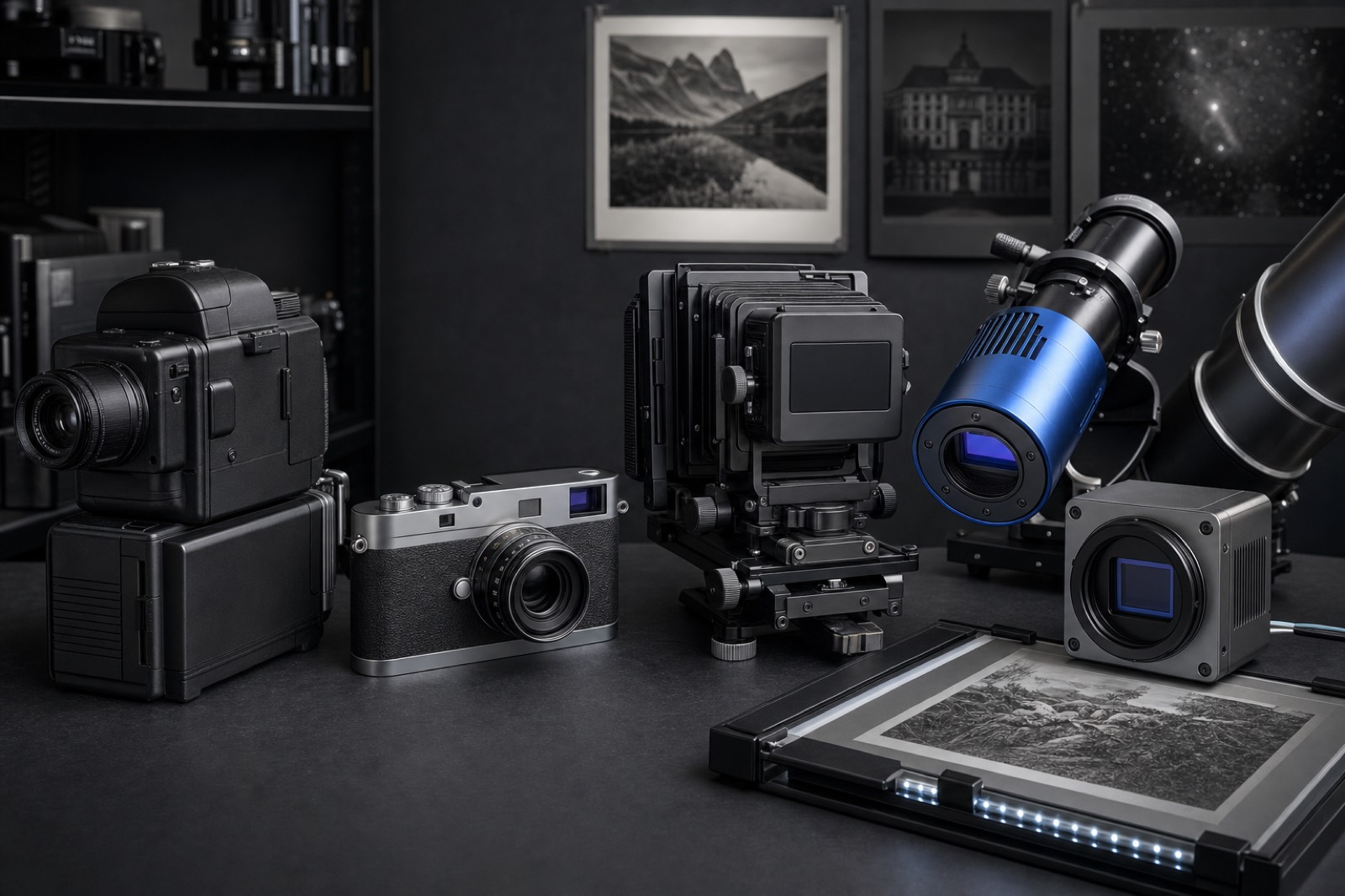
Image notice: This title image is a temporary, brand-neutral AI-generated illustration for system orientation. It is not an authentic photograph of the named historical models and will be replaced with original documentary photographs when suitable material is available.
Language note: This is the English version of the page. The corresponding German page is available at Historische und spezialisierte Monochromkameras – Deutsch.
¶ Document Information
| Field | Content |
|---|---|
| Document ID | FW-KAM-01-05 |
| Title | Historical and Specialised Monochrome Cameras |
| Section | Equipment – Cameras |
| Page type | Public SEO history, system and specialist-application guide |
| Responsible | Wiki owner |
| Version | 1.2 EN |
| Translation basis | German version 1.2 dated 1 August 2026 |
| Last reviewed | 4 August 2026 |
| Next review | 1 November 2026 or when current specialist offerings change materially |
| Document status | Public specialist page – editorially reviewed |
| Classification | Public |
| Source status | Manufacturer, manual and archive sources reviewed on 29 July 2026 |
| Wiki.js path | /Fotografen-Wiki/Ausruestung/Kameras/FW-KAM-01-05_Historische_und_spezialisierte_Monochromkameras |
¶ Review traffic light
| Review area | Status | Result |
|---|---|---|
| Translation basis | 🟢 Green | Reconciled with German version 1.2. |
| Historical camera chronology | 🟢 Green | Kodak DCS, Leica and Phase One generations are separated by introduction period and system concept. |
| Specialist applications | 🟢 Green | Cinema, cultural heritage, astronomy, industry, microscopy and research are differentiated. |
| Source transparency | 🟢 Green | Manufacturer, manual and archive sources remain grouped by system. |
| Title image | 🟢 Green | Local 1600 × 1066 pixel JPEG, approximately 279 KB, with precise alt text, enlargement link and AI disclosure. |
| Internal links | 🟢 Green | Existing English pages use /en/; untranslated registers and specialist pages are marked as German fallbacks. |
| Availability and serviceability | 🟠 Orange | Rare historical variants, rental fleets, firmware, software and specialist support can change or remain incompletely documented. |
Overall status: Orange. The historical structure, specialist classifications, image and links have been reviewed. The exact model variant, current availability and operational workflow must still be verified for each device.
¶ 1. Purpose and Scope
Dedicated monochrome cameras existed long before the Leica M Monochrom. Early professional digital cameras were already offered with sensors that recorded brightness values only. Specialised black-and-white systems were later developed for digital cinema, fine-art photography, cultural-heritage digitisation, astrophotography, microscopy and industrial machine vision.
This page supplements the general overview:
Dedicated Black-and-White Cameras: Leica Monochrom, Pentax and Phase One
It covers:
- historical photographic monochrome cameras,
- digital black-and-white rangefinder cameras,
- achromatic medium-format backs,
- dedicated monochrome cinema cameras,
- cameras for archives, museums and research,
- cooled monochrome astronomy cameras,
- industrial and scientific cameras,
- aftermarket monochrome conversions.
A literally complete list of every industrial and astronomy camera would not be useful. Manufacturers offer numerous sensor sizes, interfaces, cooling options and model revisions. The tables therefore present important documented examples and historically or technically relevant product families.
Important: Inclusion of a historical or specialist system does not confirm current availability, serviceability or suitability for a specific scientific workflow. Before purchase, rental or project use, verify the exact variant, spectral range, accessories, software and support for the actual system.
¶ 2. What Does “Monochrome” Mean in a Specialised Camera?
A true monochrome camera has no colour-filter array over its individual sensor pixels. Each pixel measures the intensity of the incoming light within the spectral range allowed by the sensor, protective glass and any additional filters.
This does not necessarily mean that the final result must always be a conventional black-and-white photograph:
- An astronomy camera can record separate exposures through red, green and blue filters. The three monochrome data sets are later combined into a colour image.
- A cultural-heritage camera can document visible light, ultraviolet and infrared separately.
- A cinema camera can produce exclusively black-and-white motion pictures.
- An industrial camera can inspect brightness, edges, component position or defects without producing an aesthetic photograph.
“Monochrome” therefore describes the sensor recording first; it does not necessarily define the final presentation or application.
¶ 3. Timeline of Important Monochrome Cameras
| Year | Camera or system | Significance |
|---|---|---|
| 1991 | Kodak Professional DCS, monochrome DM3 version | early commercial DSLR technology based on the Nikon F3 |
| 1992 | Kodak DCS 200m and 200mi | more compact professional DCS system with a monochrome CCD |
| 1994–1995 | Kodak DCS 420m, 460m and Canon/Kodak EOS DCS “m” versions | monochrome professional DSLRs using Nikon or Canon bodies |
| 1999 | Kodak DCS 660M | six megapixels and a professional Nikon F5-based body |
| 2001 | Kodak DCS 760M | further-developed six-megapixel monochrome DSLR |
| 2012 | Leica M Monochrom and RED EPIC-M MONOCHROME | monochrome sensors reach rangefinder and digital cinema cameras |
| 2015 | Leica M Monochrom Typ 246 | transition from CCD to CMOS, with Live View and video |
| 2017 | Phase One IQ3 100MP Achromatic | 101 MP medium-format back without Bayer or IR-cut filter |
| 2018 | Phase One IQ4 150MP Achromatic | 151 MP BSI system for fine art and technical applications |
| 2020 | Leica M10 Monochrom and Q2 Monochrom | 40.89 and 47.3 MP in two different Leica concepts |
| 2023 | Leica M11 Monochrom and Pentax K-3 Mark III Monochrome | modern rangefinder and DSLR alternatives |
| 2025 | Leica Q3 Monochrom | 60 MP fixed-lens camera with autofocus and Content Credentials |
| 2026 | current specialist offerings | Phase One, ARRI Rental, RED support, ZWO, QHYCCD and numerous industrial suppliers continue to document monochrome systems |
The dates refer to the introduction or market launch of the principal models. Special editions, small production runs and customer-specific versions may have different time frames.
¶ 4. Kodak DCS: Early Professional Monochrome DSLRs
Kodak was one of the most important pioneers of professional digital photography. Many DCS cameras combined an analogue Nikon or Canon SLR body with a Kodak digital back. Several monochrome versions were produced alongside colour and infrared models.
In early Kodak model designations, the suffix identified the version:
cindicated a colour version,mindicated a monochrome version,irindicated an infrared version,iindicated integrated internal storage.
¶ Documented Kodak Monochrome Models
| Model | Period | Base camera | Resolution | Distinguishing feature |
|---|---|---|---|---|
| Kodak DCS DM3 | from 1991 | Nikon F3 | approximately 1.3 MP | monochrome version of the first DCS generation |
| Kodak DCS 200m / 200mi | 1992–1994 | Nikon F-801s/N8008s | 1,012 × 1,524 pixels | mi with internal hard-disk storage; ISO 100–800 |
| Kodak NC2000m | mid-1990s | Nikon F90/N90 | approximately 1.3 MP | professional and agency-related applications |
| Kodak DCS 420m | from 1994 | Nikon F90/N90 | approximately 1.5 MP | rare monochrome version, partly produced to order |
| Kodak DCS 460m | from 1995 | Nikon F90/N90 | approximately 6 MP | exceptionally high resolution for its time |
| Kodak EOS DCS 1m | from 1995 | Canon EOS-1N | approximately 6 MP | Canon EF system with Kodak digital technology |
| Kodak EOS DCS 3m | mid-1990s | Canon EOS-1N | approximately 1.3 MP | higher sensitivity than the contemporary colour version |
| Kodak EOS DCS 5m | mid-1990s | Canon EOS-1N | approximately 1.5 MP | monochrome member of the EOS DCS 5 family |
| Kodak DCS 660M | from 1999 | Nikon F5 | approximately 6 MP | ISO 320–800, 12-bit raw and a professional F5 body |
| Kodak DCS 760M | from 2001 | Nikon F5 | approximately 6 MP | ISO 400–800 and up to 12 frames at approximately 1.5 fps |
Some versions were made only to order or in very small quantities. The model year, sales designation and sensor version must therefore be checked on the individual camera.
¶ Historical Importance
Monochrome DCS cameras were developed or adapted not only for art photography but also for science, medicine, forensics, military and government use, reproduction, press work and low-light photography.
¶ Buying One Today
A historical Kodak DCS is now more likely to be a collector’s, research or museum object than a dependable everyday camera. Check:
- NiCd or proprietary batteries,
- chargers and mains adapters,
- PCMCIA cards or historical hard drives,
- SCSI and other legacy computer interfaces,
- Kodak DCS file formats and available conversion software,
- display, buffer and camera electronics,
- sensor filter and dust protection,
- unavailable spare parts,
- condition of the Nikon or Canon base camera.
A mechanically working camera body does not prove that the digital module, storage and software workflow remain usable.
¶ 5. Leica Monochrom as a Production Still Camera
Leica re-established the dedicated monochrome camera as a regular tool for artistic and documentary photography.
| Model | Introduction | Resolution | Concept |
|---|---|---|---|
| Leica M Monochrom, first generation | 2012 | approximately 18 MP CCD | digital M rangefinder without a colour-filter array |
| Leica M Monochrom Typ 246 | 2015 | 24 MP CMOS | M system, Live View, focus peaking and black-and-white video |
| Leica M10 Monochrom | 2020 | 40.89 MP CMOS | slimmer M10 body and extensive high-ISO capability |
| Leica Q2 Monochrom | 2020 | 47.3 MP CMOS | full-frame fixed-lens camera with Summilux 28 mm f/1.7 |
| Leica M11 Monochrom | 2023 | 60.3 MP BSI CMOS | M system, three DNG resolutions and 256 GB internal memory |
| Leica Q3 Monochrom | 2025 | 60 MP | autofocus, stabilisation, 28 mm Summilux, 8K video and Content Credentials |
Special editions such as “Stealth”, “Leitz Wetzlar” or other design variations are not counted as separate sensor generations.
Compare the Leica M246, M10 Monochrom and M11 Monochrom
¶ 6. Phase One Achromatic Digital Backs
Phase One uses the name Achromatic for its dedicated monochrome systems. They are designed for fine-art photographers as well as technical, scientific and museum applications.
| Model | Resolution | Sensor format and technology | Typical application |
|---|---|---|---|
| Phase One IQ160 Achromatic | approximately 60 MP | monochrome digital medium-format back | reproduction, art and technical imaging |
| Phase One IQ260 Achromatic | approximately 60 MP | monochrome medium-format back with long-exposure capability | fine art, architecture, landscape and infrared |
| Phase One IQ3 100MP Achromatic | 101 MP | 53.4 × 40 mm CMOS without Bayer or IR-cut filter | fine art, portraiture, architecture, science and infrared |
| Phase One IQ4 150MP Achromatic | 151 MP | 53.4 × 40 mm BSI CMOS | maximum resolution, very large prints and technical cameras |
According to Phase One, the IQ3 100MP Achromatic records light beyond the visible spectrum. Suitable external filtration is therefore required when the aim is a natural rendering of visible light only. Conversely, this broad sensitivity supports deliberate ultraviolet and infrared investigations.
Define the filter chain: An Achromatic or wide-spectrum system does not automatically produce a neutral visible-light image. Filters, light source, calibration and spectral range belong to the documented imaging chain.
The IQ4 150MP Achromatic can be used with Phase One XF, XT and XC systems and, depending on the configuration and adapter, technical cameras. It provides 14,204 × 10,652 active pixels, ISO 200–102,400 and exposures of up to 60 minutes.
¶ 7. Dedicated Monochrome Digital Cinema Cameras
A black-and-white cinema camera also dispenses with the colour-filter array. Its potential advantages include high light efficiency, fine detail and a workflow in which the monochrome decision is made on set.
¶ RED Monochrome
| Camera | Generation | Key characteristic |
|---|---|---|
| RED EPIC-M MONOCHROME | MYSTERIUM-X, introduced in 2012 | 5K monochrome sensor and native ASA 2000 |
| RED EPIC-X MONOCHROME | DSMC generation | monochrome version within the modular EPIC system |
| RED EPIC-M RED DRAGON MONOCHROME | RED DRAGON generation | later monochrome sensor generation |
| RED DSMC2 MONSTRO 8K VV Monochrome | DSMC2 | 35.4 MP CMOS, 8,192 × 4,320 pixels and up to 60 fps at 8K full format |
In RED terminology, the “brain” is the modular camera core. The lens mount, monitor, viewfinder, storage and power supply complete the production system.
¶ ARRI Rental Monochrome
ARRI Rental documents a dedicated fleet of monochrome ALEXA cameras:
- ALEXA 35 Monochrome,
- ALEXA 65 Monochrome,
- ALEXA Mini LF Monochrome,
- ALEXA XT B+W or Monochrome.
These systems are not equivalent to ordinary retail still cameras. Availability, lens mounts, accessories and production support are arranged for each project through ARRI Rental.
¶ Typical Uses
- films and series with a consistent black-and-white aesthetic,
- music videos,
- advertising and fashion films,
- high-speed and available-light work,
- visual effects,
- scientific motion-picture documentation.
¶ 8. Cultural Heritage, Archives and Reproduction
When photographing paintings, manuscripts, maps, drawings and historical documents, the visible image is not always the only objective. Different spectral regions can reveal retouching, underdrawings, faded writing, material differences or damage.
¶ Phase One iXH
Documented configurations include, depending on generation and specification:
- iXH 150MP,
- iXH Achromatic,
- iXH Wide Spectrum,
- iXH 250MP or iXH 250 Achromatic.
¶ Typical Workflow
- reproducible camera position and parallel alignment,
- calibrated lighting,
- capture in the visible spectrum,
- additional UV, IR or narrow-band capture,
- reference and calibration targets,
- documented tonal processing,
- lossless or minimally processed master file,
- technical and descriptive metadata,
- redundant long-term archiving.
An achromatic camera does not automatically create scientifically reliable documentation. Optics, filters, light source, calibration, geometry, file format and process evidence are equally important.
¶ 9. Monochrome Astronomy Cameras
Dedicated monochrome sensors are widely used in astrophotography. These cameras are usually cooled and controlled by a computer or dedicated astronomy controller. A telescope or photographic lens, tracking mount and often a filter wheel form part of the complete system.
¶ Why Use Monochrome for Astrophotography?
Every pixel can detect the light transmitted by the selected filter. Separate data can therefore be recorded for luminance, red, green, blue, H-alpha, O-III, S-II and other narrow bands.
A later colour image is created by combining several monochrome capture sequences. The camera records intensity only in each individual exposure but can form part of an LRGB or narrow-band colour workflow.
¶ Important Current Examples
| Camera | Sensor format | Resolution | Distinguishing feature |
|---|---|---|---|
| ZWO ASI533MM Pro | approximately 1 inch, square | approximately 9 MP | cooled, compact introduction to deep-sky monochrome imaging |
| ZWO ASI2600MM Pro | APS-C | approximately 26 MP | Sony IMX571, 6,248 × 4,176 pixels and cooled |
| ZWO ASI6200MM Pro | 35 mm full frame | approximately 62 MP | large sensor for high-resolution deep-sky systems |
| ZWO ASI461MM Pro | digital medium format | more than 100 MP | specialised large-format astronomy and research application |
| QHY268M | APS-C | approximately 26 MP | cooled monochrome camera with filter-wheel integration |
| QHY600M | 35 mm full frame | approximately 61 MP | Sony IMX455 and native 16-bit analogue-to-digital conversion |
| QHY533M | approximately 1 inch, square | approximately 9 MP | compact cooled monochrome solution |
¶ Additional Components
- motorised filter wheel,
- LRGB or narrow-band filter set,
- off-axis guider or guide scope,
- tracking mount,
- dew control and focus motor,
- capture and guiding software,
- bias, dark and flat calibration frames,
- sufficient working and archival storage.
A monochrome astronomy camera is not a practical substitute for a Leica or Pentax on a photowalk. It usually has no viewfinder, mechanical shutter, internal battery, memory-card slot or independent controls.
¶ 10. Industrial, Microscopy and Scientific Cameras
Monochrome sensors are often more suitable than colour sensors for machine vision. If a system has to detect edges, dimensions, surface defects, lettering or particles, a colour filter can unnecessarily reduce light and effective detail.
| Field | Task | Why monochrome? |
|---|---|---|
| Quality inspection | scratches, cracks, dimensional errors and completeness | strong edge and detail detection |
| Robotics | position detection and gripper guidance | short exposures and robust analysis |
| Microscopy | cells, structures and fluorescence | defined filters and high sensitivity |
| Medicine | diagnostic and laboratory imaging | controlled spectral ranges |
| Traffic and surveillance | number plates, movement and night vision | high light efficiency and infrared use |
| Spectroscopy | measuring intensity by wavelength | no fixed Bayer filtering |
| High-speed analysis | movement and material behaviour | high frame rates and short exposures |
| 3D and stereo vision | structured light, depth and position | stable luminance information |
Manufacturers such as Basler, Allied Vision, Teledyne FLIR, IDS, Canon Industrial and others offer numerous monochrome variants. Selection depends on sensor, resolution, global or rolling shutter, frame rate, pixel size, spectral sensitivity, cooling, lens mount, interface and triggering.
An industrial monochrome camera is therefore a system component rather than a conventional self-contained photographic camera.
¶ 11. Monochrome Conversions of Colour Cameras
Specialist companies can remove the Bayer array and, in some cases, additional filters from the sensor of certain colour cameras. Sony, Nikon, Canon, Fujifilm and medium-format bodies are among the systems converted.
¶ Potential Advantages
- continued use of a familiar camera body,
- autofocus, stabilisation and existing lenses may remain available,
- increased light efficiency and luminance-only recording,
- potentially extended UV or infrared sensitivity.
¶ Risks
- the manufacturer’s warranty will normally be void,
- the sensor surface and filter stack are permanently altered,
- autofocus and flange distance may require recalibration,
- dust protection and sensor cleaning can be compromised,
- raw converters still identify the model as a colour camera,
- demosaicing may need to be disabled,
- resale and manufacturer service become more difficult,
- conversion quality and spectral response vary by provider.
A conversion is not a factory-produced monochrome camera. It should be identified clearly as a modified system in equipment registers and image metadata.
Irreversible modification: Removing the Bayer array or sensor filter stack can permanently affect warranty, manufacturer service, autofocus calibration and resale value. Such work belongs only in the hands of a specialist service provider.
¶ 12. What Does Not Count as a Dedicated Monochrome Camera?
| System | Why not? |
|---|---|
| ordinary digital camera in black-and-white mode | the sensor still records Bayer colour data |
| monochrome JPEG plus colour raw | the camera can still save colour information |
| Pixii Monochrome RAW | the mode creates a single-plane DNG but can be switched off |
| smartphone with an additional monochrome sensor | the overall device still contains colour cameras |
| Sigma Foveon | records colour information in several silicon layers |
| camera with a desaturated viewfinder image | only the display is monochrome |
| analogue camera with interchangeable film | the body records colour or black and white depending on the film |
A single-use camera preloaded with black-and-white film can produce only monochrome images during its intended use. Its recording principle is film, however, rather than a dedicated digital monochrome sensor.
¶ 13. Choosing a System by Application
| Application | Suitable system group |
|---|---|
| Street, travel and reportage | Leica M/Q Monochrom or Pentax K-3 Mark III Monochrome |
| Collecting historical digital-camera technology | Kodak DCS m/M |
| Fine-art large prints and technical-camera work | Phase One IQ4 150MP Achromatic |
| Film and series production | RED Monochrome or ARRI Rental Monochrome |
| Museums, archives and manuscripts | Phase One iXH Achromatic/Wide Spectrum |
| Deep-sky astrophotography | cooled ZWO MM or QHY M camera with filter wheel |
| Microscopy and industrial inspection | suitable machine-vision monochrome camera |
| Using an existing camera system in monochrome | professional sensor conversion after risk and workflow review |
¶ 14. Questions Before Purchase or Project Use
- Is a self-contained photographic camera or a computer-controlled camera module required?
- Must the system record visible light only?
- Are UV or infrared captures planned?
- Which sensor size and resolution are genuinely necessary?
- Will interchangeable lenses, technical-camera movements or a telescope be used?
- Is autofocus required?
- Does the application need cooling, triggering or synchronisation?
- Which filters and filter sizes are required?
- Can the available software process the native raw or video format?
- How large will the working data and archive become?
- Is the system sold normally, available for rental or found only used?
- Are service, spare parts and firmware available?
- Must the imaging chain be calibrated and documented for auditability?
- Will several monochrome channels later be combined into a colour image?
¶ 15. Evaluating Sources for Rare Models
Historical monochrome versions were sometimes produced only to order, sold in small numbers, adapted for government or research work, documented together with colour models or modified later.
The body marking, data plate, serial number, sensor data, original documents and a file actually produced by the camera must therefore be assessed together. A sales listing that merely uses the word “monochrome” is not sufficient evidence of authenticity.
¶ 16. Related Photographer Wiki Pages
| Topic | Link |
|---|---|
| Dedicated black-and-white cameras | Open FW-KAM-01-04 |
| Camera register | Open FW-REG-01-05 – German |
| Camera overview | Open FW-KAM-01-01 – German |
| Leica cameras overview | Open FW-KAM-LEI-01 |
| Leica Monochrom comparison | Compare the M246, M10 and M11 |
| Leica M11 Monochrom | Open English model page |
| Leica Q3 Monochrom | Open English report and comparison |
| Analogue cameras | Open FW-KAM-ANA-01 – German |
| Analogue black-and-white films | Open film overview – German |
| Filters | Open FW-ZUB-01-03 – German |
¶ 17. Manufacturer and Primary Sources
¶ Kodak DCS
- Kodak DCS 600 Series user manual including the DCS 660M
- Kodak DCS 700 Series user manual including the DCS 760M
- The DCS Story – 17 years of Kodak Professional digital camera systems
- Canon Camera Museum – EOS DCS 3
¶ Leica
- Leica M11 Monochrom technical specifications
- Leica Q3 Monochrom press release
- Leica M10 Monochrom technical specifications
¶ Phase One
- Phase One IQ3 100MP Achromatic announcement, 2017
- Phase One IQ4 150MP Achromatic system specifications
- Phase One iXH cultural-heritage and scientific systems
- Phase One iXH 250 current system page
- Phase One serial-number prefixes for historical Achromatic backs
¶ Digital Cinema Cameras
- RED EPIC-M MONOCHROME announcement
- RED DSMC2 MONSTRO Monochrome downloads
- RED DSMC2 MONSTRO formats
- ARRI Rental ALEXA Monochrome cameras
¶ Astrophotography
- ZWO ASI2600MM Pro
- ZWO manuals and current model overview
- QHYCCD QHY600M
- QHYCCD astronomy and scientific cameras
Specifications, firmware, availability, rental fleets and product ranges can change. Documentation for historical models may be incomplete. Before a purchase or scientific deployment, the exact model, sensor, spectral range and workflow must therefore be verified on the specific device.
¶ 18. Change History
| Version | Date | Change |
|---|---|---|
| 1.2 EN | 4 August 2026 | Reconciled with German version 1.2; added the enlargable local title image, seven-row vertical review traffic light, AI disclosure, important warnings for specialist-system suitability, spectral filtering and irreversible conversions, camera-register fallback and corrected English Monochrom-comparison links. |
| 1.1 EN | 29 July 2026 | Linked the new English version of FW-KAM-01-04 Dedicated Black-and-White Cameras |
| 1.0 EN | 29 July 2026 | Complete English translation of the public SEO page covering historical Kodak DCS monochrome cameras, Leica, Phase One Achromatic backs, RED and ARRI cinema cameras, cultural-heritage, astronomy, industrial and research systems, and monochrome conversions |