¶ Buying a Used Leica – Known Issues, Spare Parts and Serviceability
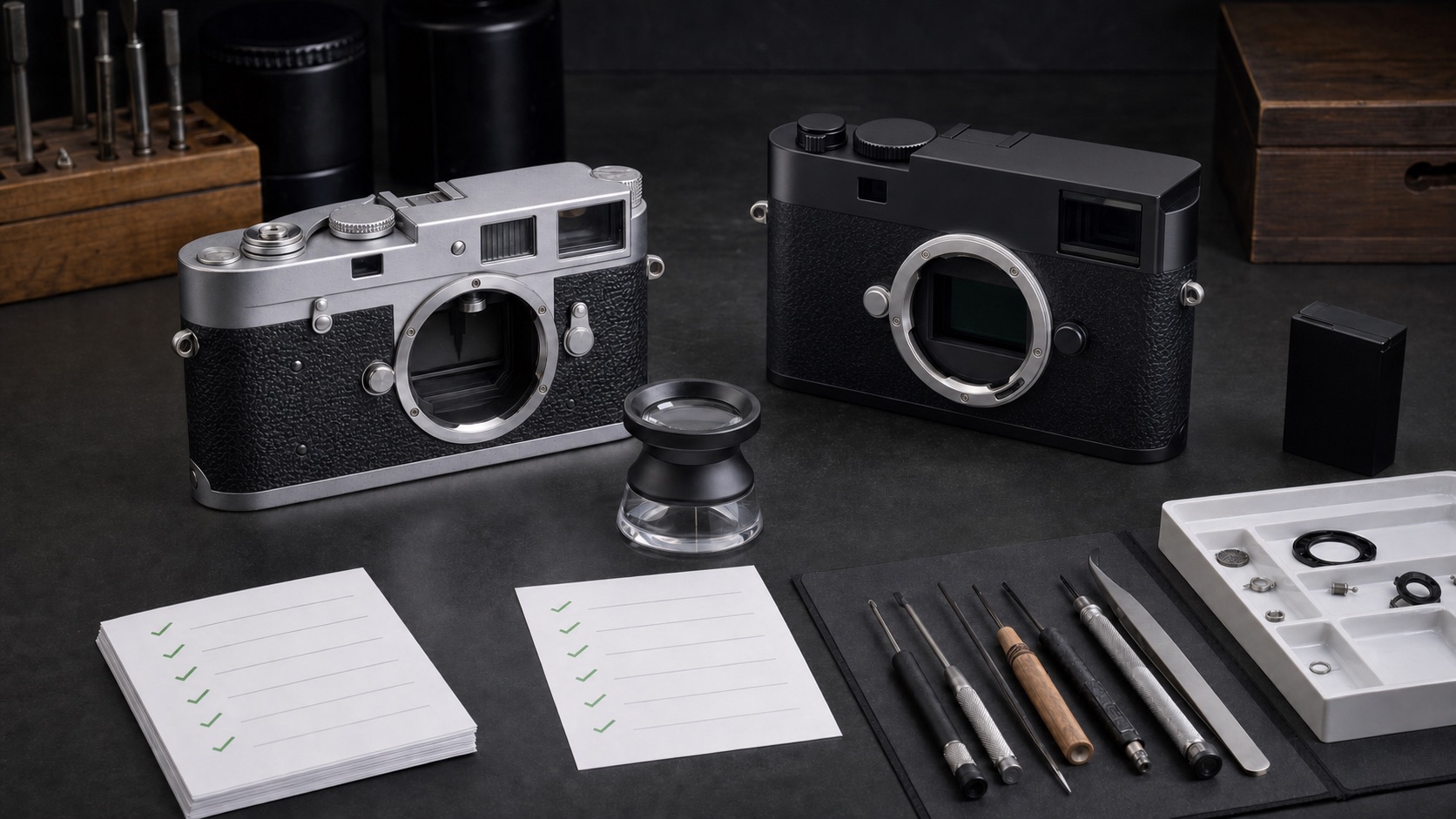
Used-camera inspection covering condition, shutter and sensor area, spare parts and serviceability. Temporary AI-generated symbolic image without authentic Leica branding; it will later be replaced with an original documentary photograph.
Language note: This is the English version of the Leica buying-used guide. Model pages that have not yet been translated open in the German namespace.
¶ Document Information
| Document information | Specification |
|---|---|
| Document ID | FW-KAM-LEI-19 |
| Title | Buying a Used Leica – Known Issues, Spare Parts and Serviceability |
| Section | Equipment – Cameras – Leica |
| Document type | Public buying guide and practical checklist |
| Responsible | Wiki owner |
| Version | 1.4 EN |
| Translation basis | German version 1.4 |
| Last reviewed | 4 August 2026 |
| Document status | Editorially reviewed for publication; serviceability remains case-specific |
| Classification | Public |
| Review basis | Official Leica service information, instruction manuals and selected specialist repair workshops, checked on 4 August 2026 |
| Wiki.js path | /Fotografen-Wiki/Ausruestung/Kameras/Leica/FW-KAM-LEI-19_Leica_Gebrauchtkauf_Schwachstellen_Ersatzteile_Servicefaehigkeit |
¶ Review Traffic Light
| Review area | Status | Result |
|---|---|---|
| Page title and SEO metadata | 🟢 Checked | Search intent, title, description and focus keyword are consistent |
| German translation basis | 🟢 Checked | Content synchronized with German version 1.4 |
| Analogue camera families | 🟢 Checked | Mechanical, metering and electronic risks are clearly separated |
| Digital camera families | 🟢 Checked | Sensor, display, storage, battery and electronics risks are covered |
| Leica Customer Care | 🟢 Checked | Current official service contact and repair information verified |
| Leica Service Certificate | 🟢 Checked | Eligible product groups, technical review and 24-month warranty wording verified |
| M9 service limitation | 🟢 Checked | Officially discontinued CCD-sensor replacement clearly identified |
| Image and accessibility | 🟢 Checked | Local 1672 × 941 px image, precise alternative text and enlargable view available |
| Internal and external links | 🟢 Checked | Targets reviewed; external sources open in a new tab |
Important: The traffic light confirms the editorial review status of this page. It is not a promise that a particular camera or fault can be repaired. Always request a current written assessment for the exact model, serial number and fault.
¶ 1. Buying a Used Leica: Buy Its Future, Not Just Its Present Condition
When buying a used Leica, scratches, shutter count and included accessories are not the only considerations. It is at least as important to ask whether a fault can still be repaired. A heavily used but mechanically sound Leica M3 may be the safer long-term choice than an immaculate electronic camera for which one essential component is no longer available.
This page therefore combines three assessments:
- Is the camera fully functional today?
- Which age- or model-specific risks need to be tested deliberately?
- Are spare parts, batteries, electronic modules and qualified workshops likely to remain available?
Core rule: A current functional inspection is not a promise of future repairability. Before an expensive purchase, ask Leica Customer Care or a suitable specialist workshop to confirm in writing, using the exact model and serial number, whether the relevant fault can still be repaired.
The issues listed here are inspection points. They do not mean that every camera in a particular series is affected.
¶ 2. Four Levels of Serviceability
| Rating | Meaning | Buying consequence |
|---|---|---|
| 🟢 High | Mechanical maintenance and typical wear-related repairs are generally realistic through Leica or specialist workshops | Good used candidate if the price allows for possible maintenance |
| 🟡 Medium | Many repairs are possible, but certain electronic or optical assemblies may be scarce | Clarify the specific fault and parts status before buying |
| 🟠 Limited | Repair depends heavily on remaining stock, donor equipment or a small number of specialists | Buy only at a substantial discount and with the failure risk accepted |
| 🔴 Critical | A central component is officially no longer replaceable or repair options are severely restricted | Buy only after a documented inspection or consciously as a collector’s item or risk purchase |
This rating is not a guarantee. A particular spare part may be unavailable even for a model that is generally serviceable.
¶ Evidence Hierarchy for a Serviceability Statement
| Reliability | Evidence | Appropriate use |
|---|---|---|
| Very high | Current written answer from Leica or a specialist workshop referring to the exact model, serial number and fault | Basis for a cost estimate and buying decision; still not an unlimited parts guarantee |
| High | Current official manufacturer information for a clearly identified model family or component | Establishes the stated official service or limitation |
| Medium | Current workshop page explicitly naming the model and type of work | Indicates competence or acceptance, but not parts availability for the individual camera |
| Low | Old invoice, forum post, sales listing or undated statement | Research lead only; never use as a repair commitment |
Beware of old documents: A sensor, display or electronics repair completed in the past does not prove that the same repair can still be performed today.
¶ 3. What Leica Officially Offers
Leica operates a worldwide service network and identifies Customer Care at its headquarters in Wetzlar for photographic products. According to the manufacturer, repair and maintenance work uses original spare parts where this remains possible for the particular product.
Official services include:
- diagnosis and a cost estimate,
- maintenance and repair,
- sensor cleaning,
- rangefinder and lens calibration,
- in some cases replacement covering or cosmetic work,
- inspection of used M, Q and SL cameras and M lenses,
- the Leica Service Certificate for qualifying used products.
After a successful inspection, the Leica Service Certificate includes a 24-month warranty from the date of inspection. Leica currently lists digital M cameras from the M9 onward, analogue M6, M7, MP and M-A (Typ 127) bodies, Leica SL and successors, Q2 and successors, plus Leica M and SL lenses. Whether a certificate can actually be issued is determined only after Leica Customer Care has technically reviewed the individual product. The certificate does not establish whether a different future fault will still be repairable.
¶ Official Special Case: The Leica M9 Family
Leica explicitly states:
- Production of the CCD sensors for the M9, M9-P, M Monochrom and M-E has ended.
- Defective sensors can no longer be replaced.
- Other repairs to this model generation remain possible until further notice.
An M9 whose sensor has not been clearly assessed is therefore a high-risk purchase. A clean test image at maximum aperture is insufficient; sensor corrosion is particularly visible on even surfaces and at smaller apertures.
¶ 4. Quick Overview by Camera Family
| Camera family | Typical buying inspection | Serviceability assessment in 2026 |
|---|---|---|
| Screw-mount Leica, M3, M2 and M4 | Shutter curtains, slow speeds, transport, rangefinder, finder separation and body covering | Often high for mechanical work; verify the specialist and parts for the individual case |
| M5 | Mechanics plus swinging-arm meter, electronics and battery issue | Medium to limited; not every M workshop accepts the M5 |
| M6 Classic and M6 TTL | Shutter, rangefinder, meter, viewfinder flare and top-plate corrosion | Mechanical core usually serviceable; clarify electronics and top plate in advance |
| M6 from 2022, MP and M-A | Shutter, rangefinder and transport; meter additionally on MP and M6 | Generally high, but confirm current acceptance and parts |
| M7 | Electronics, aperture priority, DX recognition, finder display and battery compartment | Medium; electronic assemblies are decisive |
| R3 to R7 | Shutter, electronics, finder, light seals and meter | Medium to limited and workshop-dependent |
| R6 and R6.2 | Mechanical shutter, meter, finder and transport | Usually more favourable than electronic R models, but verify R-specific parts |
| R8 and R9 | All electronics, displays, contacts, transport and shutter | Limited; confirm repair acceptance specifically before buying |
| R8/R9 with Digital-Modul-R | Additionally sensor, display, battery, charger and cables | Critical to severely limited; a complete and demonstrably functional set is essential |
| Analogue Leica compact cameras | Electronics, lens transport, shutter, flash and LCD | Often limited; economic total loss is possible |
| M8/M8.2 | Sensor, display, shutter, rangefinder and battery; consider IR sensitivity | Medium to limited; confirm repairability for the specific fault |
| M9 family | CCD sensor corrosion and sensor ID, shutter, display and battery | Critical for the sensor; official sensor replacement is no longer possible |
| M (Typ 240), M-P 240, M 262 and M246 | Sensor, rangefinder, shutter, display and BP-SCL2 battery | Medium; verify batteries and electronic assemblies before buying |
| M10 family | Rangefinder, shutter, display, sensor, battery and Wi-Fi | Medium to good; nevertheless confirm the particular parts stock |
| M11 family | Rangefinder, internal memory, SD card, USB-C, battery and firmware | Generally good at present; perform a complete functional and storage test |
| Q and Q2 | AF, OIS, macro ring, finder, sensor dust and battery | Medium to good; sensor cleaning requires dismantling because the lens is fixed |
| Q3 family | Additionally tilting display, USB-C, wireless charging and firmware | Generally good at present; test every moving and electronic function |
| SL (Typ 601), SL2 and SL2-S | EVF, sensor, IBIS from SL2, card slots, battery and ports | Medium; explicitly check battery and parts availability for the Typ 601 |
| SL3 family | IBIS, AF, EVF, memory cards, USB/HDMI and tilting display | Generally good at present; a professional complete inspection is advisable |
| CL, TL and TL2 | Display/touchscreen, EVF or Visoflex, battery, mount and ports | Medium to limited because the APS-C system has been discontinued |
| Leica S | Sensor, AF, central-shutter lenses, battery and system-specific electronics | Only after model-specific assessment; possible repair costs are very high |
No model-level guarantee: This table is an editorial risk pre-screening tool. It does not promise that Leica or a specialist workshop will accept the camera or that the component required for the particular fault is available.
Their largely mechanical construction is a major advantage. Specialist workshops continue to offer cleaning, lubrication and adjustment—often abbreviated to CLA—as well as shutter and finder work.
Inspect specifically:
- shutter curtains for holes, tears, creases and hardened material,
- even operation at every speed, particularly 1 s to 1/15 s,
- operation of the slow-speed escapement without pronounced overrun,
- film transport and rewind,
- correct frame spacing on a test film,
- rangefinder coincidence at infinity and close range,
- brightness and contrast of the rangefinder patch,
- finder for haze, fungus, separation or a damaged beamsplitter,
- bright-line frames and frame selector,
- rear door, baseplate and film pressure plate,
- brittle or missing vulcanite covering.
Independent specialists explicitly offer shutter-curtain replacement, replacement covering and recementing of separated rangefinder components for the M2, M3 and M4. This indicates good mechanical maintainability but is not a promise for every individual camera.
The M5 combines robust mechanics with an unusual TTL exposure meter. Its metering arm swings in front of the film and must move completely out of the light path when the shutter is released.
Inspection points:
- metering arm moves freely and fully,
- meter responds plausibly and repeatedly,
- battery compartment is free of corrosion,
- the battery or voltage adaptation in use is technically appropriate,
- finder displays work,
- shutter and film transport work correctly independently of the metering system.
Not every workshop specialising in classic M cameras accepts the M5. Identify a suitable workshop before buying.
The mechanical shutter works without a battery; the battery powers the exposure meter. The camera therefore remains usable if the metering electronics fail, but it loses an important convenience and value factor.
Known inspection points:
- meter responds evenly and without interruption,
- battery compartment and cover are undamaged and corrosion-free,
- viewfinder does not exhibit excessive flare in backlight,
- rangefinder is vertically and horizontally aligned,
- shutter speeds run evenly,
- film transport, frame counter and rewind work,
- top plate shows no bubbles or pinhead-like under-film corrosion.
Many older M6 bodies used die-cast zinc top plates. In unfavourable conditions, bubbles or corrosion marks may develop beneath the finish. Initially this is often cosmetic, but it can materially affect value. The M6 manufactured since 2022 has brass top and bottom plates according to Leica and must not be treated as equivalent to the classic M6 on this point.
Older finders may flare in backlight. Some specialist workshops offer conversion towards a newer, more flare-resistant finder. Before buying, establish whether such a modification has already been made and documented.
The M-A and MP have mechanically controlled shutters. The M-A has no exposure meter; the MP requires batteries only for metering. This reduces the risk of a complete electronic failure.
Inspection points:
- even shutter operation,
- smooth film transport,
- rangefinder calibration,
- bright-line frames,
- fit of baseplate and rear door,
- on the MP, additionally the meter and battery compartment,
- on black-painted examples, distinguish normal wear patina from corrosion.
Current production and their close constructional relationship to analogue M models still being manufactured suggest a comparatively favourable service outlook. This does not constitute a binding repair commitment.
The M7 depends more heavily on electronics. According to Leica’s instructions, exposure metering and all electronically controlled speeds require batteries. Only 1/60 s and 1/125 s remain mechanically available.
Test before buying:
- aperture priority across different light levels,
- every manually selectable speed,
- both mechanical emergency speeds without a battery,
- finder displays and exposure lock,
- DX recognition with different cartridges or simulated contacts,
- manual ISO setting,
- battery compartment, contacts and cover,
- shutter behaviour with a weak battery,
- any documented finder or DX modifications.
An electronic fault can substantially limit usability. Confirm acceptance by Leica or a qualified workshop before an expensive purchase.
These models contain a substantial amount of electronics. In addition to normal age-related issues such as light seals, finder contamination and mirror buffers, exposure metering, shutter control, displays and contacts are critical.
Inspect:
- every exposure program and manual shutter speed,
- metering against known reference values,
- aperture transmission with several R lenses,
- mirror and shutter operation,
- finder display and illumination,
- self-timer, multiple exposure and motor connection where applicable,
- battery compartment for leaked cells,
- light seals and mirror buffer.
Some specialist businesses explicitly include R3 to R7 in their repair lists, while others do not accept R cameras at all. Service is possible but not universally available.
The mechanically controlled shutter makes the R6 and R6.2 more attractive in the long term than fully electronically dependent R bodies. The meter and its display nevertheless remain electronic components.
Also inspect:
- correct shutter speeds without a battery,
- integral and selective metering,
- depth-of-field preview,
- mirror lock-up on the R6.2,
- advance lever, frame counter and rewind,
- focusing screen, prism and finder,
- lens coupling and aperture control.
The R8 and R9 are complex electronic cameras. An externally excellent body is not sufficient evidence of reliable operation.
Mandatory tests:
- every exposure mode,
- shutter speeds and continuous operation,
- film transport, rewind and frame counter,
- top and rear displays,
- control wheels and switches without contact interruptions,
- flash control,
- motor or drive accessories,
- aperture transmission and ROM contacts,
- battery compartment and rechargeable-battery accessories.
Specialist workshops may list the R8 and R9 only “on request”. Serviceability should be treated as limited without a specific repair confirmation.
The Digital-Modul-R adds discontinued digital components:
- sensor and sensor cover glass,
- display,
- electronics,
- dedicated battery and charger,
- cables and memory-card compatibility,
- mechanical connection between the R8/R9 and digital back.
Buy a DMR only as a completely tested set with battery, charger, cables and current DNG test files. A missing accessory may restrict use more severely than cosmetic body damage.
¶ 7. Analogue Leica Compact Cameras
Leica Mini, Minilux, CM and related compact cameras use fixed lenses, motorised film transport, electronics and in some cases complex shutter/aperture modules. Their small size does not make them inherently easy to repair.
Before buying:
- switch the camera on and off repeatedly,
- allow the lens to extend and retract completely,
- test AF with close and distant subjects,
- test shutter and aperture over several settings,
- charge and fire the flash,
- check film transport and rewind with a test film,
- inspect the complete LCD,
- examine the battery compartment for corrosion,
- make several consecutive exposures.
A fault in a flexible circuit, motor unit, display or specialised electronics may be technically or economically irreparable. A right of return is especially valuable here.
The pronounced infrared sensitivity is a design characteristic, not a defect. Certain dark textiles may show substantial colour shifts without a UV/IR-cut filter.
Inspect:
- sensor at low ISO and a small aperture,
- display for lines, marks and ageing,
- shutter sound and every speed,
- rangefinder calibration with 28, 50 and, where possible, 90 mm lenses,
- battery under load and availability of a replacement,
- charger and cables,
- SD-card operation,
- buttons, control wheel and USB port,
- DNG files for banding, hot pixels and write errors.
Repairability of a particular sensor, display or electronic fault must be confirmed before buying.
Sensor inspection has the highest priority.
Recommended test:
- Stop the lens down to at least f/11.
- Photograph an evenly bright sky or homogeneous surface slightly out of focus.
- Inspect the DNG file at 100 per cent.
- Increase contrast and clarity for diagnosis only.
- Look for branching, blotchy or dot-like structures.
- Request evidence of any previous sensor replacement and the sensor version.
Dust can be cleaned; corrosion or damage to the sensor cover glass is different. Because Leica can no longer supply replacement CCD sensors, an affected M9 is sensible for normal use only with a substantial acceptance of risk.
Also inspect:
- shutter and shutter count,
- rangefinder,
- display,
- battery and charger,
- SD-card slot,
- buttons and thumb wheel,
- DNG writing.
This generation is newer than the M9 but is now also affected by ageing electronic components and batteries.
Inspection points:
- sensor for scratches, marks, hot pixels and even rendering,
- rangefinder at several distances,
- Live View and Visoflex where applicable,
- shutter across its entire speed range,
- display and buttons,
- video on the Typ 240/M-P if relevant,
- BP-SCL2 battery under realistic load,
- charger, accessory connector and SD cards,
- DNG/JPEG storage and firmware version.
The fact that a battery or accessory is listed in an old manual does not establish that it is available today. Verify that a replacement battery and charger can actually be purchased before buying.
Inspect:
- rangefinder coincidence at infinity and approximately one metre,
- sensor at base ISO and higher sensitivities,
- mechanical shutter and continuous shooting,
- ISO dial, thumb wheel and buttons,
- display,
- Wi-Fi/Leica FOTOS if important to the intended use,
- BP-SCL5 battery and charger,
- Visoflex compatibility with the intended accessory,
- particularly highlights and sensor uniformity on the M10 Monochrom.
An imperfectly calibrated rangefinder can often be corrected, but it should not automatically be priced as a trivial issue. The camera and a critical lens may need to be calibrated together.
In addition to classic rangefinder checks, test every digital storage route:
- completely fill and read the internal memory,
- test the SD card separately and in the chosen storage strategy,
- test USB-C data transfer and charging,
- insert and remove the battery and test it under load,
- verify current firmware and a documented reset,
- record several bursts and long exposures,
- open DNG files in every resolution that will be used,
- test Leica FOTOS and Bluetooth only if they form part of the workflow.
An intermittent fault is harder to assess than a permanently reproducible one. Make at least 50 to 100 test exposures while alternating between playback, standby, SD card and internal memory.
On Q cameras, the lens and body form one unit. Sensor dust cannot be reached simply by removing the lens. Leica notes for its cleaning service that a Q must be dismantled for sensor cleaning.
Inspect:
- AF-S and AF-C,
- manual focusing and focus magnification,
- macro ring and focusing ring,
- aperture ring,
- optical stabilisation,
- mechanical and electronic shutters,
- finder for marks, flicker and dead pixels,
- sensor at f/16,
- display or tilting mechanism,
- microphone, speaker and video if required,
- USB-C and wireless charging on supported Q3 models,
- battery and charging options.
A dust spot need not rule out a purchase, but the necessary dismantling must be included in the cost calculation.
Inspect:
- L-Mount for play and damaged contacts,
- AF with at least two lenses,
- IBIS on SL2 and SL3,
- EVF and eye sensor,
- both memory-card slots,
- USB, HDMI, flash shoe and any other required ports,
- sensor and shutter,
- battery under burst and video load,
- microphone and headphone sockets,
- video recording in the formats actually required,
- fan or temperature behaviour where model-dependent,
- tilting monitor on the SL3.
For the SL (Typ 601), pay particular attention to battery, charger and older electronic assemblies.
The APS-C system is no longer a current camera line. Its lenses remain optically interesting and, depending on the lens, can continue to be used on L-Mount bodies, but the camera electronics are not modularly replaceable.
Inspect:
- touchscreen over its entire area,
- control wheels and buttons,
- internal storage on TL/TL2,
- SD card and USB,
- AF and mount contacts,
- integrated EVF on the CL or Visoflex on the TL/TL2,
- BP-DC12 or BP-DC13 battery and matching charger,
- Wi-Fi/app as an additional function, not the sole evidence of operation.
A used purchase in the S-System requires separate assessment of the body and every lens. Potentially high repair costs justify a manufacturer or dealer diagnosis.
Inspect:
- sensor and finder,
- AF accuracy,
- battery and charger,
- card slots and tethering,
- central shutter on CS lenses,
- aperture control,
- lens AF and focus repeatability,
- current repair acceptance for the exact body and lens.
¶ 10. Leica Lenses: Often Durable, but Not Automatically Trouble-Free
¶ Mechanical and Optical Inspection Points
- inspect glass surfaces in oblique light for scratches and cleaning marks,
- use a torch only diagnostically to look for haze, fungus and separation,
- check aperture blades for oil, slow closing and uneven alignment,
- check the focusing ring for play, scraping and stiff points,
- inspect the infinity stop and rangefinder coupling,
- examine the filter thread and mount for impact marks,
- check 6-bit coding or ROM contacts,
- test decentring by photographing a flat, detailed surface,
- with floating elements, test the entire close-focusing range,
- with SL lenses, test AF, OIS, firmware and electronic aperture.
¶ Fungus and Haze
Light internal dust is normal in older lenses. Fungus, heavy haze or separation can significantly affect contrast, backlight behaviour and value. Cleaning is not always complete or economical for every construction.
¶ M Lens and Rangefinder as a Unit
A lens may focus correctly on camera A and visibly miss on camera B. Test fast M lenses:
- at maximum aperture,
- at close range,
- at medium distance, and
- at infinity
with the intended body. Leica explicitly offers calibration of older M lenses for the higher demands of digital sensors.
¶ 11. Assessing Spare Parts Correctly
¶ Consumables and Accessories
Usually easier to replace:
- body caps,
- eyecups,
- carrying straps,
- body coverings,
- sync sockets or covers,
- standard batteries for analogue light meters where a suitable replacement exists.
¶ Model-Specific Wear Parts
Verify individually:
- shutter curtains,
- gears and transport parts,
- rangefinder components,
- top plates,
- battery-compartment covers,
- seals and mirror buffers,
- display covers,
- lens helicoids or aperture components.
¶ Critical Electronic or Optoelectronic Assemblies
Highest risk:
- sensor and sensor cover glass,
- main circuit board,
- display and EVF,
- AF or OIS assembly,
- electronically controlled shutter,
- flexible circuit boards,
- proprietary batteries and chargers,
- motor and lens units in compact cameras,
- DMR-specific components.
Important: “Spare parts are generally available” is too vague. A reliable answer requires the model, serial number, fault description and required work.
¶ 12. A 20-Minute Buying Inspection for Digital Leica Cameras
¶ Preparation
Bring:
- your own known-good lens,
- a freshly formatted compatible memory card,
- a card reader or laptop/tablet,
- a torch,
- a charged reference battery if available,
- a white or evenly coloured test surface.
¶ Test Sequence
- Document the serial number, model and included items.
- Inspect the body for impact, moisture and signs of opened screws.
- Make a sensor photograph at base ISO and f/11 to f/16.
- Inspect a high-ISO image for unusual lines or major defects.
- Operate every button, dial, door and port.
- Make single exposures and a burst.
- Test the mechanical and electronic shutters where available.
- Check focusing with near and distant subjects.
- On M cameras, test the rangefinder at several distances.
- On Q and SL cameras, test AF, EVF, OIS/IBIS and video.
- Save DNG and JPEG files and open them outside the camera.
- Test the SD card, internal memory and USB separately.
- Observe the battery indicator during continuous shooting, playback and data transfer.
- Switch the camera off, remove the battery, restart and check the settings.
- Check firmware and a factory reset only with the seller’s consent.
¶ 13. Buying Inspection for Analogue Leica Cameras
An inspection without film will reveal many but not all faults.
¶ Dry Test
- compare shutter speeds acoustically and visually,
- open the back and examine the shutter curtains against light,
- test film transport and rewind,
- check the rangefinder at infinity and close range,
- compare the exposure meter with a reference reading,
- test the self-timer and frame selector,
- check flash synchronisation where possible,
- inspect the battery compartment,
- examine seals, mirror buffer and pressure plate.
¶ Test Film
A test film provides stronger evidence:
- bright and dark subjects,
- all important shutter speeds,
- maximum aperture and stopped down,
- close range and infinity,
- an even surface to reveal light leaks,
- complete film transport,
- frame spacing and rewind.
Assess the negatives or transparencies together with a shooting record. For valuable cameras, a recent workshop invoice is often more informative than the statement that the camera “worked fine on the last roll”.
¶ 14. Documents and Accessories That Genuinely Increase Value
- original invoice or traceable provenance,
- matching serial number on invoice and equipment,
- repair invoices stating the work performed,
- documented sensor replacement on older digital cameras,
- current Leica or workshop inspection report,
- Leica Service Certificate where available,
- original-resolution DNG test files,
- shutter count where it can be read reliably,
- original batteries and chargers,
- complete specialised accessories,
- right of return or dealer warranty.
The original box and cosmetic condition affect value but reveal little about the shutter, sensor, rangefinder or electronics.
¶ 15. Allowing for Maintenance and Repair
Alongside the sale price, budget a risk reserve:
Total risk = purchase price + immediate maintenance + missing accessories + possible major fault
Examples:
- Mechanical analogue M: possible CLA, finder calibration and shutter curtains.
- M6/M7: additionally meter or electronics.
- R8/R9: electronics that may be difficult to obtain.
- M9: non-replaceable CCD sensor as an exclusion risk.
- Q: dismantling for sensor cleaning or lens/AF work.
- Older digital M/SL/CL: battery, charger, display and electronics.
- DMR: battery, charger and non-replaceable specialised components.
If the possible major fault approaches the camera’s economic value, the purchase price should clearly reflect that risk.
¶ 16. Enquiry to Leica Customer Care or a Specialist Workshop
Template:
Subject: Repair and spare-parts enquiry before buying used – Leica [model], serial number [number]
I am considering buying a Leica [exact model designation] with serial number [number].
Known or suspected fault: [fault description]. Could you please tell me whether this model, and specifically the stated fault, are currently accepted and can in principle be repaired? Are the spare parts normally required for this work still available? I would also be grateful to know whether a paid inspection or Service Certificate is possible before purchase. I understand that a binding diagnosis can only be made after the equipment has been submitted.
Keep the written reply with the purchase documents. It records the position at the time of enquiry and is not an unlimited spare-parts guarantee.
¶ 17. Decision Matrix
| Finding | Recommendation |
|---|---|
| Mechanical M, fully functional, specialist workshop available | Good buying candidate at an appropriate price |
| Minor misalignment with repairability confirmed in writing | Include the estimate in the purchase price |
| Old electronic model without an opportunity to test | Buy only with a right of return or a substantial risk discount |
| M9 without a meaningful sensor test | Do not buy, or buy only as a conscious risk |
| DMR without a working battery and charger | Buy only as a collector’s item or for parts |
| Q with sensor dust | Account for cleaning costs and required dismantling |
| Analogue compact camera with intermittent electronic fault | Generally do not buy |
| Dealer offer with a current inspection and warranty | A higher price may be justified by lower risk |
| Private offer without serial number, DNG file or functional evidence | Abandon the purchase or require a full personal inspection |
¶ 18. Fraud, Provenance and Collector Value
For expensive Leica products:
- request the serial number before payment,
- compare it with the body, box and documents,
- exclude stolen or manipulated goods,
- do not rely solely on irreversible payment methods,
- check photographs with reverse-image search,
- have the authenticity and contents of special editions assessed professionally,
- document engravings, repainting and replaced parts,
- assess collector originality separately from technical usability.
A renewed shutter or recemented finder may be positive for use but may affect originality value in a historically important collector’s camera.
¶ 19. Frequently Asked Questions
¶ Can Every Old Mechanical Leica Be Repaired?
No. The prospects are often good, but individual finder, body or shutter components may be unavailable. Impact, water and corrosion damage may also be uneconomical.
¶ Is the Shutter Count the Most Important Criterion?
No. Shutter operation, sensor, rangefinder, moisture, storage operation and repairability matter more than an isolated counter figure.
¶ Can I Safely Buy a Leica M9 with a Replaced Sensor?
Only after inspection. The sensor-replacement record, exact sensor version and current test DNGs must correspond. A previously replaced sensor and the remaining electronics continue to age.
¶ Is a Leica M6 with a Defective Meter Still Usable?
The mechanical shutter works without a battery. The camera can be used with an external light meter, but the fault affects convenience, value and resale.
¶ Are the M-A and MP the Safest Analogue Models?
Their mechanical construction and proximity to the current system are favourable. Damage, misalignment and unavailable individual parts remain possible.
¶ Why Is Sensor Dust More Expensive to Address on a Leica Q than on an M?
The lens can be removed from an M, providing direct access to the sensor. A Q has a fixed lens; Leica notes that the camera must be dismantled for sensor cleaning.
¶ Is a Dealer Inspection Sufficient?
It is considerably better than no inspection. The scope, date, warranty and functions actually tested should be documented in writing.
¶ How Current Is the Serviceability Assessment?
This page was reviewed on 4 August 2026. Spare parts and repair acceptance can change at any time. The current answer for the specific equipment is decisive.
¶ 20. Related Photographer Wiki Pages
| Topic | Link |
|---|---|
| Leica overview | Open FW-KAM-LEI-01 |
| Used Leica cameras – fundamentals | Open FW-KAM-LEI-GEB-01 – German |
| Leica M | Open FW-KAM-LEI-02 – German |
| Leica M-A and MP | Open FW-KAM-LEI-MAMP-01 – German |
| Leica M9 | Open FW-KAM-LEI-M9-01 – German |
| Leica M (Typ 240) | Open FW-KAM-LEI-M240-01 – German |
| Leica M Monochrom (Typ 246) | Open FW-KAM-LEI-M246-01 – German |
| Leica R 6.2 | Open FW-KAM-LEI-R62-01 – German |
| Leica R9 with Digital-Modul-R | Open FW-KAM-LEI-R9DMR-01 – German |
| Leica compact cameras | Open FW-KAM-LEI-07 – German |
| Leica CL/TL | Open FW-KAM-LEI-05 – German |
| Leica SL | Open FW-KAM-LEI-04 – German |
| Leica serial numbers | Open FW-KAM-LEI-11 – German |
| Leica M lens coding | Open FW-OBJ-LEI-M-01 – German |
| Leica R lenses | Open FW-OBJ-LEI-R-01 – German |
¶ 21. SEO Data for Wiki.js
| Field | Content |
|---|---|
| Page title | Buying a Used Leica: Known Issues, Spare Parts and Service |
| Meta description | How to buy a used Leica: known issues, spare parts, serviceability and inspection checks for analogue and digital Leica M, R, Q, SL and CL cameras. |
| Focus keyword | buying a used Leica |
| Secondary keywords | used Leica, Leica known issues, Leica spare parts, Leica repair, used Leica M, buying an analogue Leica |
| Slug | FW-KAM-LEI-19_Leica_Gebrauchtkauf_Schwachstellen_Ersatzteile_Servicefaehigkeit |
| Search intent | Buying advice, fault diagnosis, repairability and risk assessment |
¶ 22. Sources and Review Status
¶ Official Leica Sources
- Leica repair and maintenance, including current information on M9 repairability
- Leica service contact – Customer Care Wetzlar and Photography Spare Parts
- Leica M-System service – lens calibration and sensor cleaning
- Leica Service Certificate – eligible products, technical review and 24-month warranty
- Leica M7 – instructions and mechanical emergency speeds
- Leica M6 from 2022 – instructions and brass top plate
- Leica M-A – downloads and technical documents
- Leica MP – downloads and technical documents
- Leica M (Typ 240) – instructions and BP-SCL2
- Leica TL2 – instructions and BP-DC13
- Leica CL/TL system accessories
¶ Additional Workshop Sources
- Leica M Classics – repairs accepted for analogue M models
- Cologne Camera Service – listed Leica M models
- YYeCAMERA – typical work on classic Leica M cameras
- Paepke Fototechnik – overview of repairable types; R8/R9 on request
- Kameraspezi – repair range and model-dependent limits
¶ Source Note
Official Leica information takes precedence. Workshop lists indicate only which work or models the respective business mentioned at the time of publication or review. They are not a general promise of parts availability. Experience reports were used only as prompts for specific inspection points; unconfirmed serial defects are not presented as established facts.
Source status: 4 August 2026. Repair acceptance, spare-parts stocks, prices and eligibility for a Service Certificate can change at short notice. Next scheduled review: 4 November 2026, or earlier if Leica changes its service information.
¶ 23. Change History
| Version | Date | Change |
|---|---|---|
| 1.4 EN | 4 August 2026 | Synchronized with German version 1.4; added the vertical review traffic light, evidence hierarchy, warning blocks, tab sets, precise Service Certificate scope, enlargable title image and external links opening in a new tab |
| 1.2 EN | 31 July 2026 | Replaced the invalid reference with the valid German lens-coding page FW-OBJ-LEI-M-01 |
| 1.0 | 28 July 2026 | Created an SEO-oriented buying guide covering known Leica inspection points, spare parts and serviceability for analogue and digital cameras |
| 1.0 EN | 28 July 2026 | Created the complete English translation; retained the same Wiki.js path under locale en and linked untranslated model pages explicitly to the German locale |