¶ Leica M6 – Technology, Operation, Variants and Buying Guide
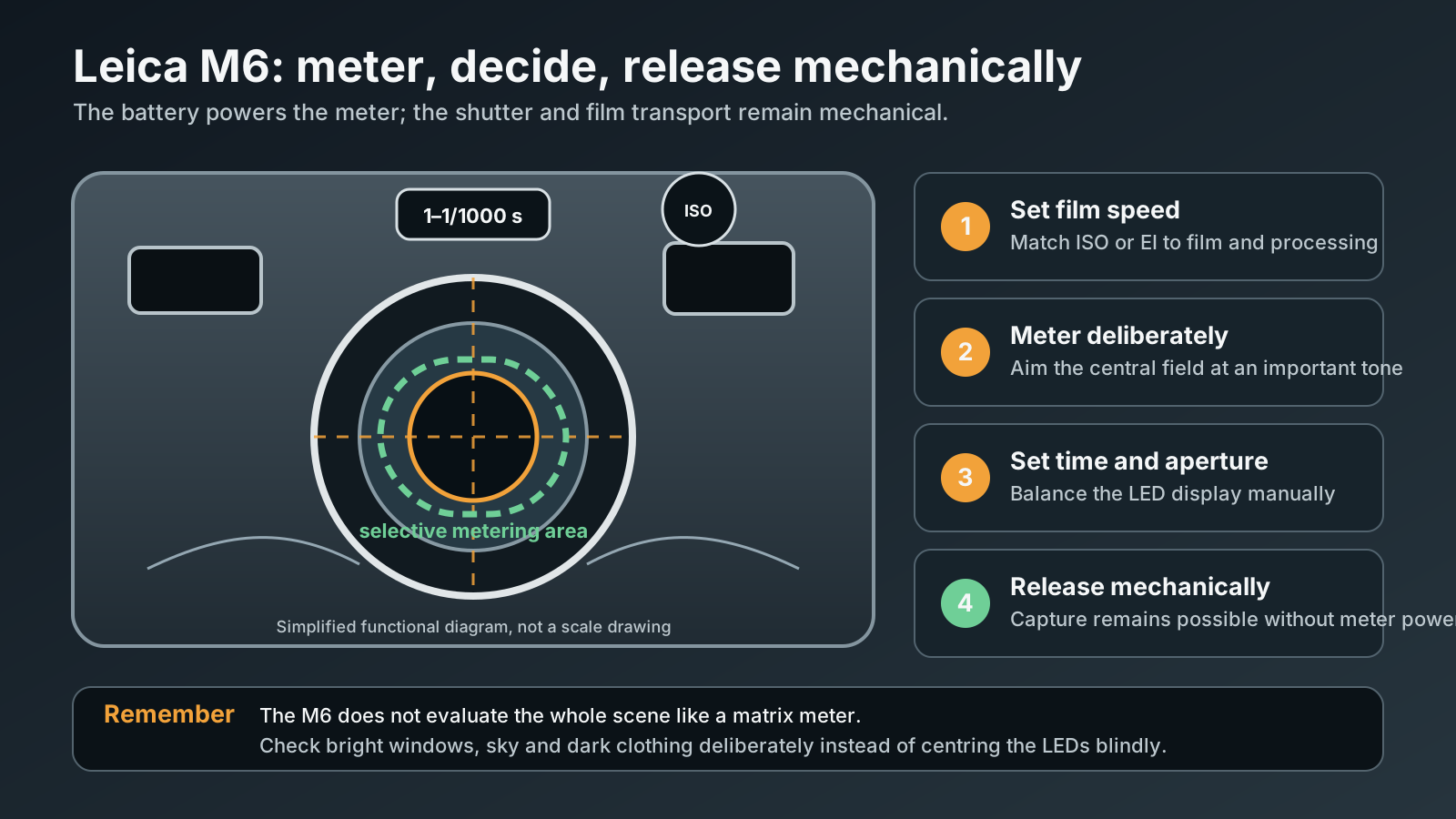
The Leica M6 combines mechanical image capture with selective TTL exposure metering. Original English technical illustration created for the Photographer Wiki; open it in a new tab for the full-size view.
The Leica M6 is an analogue 35 mm rangefinder camera with a Leica M mount, manual focusing and manual exposure control. Its mechanically controlled cloth focal-plane shutter and film transport work without a battery. Electrical power is required only for the built-in exposure meter and its LED display.
Short answer: The M6 suits photographers who want to set film speed, distance, aperture and shutter speed deliberately but still value an in-camera meter. Anyone expecting automatic exposure, autofocus, close-up convenience or an immediate preview needs a different camera concept.
Language note: This is the English version of the Leica M6 page. Specialist articles that have not yet been translated open explicitly in the German namespace.
¶ Document Information
| Document information | Definition |
|---|---|
| Document ID | FW-KAM-LEI-M6-01 |
| Title | Leica M6 – Technology, Operation, Variants and Buying Guide |
| Area | Equipment – Cameras – Leica – Leica M6 |
| Document type | SEO model, practical-use and buying guide |
| Manufacturer | Leica Camera AG |
| Responsible | Wiki owner |
| Version | 2.0 EN |
| Translation basis | German version 2.0, independently reviewed against official English Leica sources |
| Last reviewed | 4 August 2026 |
| Next review | 4 February 2027 or after changes to model, price, warranty or service information |
| Document status | Public – editorially reviewed |
| Classification | Public |
| Source status | Current Leica M6 product page, technical data, English instructions, press release, timeline and service information; reviewed on 4 August 2026 |
| SEO title | Leica M6 – Technology, Operation, Variants and Buying Guide |
| Meta description | Leica M6 explained in detail: current reissue, classic M6 and M6 TTL, specifications, selective TTL metering, focusing, film choice and used-camera checks. |
| Wiki.js tags | leica m6, leica m6 2022, leica m6 ttl, analogue leica, rangefinder camera, used leica |
| Wiki.js path | /Fotografen-Wiki/Ausruestung/Kameras/Leica/Leica_M6/FW-KAM-LEI-M6-01_Leica_M6 |
¶ Review Traffic Light
| Review area | Status | Result |
|---|---|---|
| Page title and SEO data | 🟢 Checked | Search-oriented title, description, tags and focus terms are consistent |
| German translation basis | 🟢 Checked | Content synchronized with German version 2.0 |
| Current M6 specifications | 🟢 Checked | Type, format, finder, shutter, metering, dimensions and weight checked against Leica data |
| Historical classification | 🟢 Checked | Classic M6, M6 TTL and 2022 reissue clearly separated |
| Operation and exposure | 🟢 Checked | Film loading, selective metering, focusing and battery-independent operation explained |
| Buying and service guidance | 🟠 Review per camera | Condition, parts and repairability must be confirmed for the individual body |
| Images and accessibility | 🟢 Checked | Three local images below 1 MB, descriptive alternative text and full-size links provided |
| Internal links | 🟢 Checked | English direct links and German fallback links reviewed |
| External sources | 🟢 Checked | Official English Leica sources reviewed and configured to open in a new tab |
¶ 1. Leica M6 at a Glance
Leica introduced the M6 in 1984. The manufacturer summarises the historical production period as 1984 to 2002, with almost 175,000 cameras made. Within this long history, classic M6 versions must be distinguished from the later M6 TTL. Since November 2022, Leica has offered a technically revised reissue.
The underlying concept remains:
- 35 mm film with a 24 × 36 mm image area,
- Leica M mount for manually focused M lenses,
- optical rangefinder with projected bright-line frames,
- selective TTL exposure metering at working aperture,
- mechanical cloth focal-plane shutter,
- manual selection of shutter speed, aperture and distance.
Do not mix variants: “Leica M6” can mean a historical M6, an M6 TTL or the reissue introduced in 2022. Specifications, shutter-speed dial, flash functions, manual, parts availability and buying price should be transferred only after the camera has been identified precisely.
¶ 2. Technical Data of the Current Leica M6
The following table describes the Type 2248 reissue introduced in 2022. Historical cameras may differ.
| Feature | Current Leica M6 |
|---|---|
| Camera type | Analogue 35 mm rangefinder system camera |
| Type and order number | Type 2248; black 10 557 |
| Image format | 24 × 36 mm on 35 mm film |
| Lens mount | Leica M bayonet |
| Focusing | Manual split-image and superimposed-image rangefinder |
| Viewfinder magnification | 0.72× |
| Bright-line frames | 28/90 mm, 35/135 mm and 50/75 mm |
| Shortest coupled distance | 0.7 m; additionally dependent on the lens |
| Shutter | Mechanically controlled cloth focal-plane shutter |
| Shutter speeds | 1 s to 1/1,000 s plus B |
| Flash synchronisation | 1/50 s |
| Exposure metering | Selective through-the-lens metering at working aperture; reflected from the bright metering spot on the first shutter curtain |
| Metering field | Approximately 13% of the negative format |
| Exposure control | Manual, using two LED arrows and a confirmation dot |
| Film speed | ISO 6 to ISO 6,400, set manually |
| Power supply | 2 × SR44/PX76 or 1 × DL1/3N; only for metering and display |
| Body | Closed all-metal body; brass top and bottom covers, black finish |
| Dimensions | Approximately 138 × 40 × 77 mm |
| Weight | Approximately 575 g without battery |
| Operating conditions | 0 °C to +40 °C |
Photography remains possible without a battery: Film transport and the mechanical shutter continue to work. Metering and the LED display are unavailable, so exposure must then be determined externally or from reliable experience.
¶ 3. Distinguishing the Classic M6, M6 TTL and 2022 Reissue
Leica describes the historical M6 as a model family produced from 1984 to 2002. Buying and documentation require a more precise distinction:
| Feature | Classic M6 | M6 TTL | M6 from 2022 |
|---|---|---|---|
| Classification | Original M6 from 1984 | Later, distinct historical variant | Current reissue |
| Exposure metering | Selective continuous TTL metering | Selective TTL metering | Selective continuous TTL metering |
| Display | Classic arrow display, depending on version | Variant-specific display | Two arrows, red confirmation dot and battery warning |
| Flash | Conventional synchronisation | Extended TTL flash control | Conventional synchronisation; not equivalent to the M6 TTL |
| Shutter-speed dial | Classic direction and design | Larger, with different operation | Based on the classic concept |
| Top plate | Zinc die-cast on the standard classic series | Depends on variant | Milled from solid brass |
| Buying route | Used | Used | New or used |
| Main check | Condition, calibration, history and parts | Additionally TTL flash system and exact manual | Invoice, warranty, condition and current supplied items |
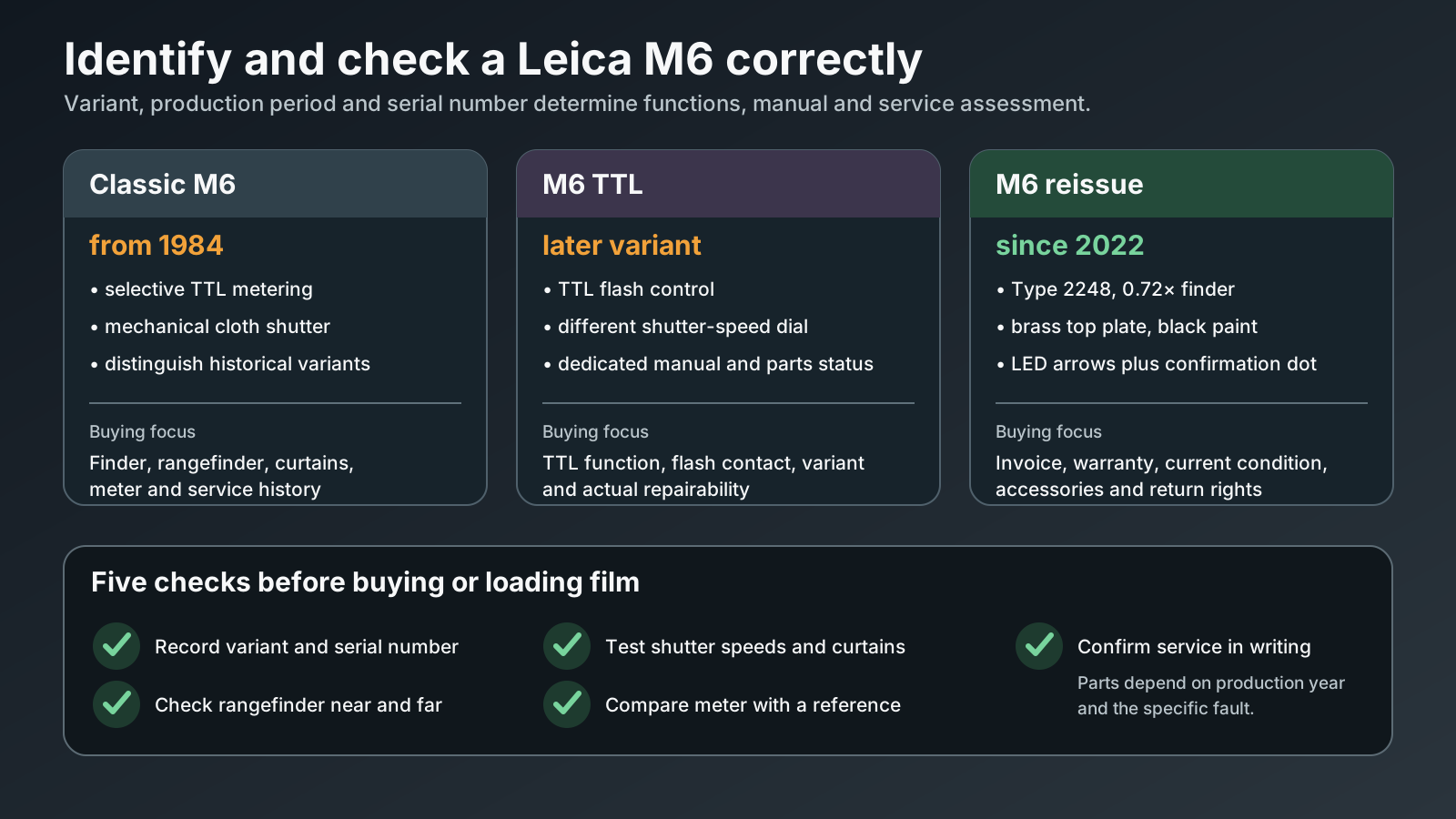
Variant and serial number are the starting points for every buying, manual and service decision. Original English technical illustration created for the Photographer Wiki; open it in a new tab for the full-size view.
¶ 4. Interactive Model and Buying Decision
The filters support an initial classification. They do not replace testing the actual camera or obtaining written service information.
3 of 3 M6 variants
| Classification | Distinguishing feature | Main buying check | Best suited when | |
|---|---|---|---|---|
| Classic M6 | Historical, from 1984 | Original M6 concept | Finder, rangefinder, curtains, meter and service history | Originality and classic operation matter more than a current warranty |
| M6 TTL | Later historical variant | TTL flash control and different shutter-speed dial | TTL function, flash contact, exact variant and parts status | TTL flash with an analogue M camera is explicitly required |
| M6 from 2022 | Current reissue, Type 2248 | Coated 0.72× finder, brass top plate and extended LED display | Invoice, warranty, current supplied items and condition | A new camera and a clear manufacturer route are preferred |
| No matching M6 variant found. Change or reset the filters. | ||||
Technical requirement: Search, filtering and sorting use the centrally installed filter-table component. Without JavaScript, the complete comparison table remains visible and readable.
¶ 5. Exposure Metering in Practice
The internal meter evaluates a limited area in the centre of the image. The M6 has no multi-field or matrix metering. This is useful for deliberate measurements but requires conscious subject evaluation.
¶ Standard Procedure
- Set the film speed to match the film, exposure index and planned development.
- Aim the central metering field at an important tonal value.
- Change aperture or shutter speed until the arrows and confirmation dot indicate the desired exposure.
- In high-contrast scenes, meter shadows and highlights separately.
- Return to the final composition, focus and release the shutter.
¶ Common Metering Errors
| Situation | Risk | Practical response |
|---|---|---|
| Bright sky occupies much of the frame | Foreground becomes too dark | Meter the ground or a midtone separately |
| Bright window in a dark room | Interior is strongly underexposed | Meter interior and window separately, then set a priority |
| Black clothing fills the metering field | Image becomes too bright | Meter skin, a grey card or a comparable tone |
| Snow or bright sand | Result becomes too grey | Give more exposure after evaluating the subject |
| Stage or spot lighting | Small highlight can dominate | Meter illuminated skin or the main subject deliberately |
Negative film does not prevent exposure errors: Colour and black-and-white negative films often offer latitude, but it depends on the film, development and scanning process. Slide film reacts much more critically to exposure errors.
¶ 6. Rangefinder, Bright-Line Frames and Focusing
Turn the lens focusing ring until the double contours coincide in the central rangefinder patch. The bright-line frames show the probable image area for the selected focal length. They are not a through-the-lens view and do not display actual depth of field or filter effect.
Analogue film rolls, negatives and contact sheets representing the Leica M6 workflow. Temporary AI-generated illustration; it will later be replaced by an original photograph.
¶ Suitable Focusing Methods
- Rangefinder focusing: for wide apertures, static subjects and precise focus placement,
- prefocusing: at an expected subject distance for reportage and events,
- zone focusing: for street photography and dynamic situations,
- hyperfocal setting: for documentary overviews, travel and landscapes.
If images are repeatedly unsharp, operation, lens and rangefinder must be checked separately. A seemingly aligned rangefinder image does not prove that the lens and camera rangefinder are calibrated correctly as a pair.
¶ 7. Loading Film and the First Functional Check
¶ Before Loading
- Check that the battery compartment is clean and dry.
- Insert a suitable battery with the correct polarity.
- Inspect the shutter curtains visually without touching them.
- Decide on film, rated speed and planned exposure index.
- Lock the lens correctly and remove the front cap.
¶ Checking Film Transport
Load and thread the film according to the manual. During careful film advance, the rewind crank should rotate as an indication that the film is moving. The frame counter alone does not reliably prove that the film has been transported.
Do not touch the shutter curtains: They are essential to operation and easily damaged. Do not place fingers, tools or compressed air inside the shutter chamber. If anything appears abnormal, close the camera and have it checked professionally.
¶ 8. Personal Use with Kodak TRI-X 400
The Leica M6 fits the author’s analogue workflow with Kodak TRI-X 400. This combination is particularly suitable for:
- festivals, events and reportage,
- street photography and photowalks,
- lost places and documentary series,
- landscapes and deliberate individual exposures,
- a compact 35 mm kit using M-mount prime lenses.
An article on the author’s website documents use of the Leica M6 with TRI-X 400 at Radquartier Kirchenlamitz. An earlier description of the M6 as a “medium-format camera” is incorrect and should be corrected: the Leica M6 is a 35 mm camera.
¶ Personal Shooting Record
| Date/project | Lens | Film/EI | Shutter/aperture | Filter | Development | Result |
|---|---|---|---|---|---|---|
| TRI-X 400 / |
¶ 9. Buying Used and Functional Checks
¶ Identity and Documents
- Photograph the exact variant and serial number.
- Assign a production period only from reliable documentation.
- Check invoice, service records and return rights.
- Use the correct manual for the exact variant.
- Document modifications, engravings and special editions.
¶ Mechanics and Optics
- Check the finder for clarity, contrast, haze and fungus.
- Test rangefinder coupling on near and distant subjects.
- Release every shutter speed and listen for consistency.
- Inspect shutter curtains for damage, folds and light leaks.
- Check film transport, frame counter and rewind.
- Inspect mount, baseplate, back and tripod thread.
¶ Electronics and Metering
- Check the battery compartment for corrosion.
- Test the LED display and battery warning.
- Compare the meter with a reliable reference under several lighting conditions.
- On the M6 TTL, also have the flash contact and TTL function checked appropriately.
Clarify service before buying: Leica continues to provide Customer Care, repairs and parts enquiries for photographic products. This is not a general promise that every fault on every historical M6 can be repaired. Ask in writing about the model, serial number, fault and requested work before purchase.
¶ 10. Strengths and Limitations
| Strengths | Limitations |
|---|---|
| Compact 35 mm system camera | No autofocus or automatic exposure |
| Mechanical capture without a battery | Exposure meter remains battery-dependent |
| Direct control of time, aperture and focus | No preview or immediate exposure check |
| Selective in-camera metering aid | No matrix metering |
| Large choice of M lenses | Close-up, macro and long telephoto work are less convenient |
| Zone focusing works particularly well | Accuracy depends on rangefinder and lens calibration |
| Film, development and scanning shape the image character | Recurring costs and a longer workflow |
¶ 11. M6, M-A or MP?
| Requirement | M6 | M-A | MP |
|---|---|---|---|
| In-camera exposure meter | Yes | No | Yes |
| Fully mechanical image capture | Yes | Yes | Yes |
| Available new | Yes | Yes | Yes |
| Minimal setup without a metering battery | Possible, but metering is lost | Most consistent by design | Possible, but metering is lost |
| Classic angled rewind crank | Characteristic of the M6 | Different operating concept | Different rewind design |
The choice is not a simple quality ranking. Exposure metering, operation, rewind design, finder preference, budget, warranty and personal workflow are more important.
¶ 12. Frequently Asked Questions
¶ Does the Leica M6 Work Without a Battery?
Yes. Film transport and the mechanical shutter work without a battery. The internal meter and LED display are then unavailable.
¶ Does the Leica M6 Have Automatic Exposure?
No. Shutter speed and aperture are set manually. The LED display only supports exposure measurement.
¶ Is the M6 TTL Just Another Name for the M6?
No. It is a distinct later variant with TTL flash control and different operation. Manual, accessory questions and repair assessment must match the actual variant.
¶ Is the 2022 Reissue Technically Identical to a Historical M6?
No. The underlying concept is related, but Leica identifies the modern coated 0.72× finder, extended LED display and top plate milled from solid brass among the differences.
¶ Which Focal Lengths Are the Most Natural Choices?
The 28, 35 and 50 mm lenses keep the M6 particularly compact. Frames are also provided for 75, 90 and 135 mm. The personal choice depends on subject, glasses, frame visibility and focusing accuracy.
¶ Is a Classic M6 Always a Better Investment?
No general assurance is possible. Variant, originality, condition, repairability, market and demand change over time. The camera should primarily be assessed as a photographic tool rather than a guaranteed financial investment.
¶ 13. Related Photographer Wiki Pages
| Topic | Further reading |
|---|---|
| Leica cameras | Leica camera overview |
| Leica M system | Leica M system overview – German |
| Leica M-A and Leica MP | Comparison of Leica M-A and MP – German |
| Used Leica cameras | Used Leica camera overview – German |
| Buying and serviceability | Buying a Used Leica |
| Analogue cameras | Analogue camera overview – German |
| Analogue films | Analogue film overview – German |
| Kodak TRI-X 400 | Kodak TRI-X 400 – German |
| Zone focusing | Leica Zone Focusing |
| Leica manuals | Leica manuals and data sheets – German |
| Serial numbers and special editions | Leica serial numbers and special editions – German |
| Camera register | Camera register – German |
¶ 14. Sources and Review Notes
¶ Official Primary Sources
- Leica Camera AG – Leica M6 product and overview page
- Leica Camera AG – technical specifications for the current Leica M6
- Leica Camera AG – M6 downloads, technical data and English instructions
- Leica Camera AG – Leica M6 instruction manual, English PDF
- Leica Camera AG – 2022 M6 reissue press release, English PDF
- Leica Camera AG – timeline 1984: Leica M6 and M6 TTL
- Leica Camera AG – M-System and service overview
¶ Personal Practice Source
Specifications for an individual historical camera must also be checked against its serial number, precise version and matching manual. A serial-number block year is not automatically the exact manufacturing date of the individual camera.
¶ 15. Editorial Conclusion
The Leica M6 is not an analogue equivalent of a modern program-automatic camera. It is a deliberately reduced rangefinder camera. Its practical value lies in the combination of mechanical capture, direct operation and a selective in-camera metering aid. The current reissue provides a straightforward route through a new camera and current manufacturer documentation. Historical M6 and M6 TTL bodies can be equally rewarding photographic tools, but require more careful identification, condition assessment and service checking.
¶ 16. Change History
| Version | Date | Change |
|---|---|---|
| 1.0 EN | 30 July 2026 | Created the first English M6 model and practical-use page on the basis of German version 1.2 |
| 2.0 EN | 4 August 2026 | Fully synchronized with German version 2.0; added current English Leica sources, orange freshness status, vertical review traffic light, two English technical SVGs, full-size image links, interactive variant and buying table, exposure and film-loading procedures, warnings, FAQ, service review, and complete internal and external link structure |